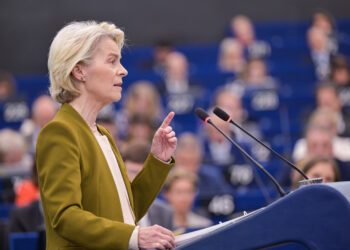
Brussels – Trump berates Europe, but the EU enjoys its supposed turnaround on Ukraine. According to the tenant of the White House, Kyiv “can regain all the territories” occupied by Moscow, and then the “embarrassing” Europe—that still buys Russian crude oil and risks dying if it does not intervene “on immigration and on its suicidal energy ideas”—takes a back seat. Indeed, on the first point, for Ursula von der Leyen, the tycoon is “absolutely right” and Brussels “must speed things up.” Perhaps with the help of Trump himself, who suggested that he might personally call Viktor Orban to convince him not to get in the way.
On the sidelines of the UN General Assembly in New York, the two leaders met for what von der Leyen called a “fruitful conversation.” The emphasis was particularly on support for Ukraine and sanctions to hit Russia’s economy. “By 2027, Europe will have definitively turned the page on Russian fossil fuels,” von der Leyen promised. The two then addressed the Kremlin’s “provocations, including regular incursions into European airspace,” reads a note released by the European Commission. “These are clear attempts to test our response,” von der Leyen reiterated to Trump. This morning, a European Commission spokesperson said that the “now strong and meaningful engagement” of the US was the result of Brussels’ “tireless work” to “ensure its involvement.”
Even at the cost of being accommodating towards the Atlantic partner. After the bitter agreement on tariffs, in which the EU committed itself to buying $750 billion worth of energy from the US by 2028, Trump has repeatedly expressed his irritation at the not-yet fully severed flow of Russian crude oil to Europe. To the point of calling it, in his lengthy speech at the Glass Palace, “embarrassing.” Von der Leyen explained that the EU has “already massively reduced” gas supplies, “completely eliminated” coal and “significantly reduced” oil supplies, admitting that the latter “continues to arrive on the European continent.” However, reiterating: “We want to get rid of it.”

In 2024, the EU still imported 54 billion cubic metres of gas and 13 million tonnes of oil from Russia. According to EU sources, the member states that still import Russian LNG are Belgium, the Netherlands, France, Spain, and Portugal. From the TurkStream pipeline, Russian gas continues to enter Greece, Slovakia, and Hungary. The latter purchased Russian crude oil in the first quarter of 2025 for €1.1 billion and €1.2 billion, respectively. Budapest and Bratislava benefit from a derogation from the ban on Russian oil imports, but will have to comply with the European Commission’s timeline to terminate all contracts by the end of 2027.
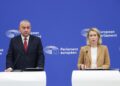
Punched by Trump, the European Commission has proposed, within the 19th package of sanctions, to bring forward the phase-out of Moscow’s LNG to 31 December 2026, one year earlier than the timetable envisaged by REPowerEU. In New York, Hungarian Foreign Minister Péter Szijjártó reportedly reiterated that Hungary will not give up Russian energy supplies, despite pressure from the White House. Szijjártó stated: “We cannot guarantee a secure supply for our country without Russian oil or gas sources.” Hungary and Slovakia are landlocked, and “we can only buy energy that passes through the pipelines that come here,” the minister explained.
Trump declared that “Orban is a friend” and seemed confident he could convince him. “This is his working plan,” an EU executive spokeswoman said today, “we have our own.” At the same time, the European Commission said it was “ready to facilitate any necessary agreement with relevant partners.”
English version by the Translation Service of Withub