Brussels – Almost five months after the disputed election, Serbia has a new government. But, with barely any time to settle in, the first hints of an all-uphill relationship with Western partners are emerging. This is due to the presence, among the members of the cabinet led by Miloš Vučević, of two figures who are particularly controversial for their relations with Vladimir Putin’s Russia, so much so that they appeared on the list of people sanctioned by the United States in the past year: the former head of Serbian intelligence, Aleksandar Vulin, and the longtime politician and owner of Russian-based companies Nenad Popović. For the European Union, too, the short-term future continues to look complex—as much as it was with former prime minister and now speaker of the National Assembly, Ana Brnabić—particularly with regard to the Brussels-brokered dialogue on normalization of relations with Kosovo.

Neo-premier Vučević called his government in “continuity” with the previous one during the parliamentary session that gave the green light to the new executive yesterday (May 2). No surprise, even considering that Vučević was deputy prime minister and defence minister in the last cabinet led by Brnabić. “Continuity” will undoubtedly mean no upheaval in foreign policy—both on the road to EU membership and in maintaining relations with Russia and China—but also in matters considered by Belgrade to be domestic policy (i.e., the relationship with Kosovo, whose independence has never been recognized since 2008), and especially with regard to the firm grip of the President of the Republic, Aleksandar Vučić, on the ruling party—Vučević is a close ally of his, as well as leader of the Serbian Progressive Party (SNS) after Vučić himself resigned last year—and on government policy more generally.

At the moment, however, all attention is focused on the 31-member government team (most of them expressions of the SNS). Among them is the former head of Serbia’s Security Information Agency Vulin, who will be one of the new deputy prime ministers. Since July of last year, Vulin has appeared in the list of the sanctioned by the United States not only for being involved in “transnational organized crime activities, illegal narcotics operations, and misuse of public office” but also for using his public positions to “facilitate Russia’s malign activities that degrade the security and stability of the Western Balkans and providing Russia with a platform to further its influence in the region.” As if that were not enough, the entrepreneur and founder of the nationalist Serbian People’s Party, Popović, was also appointed minister without portfolio, despite being sanctioned from November 2023 also by the United States for “using his Russia-based companies to enrich himself and gain close connections with senior Kremlin leaders” in the “consulting, real estate and electronics sectors of the Russian economy” through “embezzlement and tax schemes.”
Moreover, the issue of meeting democratic standards remains particularly thorny with Brussels. In its final report on the December 17, 2023, early elections, the Organization for Security and Cooperation in Europe (OSCE) warned that although “fundamental freedoms were generally respected during the election campaign,” the vote was “marred by harsh rhetoric, media bias, pressure on public sector employees, and misuse of public resources.” That is why the European Parliament required the EU Commission to take heavy actions if the authorities’ involvement in election fraud is established, including “suspension of EU funding based on serious violations of the rule of law” and, by implication, a possible halt to accession negotiations. Outgoing Prime Minister Brnabić then blocked an international investigation “because it would require the annulment of national sovereignty.” Still, major concerns remain in Brussels about irregularities at the polls and the lack of complete transparency in the electoral process.
Tensions in Serbia after early elections

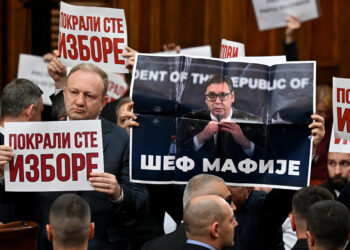
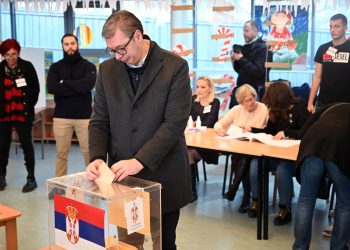
Despite high expectations on the eve of the elections from the Serbia Against Violence coalition, the Serbian Progressive Party won again in early elections with 46.67 per cent of the vote, outstripping by 23 percentage points the very united opposition that came in second place. In the face of fraud and numerous illegal actions at the ballot box, thousands of people took to the streets responding to the call of the parties and movements that had translated into political (pro-European) demands the street protests against the climate that led to the May shootout. The Organization for Security and Cooperation in Europe (OSCE)-led election observation mission (in which members of the European Parliament also participated) also noted “the misuse of public resources, the lack of separation between official functions and campaign activities, as well as intimidation and pressure on voters, including cases of vote-buying.” Nearly a month after the early elections, protests against fraud by the ruling party continue, particularly in Belgrade.
In the capital itself, the situation remained tense for weeks after the victory claimed by pro-Russian Aleksandar Šapić, to the point of forcing the Serbian government to repeat local elections on June 2. The coalition Serbia Against Violence denounced that over 40 thousand people who arrived from Republika Srpska (the Serb-majority entity of Bosnia and Herzegovina) had voted in Belgrade without being formally registered as residents and called for the annulment of the ballot result, explicitly speaking of “electoral theft.” The same complaint came from MEP and member of the parliamentary delegation Viola von Cramon-Taubadel (Greens/Ale): “We have seen cases of organized transportation of voters from Republika Srpska and intimidation of voters.”

Added to this is the case that Brussels “is following closely” (words of the EU Commission’s spokeswoman for Neighborhood Policy and Enlargement, Ana Pisonero) over the violence suffered by the leader of the opposition Republican Party, Nikola Sandulović, who was picked up by Serbian intelligence services on January 3 and severely beaten in detention for paying homage at the grave of Adem Jashari, one of the founders of the Kosovo Liberation Army (UCK). Members of the Serbian Security Information Agency (BIA) allegedly abducted and tortured Sandulović, who was then detained in Belgrade’s central prison without access to independent medical care. Those responsible for the violence would include Milan Radoičić, deputy head of Lista Srpska (the main party representing the Serb minority in Kosovo and closely controlled by President Vučić), who, among other things, has already admitted to organizing the armed attack in northern Kosovo in late September last year. Vulin, the former head of Serbian intelligence (now a member of the new government), had reportedly personally ordered Sandulović’s arrest, but the defence lawyer pointed the finger at President Vučić.
Find more insights on the Balkan region in the newsletter BarBalkans hosted by Eunews
English version by the Translation Service of Withub