Brussels – If the polls are correct, next Sunday’s regional elections in Germany will bring the ultra-right to power for the first time. The migration issue is at the centre of the political debate, instrumentalized by the radical right (and, recently, by the red-brown left). It will be yet another concrete demonstration of how the country is still deeply divided despite the reunification 34 years ago.
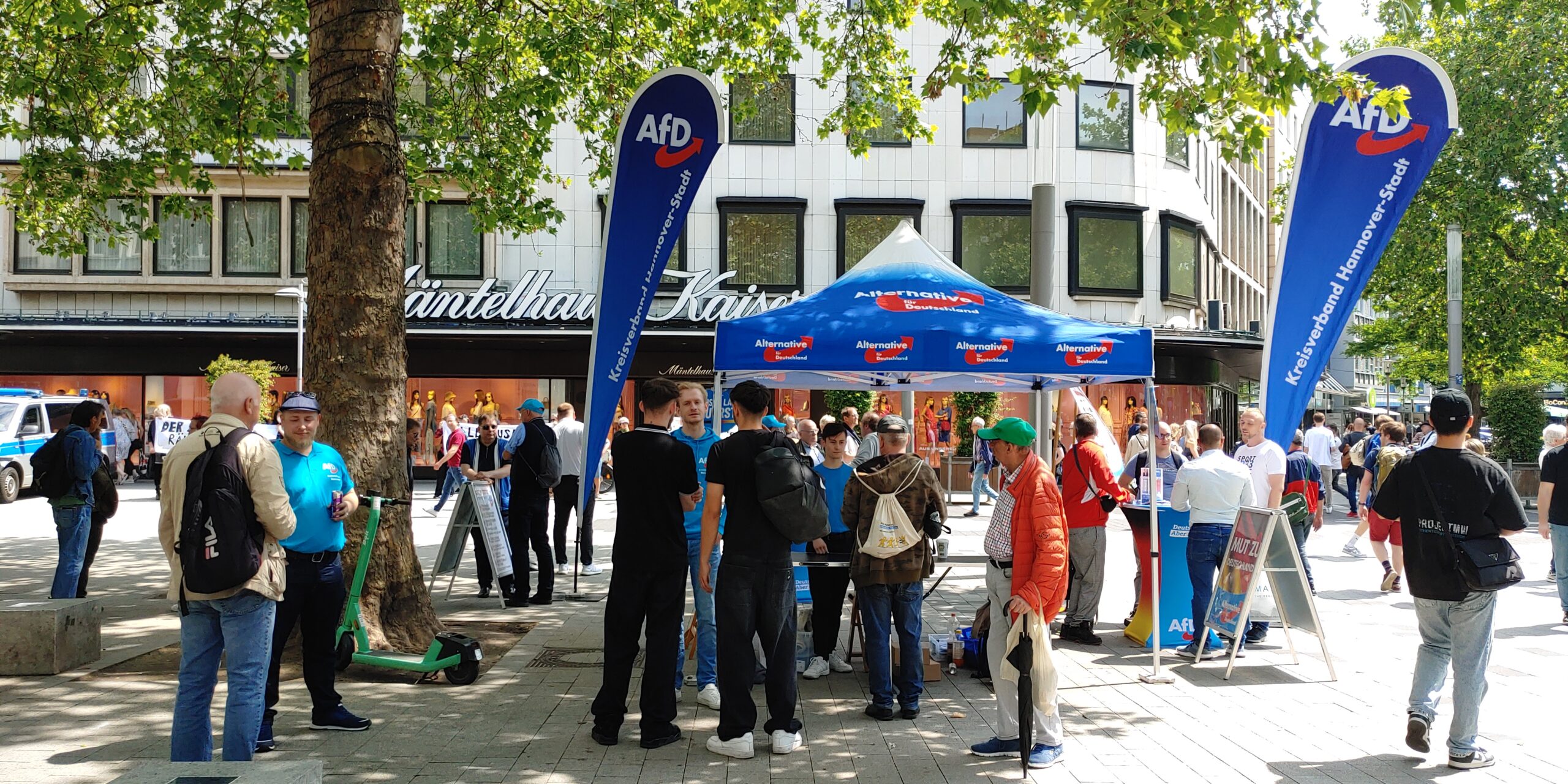
Next Sunday, September 1, voters will go to the polls to elect Regional Parliaments in the two Eastern Länder of Saxony and Thuringia, which, after 1945, ended up under Soviet occupation as part of the then East Germany. According to pre-election surveys, in Saxony, the far-right Alternative für Deutschland (AfD) party stands between 31 and 33 per cent and at 30 per cent in Thuringia. Here, the leader of the party’s most extremist fringe, Björn Höcke, would become the next regional premier: one who uses the slogans of the SA (the Sturmabteilung, or “brown shirts”, who helped Adolf Hitler come to power) in election rallies or who bemoans the construction of a Holocaust memorial in the capital. In 2019, a German court ruled that calling Höcke a “fascist” does not constitute defamation because there is “a verifiable factual basis.” Even in Brandenburg, where voting takes place on September 22, the AfD is expected to get a comfortable 24 per cent. It remains to be seen, however, how much real chance the far-right has of really getting into the control rooms, short of forming minority executives: the other parties (which are heading for substantial defeat in the polls) have for now excluded wanting to enter government coalitions with the AfD, and if they keep their promise the negotiations will be complex.
The rise of the ultra-right ethno-nationalists is not a bolt out of the blue in Europe’s leading economy. For several months now, the AfD has been skyrocketing in the polls: it is currently estimated at around 17 per cent nationwide, and in last June’s European elections, it took just under 16 per cent. This is second place after the Christian Democratic Union led by Friedrich Merz (which includes Ursula von der Leyen’s CDU and CSU, Manfred Weber’s Bavarian sister-party) and ahead of the Social Democrats of Chancellor Olaf Scholz (SPD). Above all, the AfD has long been leading in voting intentions in all eastern Länder, those that made up the German Democratic Republic (GDR) between 1945 and 1990 (Brandenburg, Mecklenburg-Vorpommern, Saxony, Saxony-Anhalt, and Thuringia) with percentages ranging between 24 and 33 per cent. The party’s support is significantly lower only in Berlin, at around 12 per cent.
At the federal level, the AfD has been classified as a “suspected right-wing extremist organization” by the Federal Office for the Protection of the Constitution (BFV), Germany’s civilian intelligence service, while its regional branches in Saxony and Thuringia have been declared “undoubtedly right-wing extremists.” The party, founded in 2013 from an anti-euro perspective and gradually moving further and further to the far right of the political spectrum by taking Islamophobic, anti-immigrant and neo-Nazi positions, is currently the fifth most elected to the Bundestag, the federal parliament, with 83 seats (in the previous legislature, the 19th, it was third with 94 deputies). Among the items on its agenda is still the “Dexit”, that is, Germany’s exit from the European Union on the model of the United Kingdom.
For that matter, the popular reaction to these developments has been strong: since the beginning of the year, hundreds of thousands of German citizens have poured into the streets and squares of the country to request federal authorities to ban the party, which they describe as neo-Nazi and which they see as a serious danger to Germany’s democratic hold. Triggering the fuse of the protests had been, in mid-January, a journalistic investigation into alleged “remigration” plans (i.e. large-scale expulsions of migrants with residence permits and asylum seekers, as well as German citizens of foreign origin) allegedly drawn up by some AfD leaders and which have not since been flatly denied. However, the fundamental political fact remains: migration flow management is one of the central themes of German public debate, especially now that the country has plummeted again into the terrorism nightmare. In fact, in addition to the AfD, the CDU-CSU on the one hand and the new political entity of the extreme left, the Bündnis Sahra Wagenknecht (abbreviated to BSW, literally “Sahra Wagenknecht alliance” after the name of its founder, an exile from the radical left of Die Linke), on the other, are also hammering on the migration issue.
Both the right-wing extremists and the so-called red-browns on the left seem bound to hoard votes on the other side of that border that separated the Old Continent during the Cold War, the Iron Curtain. If, as mentioned, the AfD has an average lead of about a dozen percentage points in the eastern Länder, the latest entrant on the German political scene, the BSW, is also expected to perform best in the former GDR: between 12 and 18 per cent, compared with a range of 2 to 9 per cent in the rest of the country. It is just the latest in a very long series of indicators pointing to a deep rift between the two “faces” of Germany, which has never been fully healed since reunification in 1990, 34 years ago.
The structures of social, cultural, political, and economic opportunities in the east and west of the country have long remained incomparable, with the “Ossis” (inhabitants of the eastern regions) feeling assimilated (rather than integrated) by the “Wessis” (citizens of the western Länder) into their new common homeland, made tangible mainly by the market economy and the Deutschmark. All this has made it easier for opposing populisms to criticize elites and point to migrants as the origin and cause of all the ills of Germans.
A recent survey revealed, for example, significant differences in the relationship with democratic institutions of Germans: while 27 per cent of respondents in former West Germany claim to live “only apparently in a democracy,” this percentage rises to 54 in the former GDR. Similarly, six out of ten citizens in the eastern regions would like strong leaders at the helm of the country who waste no time in “endless debates and compromises,” while in the western Länder, 49 per cent agree. Concerns shared by all Germans, however, are mainly related to the war in Ukraine (73 and 71 per cent in the east and west, respectively) and the resulting rising inflation in a particularly sensitive economic situation for the “Locomotive of Europe” (75 and 67 per cent), while the “invasion danger” of asylum seekers frightens 69 and 59 per cent, respectively.
English version by the Translation Service of Withub