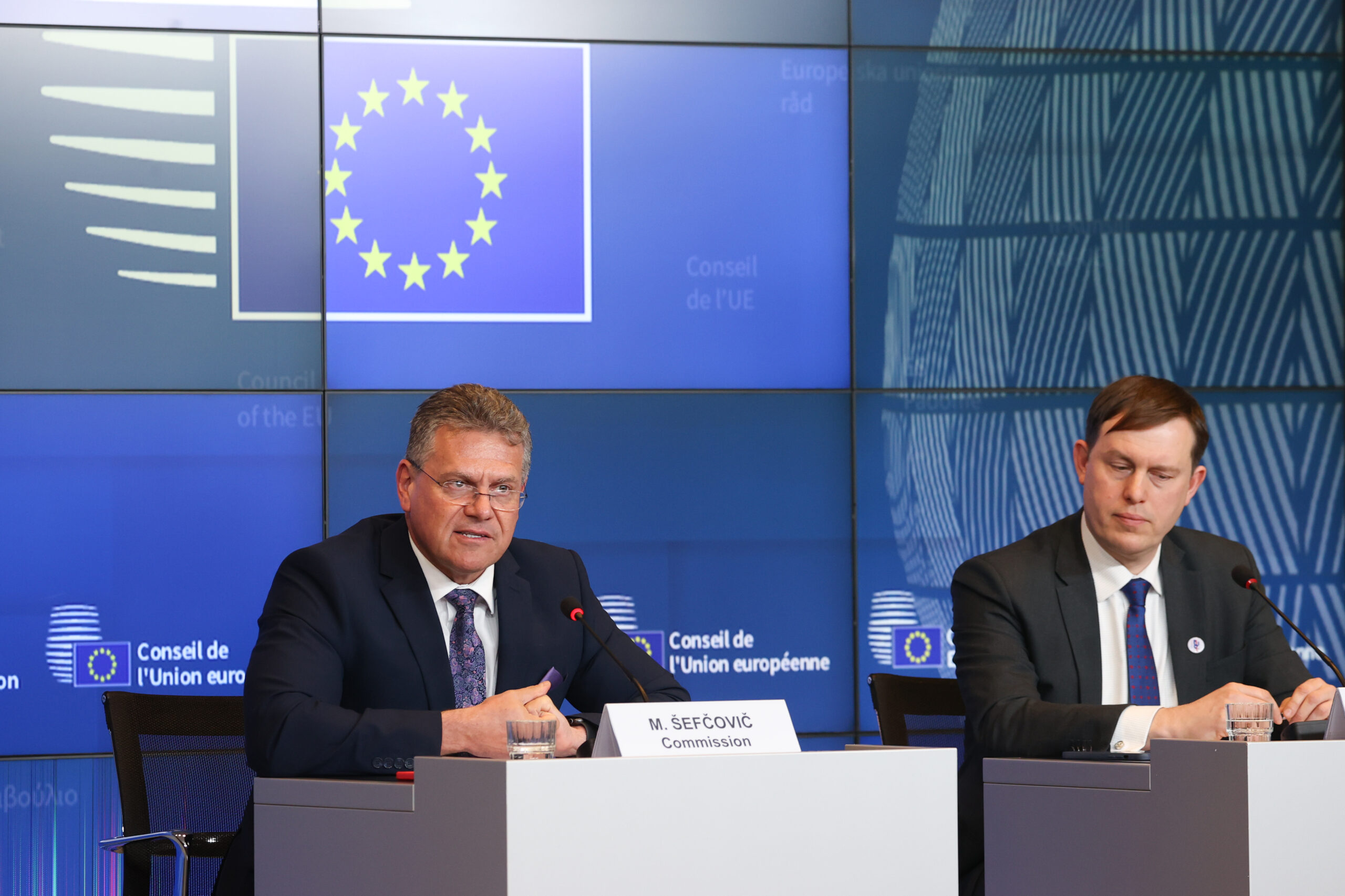
Brussels – The European Union raises the bid: it wants not only to resolve the tariff issue with the United States, but also lay the groundwork for long-term benefits. In the meantime, however, it keeps its feet on the ground and continues its plan B preparation in case of no agreement with Washington.
Saying so, at the end of the EU Council on Foreign Affairs – Trade, is European Commissioner Maroš Šefčovič, who recalled that he had yesterday (May 14) “another constructive conversation with Commerce Secretary Howard Lutnick on potential areas where an agreement could begin to take shape,” and pointed out that he was “also in close contact with Ambassador Jamieson Greer, whom I hope to meet in Europe.” For Šefčovič, the starting point remains “simple,” namely the fact that “the EU and the U.S. share a unique bond on trade and investment” and face “many of the same challenges and therefore common solutions would make the most sense.”
But there is more: “The scope of our relationship makes these negotiations different from all others. Therefore, whatever agreement is signed should resolve the current situation, but also lay the groundwork for long-term benefits,” and “we have also been clear that countermeasures are not our first choice,” he pointed out. So, “we are looking at the issue from every angle to ensure a fair, balanced and lasting outcome, with the clear objective of securing a comprehensive agreement that addresses the full scope of U.S. tariffs,” he pointed out.
This does not detract, however, from the need for the EU to prepare its defence strategies. “We are consulting stakeholders on a list of rebalancing measures. We will gather input, analyse thoroughly, and proceed cautiously—nothing is automatic,” Šefčovič said. “All rebalancing measures being considered have the sole purpose of rebalancing the playing field in case no agreement is reached, because letting the current imbalance persist indefinitely is not an option,” he said.
The fact remains that Plan B is a last resort. “I want to be very clear: Europe is about building bridges, not walls. We believe that having very good transatlantic trade relations is really valuable, as they are the most important economic relationship for the EU and the United States,” Michal Baranowski, Undersecretary of State in the Ministry of Economic Development and Technology of Poland—the country holding the six-month presidency of the EU Council—told at a press conference. “Therefore, we must prepare for Plan B if the negotiations do not reach their full potential. But I hope we will not implement it,” he illustrated. “Plan A is up to the Commission,” and here, “the commissioner and his team are making concrete progress in this direction,” he recalled.
The Polish minister said he was “moderately optimistic because there are signs” that the U.S. “is changing its approach and loosening relations with other important trading partners. Such as China and, of course, the initial agreement made with the UK,” he noted.
English version by the Translation Service of Withub


![Jamieson Greer, Howard Lutnick, Lars Rasmussen, Maros Sefcovic [Credits: Council of the EU]](https://www.eunews.it/wp-content/uploads/2025/11/d6e5c35f-e88e-4cb1-a7d5-26849ad67502-350x250.jpg)