



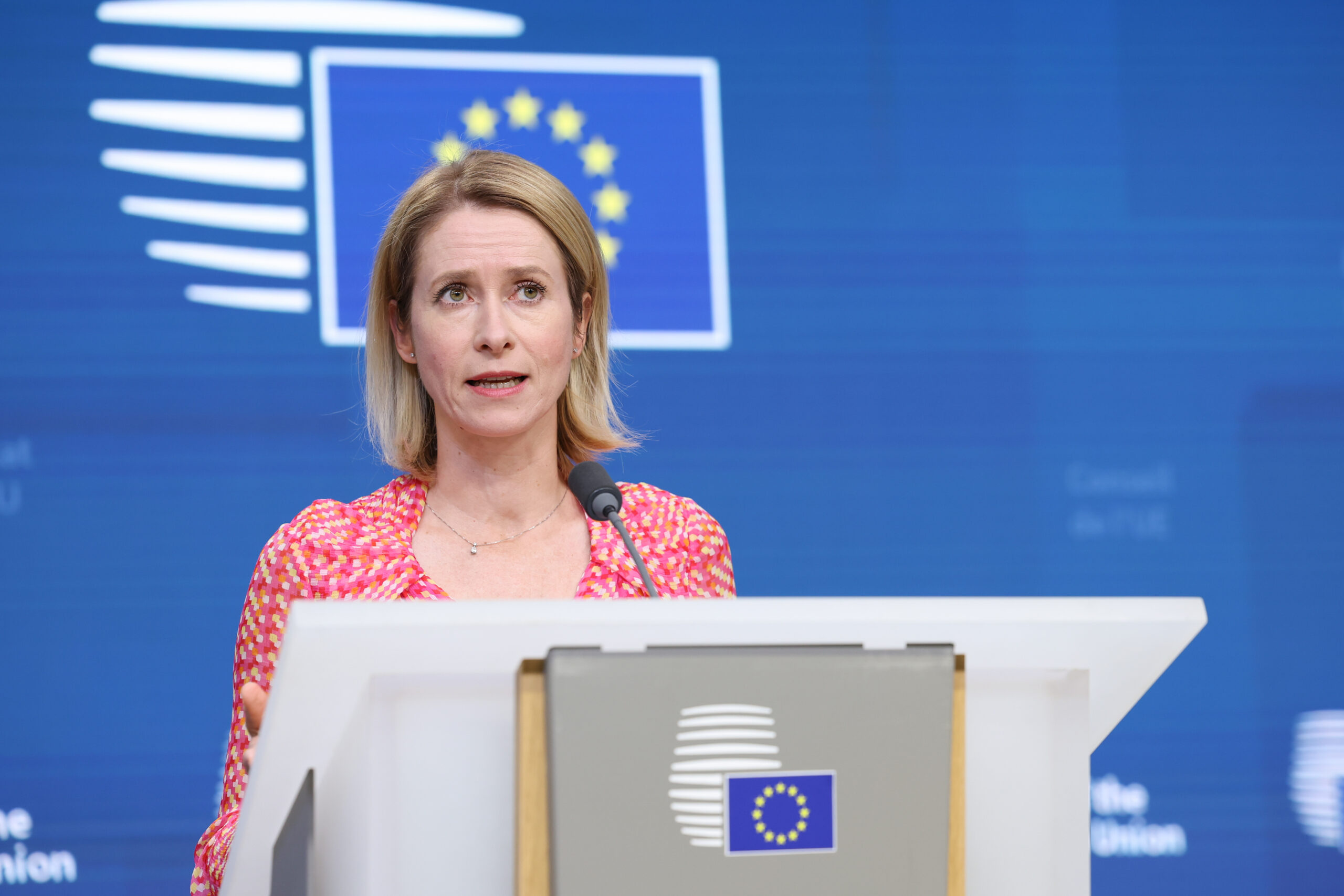
Brussels – The African Union and the European Union aim to strengthen their formal cooperation, which turns a quarter of a century old this year, to jointly address challenges common to both continents. Starting with deepening collaboration on crucial issues such as the use of critical raw materials, migration, and investment, but also countering disinformation from the Kremlin.
“Africa and Europe are each other’s sister continents“: with these words, Kaja Kallas opened the proceedings of the third EU-AU Foreign Ministerial held today (21 May) in Brussels in preparation for the next high-level summit, the seventh, scheduled for this year. The year 2025 also marks the 25th anniversary of the dialogue format between the two continental organisations, inaugurated in Cairo in 2000.
For the twelve-star diplomacy chief, there are “shared interests but also shared challenges” for the countries on both sides of the Mediterranean on a number of crucial issues. “The challenges are immense, but so are our shared resources,” she stressed, curiously mentioning only African ones: “The fastest growing population on the planet, immense entrepreneurial potential, an abundance of resources and critical raw materials needed for green and digital transitions.”
Co-chairing today’s meeting was Téte António, the Angolan foreign minister heading the AU Executive Council. On this specific issue, he was keen to point out that “projects for the processing of raw materials must take place on the ground in Africa” and not elsewhere to avoid “exporting the added value, i.e. work, welfare, development, and knowledge.” In other words, not to repeat the predatory dynamics of extractive colonialism that European states have practised for centuries on the continent.
Africa and Europe are partners of choice.
We are working together for peace, security, and sustainable growth.Today, we are gathering with foreign ministers and members of the African Union — strengthening our partnership and marking 25 years since the first EU-Africa Summit. pic.twitter.com/E4IiFarFmK
– Kaja Kallas (@kajakallas) May 21, 2025
“Since the last EU-AU summit, i.e. the sixth (dating back to mid-February 2022), “the world has changed dramatically,” Kallas noted. “War has returned to Europe, instability is growing in parts of Africa and the Middle East, we are witnessing an increase in disinformation and foreign interference in our internal affairs, unprecedented instability in world markets and threats to multilateralism and the rules-based international order.”
António called for “innovative solutions” to jointly respond to epochal challenges that “do not stop at geographical borders”—in the minister’s list, climate change, economic transformation, health, peace and security, and migration—and offer “tangible benefits for our peoples on both continents.”
The key priorities of EU-AU relations include investment and trade between the two single markets, the exploitation of critical raw materials, cooperation on security, the development of artificial intelligence and robust digital infrastructure, the blue economy, mobility (including the key chapter of management of migration flows), connectivity and regional integration as well as the challenges of global governance (starting with the preservation of multilateralism in an era of military conflicts and trade wars).
On the migration dossier, António emphasised that the movement of people “is not a problem in itself” and can indeed “bring benefits that have a positive impact” on host countries, but “the problem lies in ‘how’ this phenomenon develops”. That is, ways must be found to ensure safe routes for legal migration, he says, and the economic development of the African continent must be supported.
Kallas also agreed: “It is also in our interest that there is prosperity in Africa, that there are jobs in Africa,’ she argued in front of journalists, so that “there is no migratory pressure” on European shores. Thus, she explained, the technological transfer for extracting and processing critical raw materials will “ensure that prosperity remains in Africa.” Other actions, such as “the reform of the international financial architecture, so that access to capital is similar wherever investments are made,” in the High Representative’s view, should also contribute to the same objective.

And, of course, the prevention of conflicts, such as those afflicting the Sahel region in general and Sudan in particular, defined by the Angolan minister as ‘the microcosm of Africa’ (since, he argues, what happens there reverberates throughout the continent). “The priority is the cessation of hostilities,” the former Estonian prime minister assured, stressing that the process of recomposition of the crisis “must be driven by Africa, even if there is a need for mediation” for which, eventually, Brussels makes itself available.
Countering the hybrid campaigns of disinformation and misinformation, especially those orchestrated by Moscow, is another of the topics touched on today. “The fight against narratives takes place everywhere and disinformation is one of the tools Russia is using, especially in Africa,” the High Representative warned. And she admitted that “it is increasingly difficult” to succeed in “combating disinformation and foreign malign influence“, despite the efforts so far, because “we live in the information age” in which “lies travel fast and expand rapidly.”
The EU and its member states are the first trading partner, the first foreign investor (€309 billion in 2022) and the main donor of development and humanitarian aid. The Union’s support for security on the African continent under the European Peace Facility (EPF) is worth over 1 billion (although part of those funds, by Kallas’s own admission, are temporarily blocked), and there are currently 11 civilian missions and military operations on the continent under the CFSP umbrella.
English version by the Translation Service of Withub



![La video riunione dell'Eurogruppo [27 marzo 2026. Foto: European Council]](https://www.eunews.it/wp-content/uploads/2026/03/eurogruppo-260327-120x86.jpg)
