




Brussels – Some have already dubbed it the ‘G7 minus one’: the summit of the world’s seven major powers is being put to the test by Donald Trump. In Kananaskis, Canada, the leaders of the United Kingdom, France, Italy, Germany, Japan, Canada, and the European Union face off against the US president in one of the most high-stakes summits in years. In addition to the issue of sanctions on Russia, there is a dangerous escalation between Israel and Iran. Behind the scenes, everyone is trying to cut a deal with the tycoon to end the tariff threat.
There has already been a rift on the hard line against Moscow. Brussels has put on the table the key measure of the eighteenth package of sanctions on the Kremlin: reducing the ceiling on the price of Russian oil from $60 to $45 per barrel. The EU and the UK insist it should be a coordinated measure with Washington. However, Trump has so far closed the door: “Sanctions cost us a lot of money,” he said during a press conference with British Prime Minister Keir Starmer, suggesting that “the Europeans should do it first.” At odds with his allies, Trump argued that “throwing Russia out” of the G8 was a mistake: “I think you wouldn’t have a war right now if you had Russia in,” he explained, forgetting that Putin was booted from the group precisely because of the invasion and annexation of Crimea in 2014.

After that came a series of bilateral meetings to resolve the issue of US tariffs. Starmer, who managed to finalize a ‘historic’ agreement with Trump to limit the scope of reciprocal tariffs, smiles. Then the US president meets Meloni, who reiterates the importance of reaching an agreement with the EU bloc, with German Chancellor Friedrich Merz and French President Emmanuel Macron. He also meets with EU leaders: Antonio Costa gives him a Cristiano Ronaldo T-shirt that reads “Playing for peace.” Ursula von der Leyen addresses with the tycoon “critical issues, from Ukraine to trade.” With regard to the latter, she is optimistic about the July 9 deadline: “We instructed the teams to accelerate their work to strike a good and fair deal,” she said in a post on X.
At the summit, von der Leyen reiterated that “tariffs, regardless of who sets them, are ultimately a tax paid by consumers and businesses at home.” And “they create uncertainty that hinders investment and growth.” Then, the EU leader winks at Trump and tries to identify a common enemy. “When we focus our attention on tariffs between partners, we divert our energies from the real challenge, a challenge that threatens us all,” she warns: China. Von der Leyen claimed unfair competition from Beijing, pointing out that “the sources of the biggest collective problem we have originate from China’s accession to the WTO in 2001.”

To placate Trump and call him back to the unity of the past – because the G7 “together accounts for 45 percent of the world’s GDP” – before presenting him with a new proposal. According to
a report in the German newspaper Handelsblatt, the European Commission is reportedly ready to accept provisional tariffs of 10 percent on all exports to the United States, provided there are no higher tariffs on cars, pharmaceuticals, and electronic products. In return, the EU would be willing to reduce tariffs on US-manufactured vehicles and to change any technical or legal barriers to make them easier to sell in Europe.
Then, the twist: Trump leaves the summit early, apparently to devote himself urgently and unilaterally to the crisis in the Middle East. He denies it, personally attacking Macron, who is guilty of having “erroneously claimed” that Trump was returning to Washington to work on a ceasefire between Israel and Iran. “Whether purposely or not, Emmanuel always gets it wrong,” the White House occupant wrote on his social platform, Truth. Adding that “this is about something much more important.”
Before leaving Canada, Trump signed a joint de-escalation agreement in the Middle East, which leaves no doubt about who is responsible for what is happening in the region. For the world’s most influential democracies, “Iran is the principal source of regional instability and terror,” and “Israel has the right to defend itself.” The leaders reiterated that Iran “can never have a nuclear weapon.” For the European partners, the primary concern is to “safeguard market stability,” as the statement underlines. But even here, Trump’s strategy is decidedly more aggressive. The tycoon, back in the US, issued a dangerous threat to Tehran: renounce uranium enrichment completely, or “something will happen.” Meanwhile, the foreign ministers of the 27 EU countries met this morning, convened by the EU High Representative for Foreign Affairs, Kaja Kallas, to take stock of the situation — without the elephant in the room.
English version by the Translation Service of Withub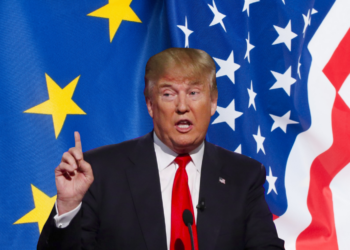



![La video riunione dell'Eurogruppo [27 marzo 2026. Foto: European Council]](https://www.eunews.it/wp-content/uploads/2026/03/eurogruppo-260327-120x86.jpg)
