



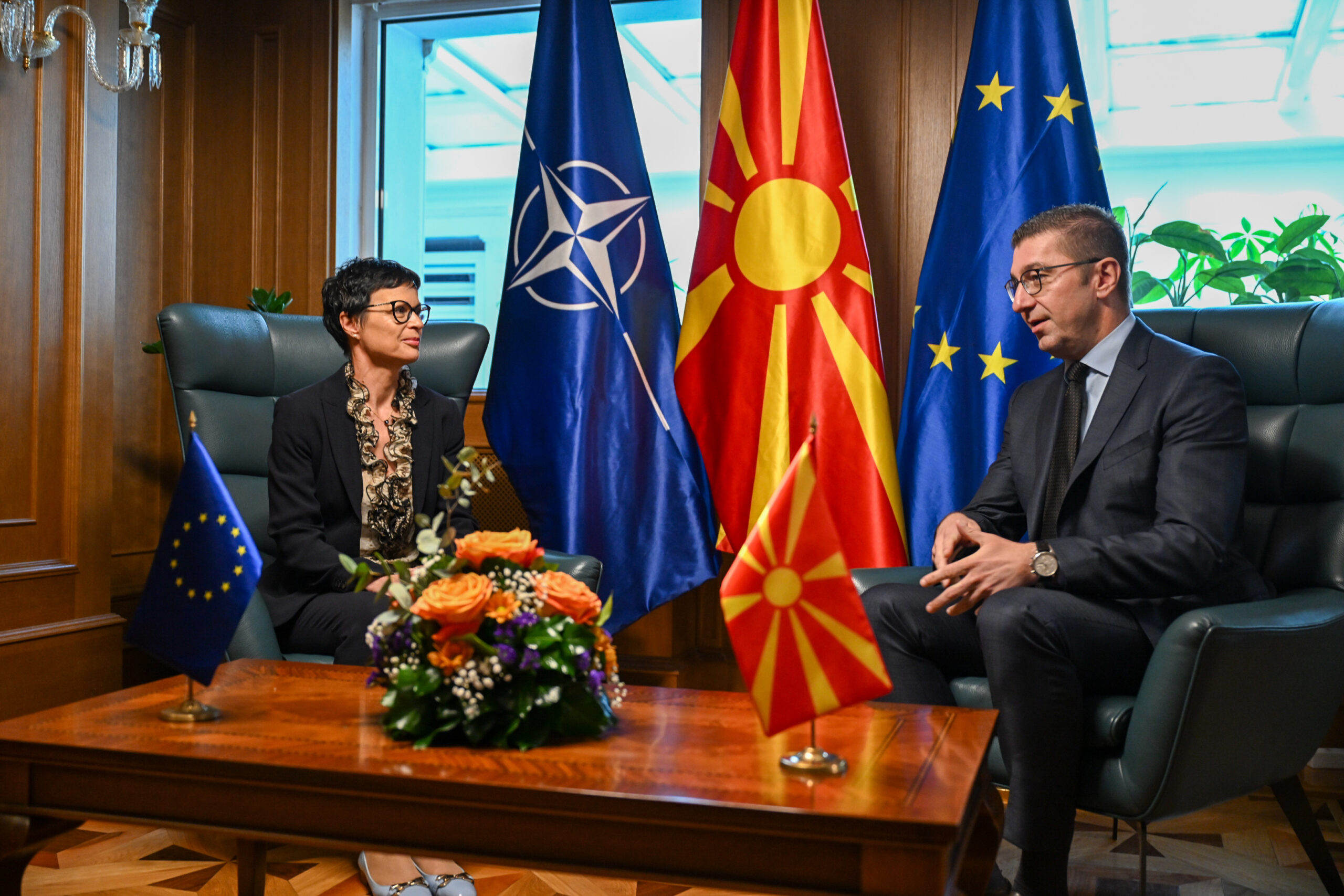
Brussels – The Western Balkans are moving towards EU accession, some faster than others. At least, according to Enlargement Commissioner Marta Kos, who met with the leaders of the candidate countries to assess progress in implementing reforms and to reaffirm the Union’s continued support. Not forgetting the political knots still to be unravelled.
The leaders of the six Western Balkan candidates for EU membership (Albania, Bosnia and Herzegovina, Kosovo, North Macedonia, and Serbia) met today in Skopje (1 July) with the EU executive’s head of enlargement, Marta Kos.
With her, they took stock of the €6 billion Growth Plan, the maxi-investment tool with which Brussels is encouraging pre-accession reforms in exchange for cooperation in several areas (e.g. finance, transport, tourism, digital connectivity) and the integration of regional economies into the single market, to accelerate the social-economic convergence with the Twenty-Seven. Last October, the Commission approved the agendas submitted by five chancelleries (all except Sarajevo, which finalised its programme at the end of June) and began disbursements for four of them, while the funds for Pristina remain at a standstill.
Happy to be in Skopje for the Western Balkans leaders’ meeting.
Good exchange with @MickoskiHM, whom I thanked for hosting tomorrow’s Summit.
Our Growth Plan is already improving lives across the region, but we can do more! Tomorrow will be about delivering more & faster. pic.twitter.com/eleDG9pfbw
– Marta Kos (@MartaKosEU) June 30, 2025
“We want to help you all cross the finish line,” Kos told the leaders of the regional partners gathered in the Macedonian capital. “The basic reforms we are asking you for are not easy,” she conceded: “They touch existing power structures, challenge inveterate interests and require a profound transformation of society. But it is worth embarking on this journey, she assured, because “the benefits of EU membership are manifold: stability, security, prosperity for all citizens.”
During the summit, Kos urged her interlocutors to press on the accelerator. “There is a clear consensus among European capitals for enlargement right now,” she said, but “the window of opportunity may not stay open forever“. “You have already done a lot,” the Commissioner acknowledged, “and now it is time to accelerate the implementation phase.”
A second Berlaymont report on the reform agendas is expected in a couple of weeks, she announced. An important detail, given that European funds will only be disbursed in full once the reforms mentioned above have been translated into reality. Additionally, given that time is running out, as the Growth Plan will only be active until 2027, any unused resources will be returned to the EU budget.
For the time being, according to Kos, the general picture is encouraging. Albania has opened three clusters of negotiations (i.e. half of the total) in the last six months, and at this rate, she says, “we could open all clusters by the end of the year.” Montenegro closed another chapter last week, Bosnia and Herzegovina finally delivered its roadmap for reforms, and Serbia is also moving (although doubts remain about Belgrade’s international position). To the Kosovan Prime Minister Albin Kurti, the Enlargement Commissioner asked for “a lot of energy” to relaunch the accession process.
To the host, Prime Minister Hristijan Mickoski, Kos signalled Brussels’ readiness to open negotiations on the fundamentals cluster as soon as Skopje has made another amendment to the Constitution, as requested by Bulgaria which, in the absence of progress on the Macedonian side, continues to stand in the way of the Balkan nation’s accession.
The Commissioner emphasised “the importance of mutual trust and understanding“, adding that “as soon as North Macedonia amends its Constitution, we should proceed immediately with the intergovernmental conference without any further political conditions.” A not-too-veiled barb directed at the Bulgarian government, in the wake of the one already shot by the President of the European Council António Costa last May.
But compared to Kos’s optimism and her remarks about preserving national identity (“EU membership is the best way” to safeguard it, she says), Mickoski prefers to remain “cautious”. “Over the past three decades we have lost many pieces of our identity, changing our flag and constitution on several occasions,” the nationalist premier laments, and now “we have no guarantee that this will be the last concession we will have to make” to defuse Sofia’s veto.
English version by the Translation Service of Withub





![[foto: Guillaume Baviere/WikimediaCommons]](https://www.eunews.it/wp-content/uploads/2026/01/Cuba_Che-120x86.jpg)
