



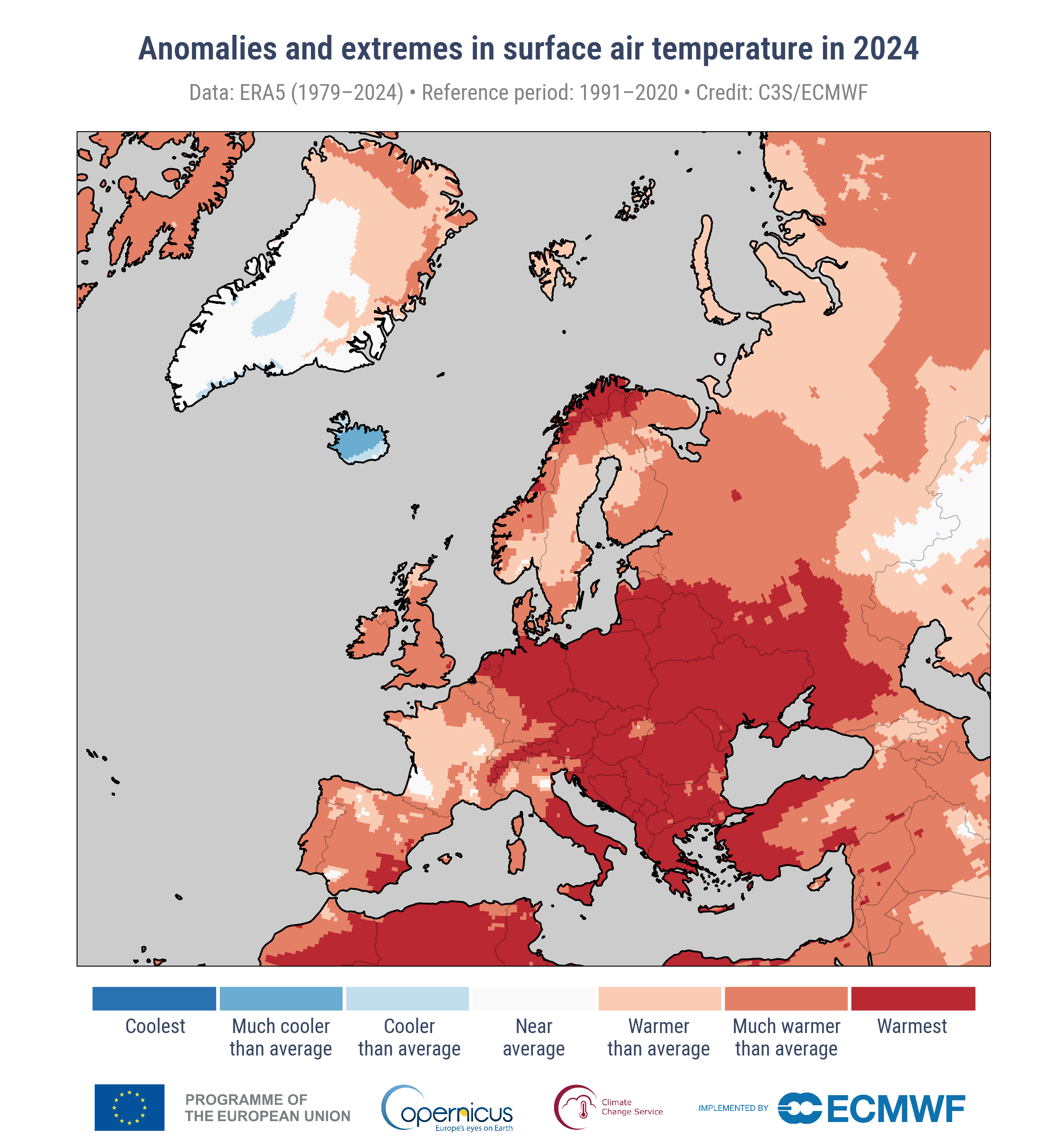
Brussels -The recent heatwaves across Europe, the United States, and other parts of the Northern Hemisphere are a clear sign of the intensifying physical risks associated with climate change. Extreme temperatures well above seasonal averages are endangering public health, the environment, and the global economy.
According to data from the Copernicus Climate Change Service/ECMWF, 2024 was the hottest year on record, while May 2025 was the second warmest May globally. Projections indicate that, due to persistent heatwaves, temperatures are expected to continue rising in many areas over the coming days.
The new study conducted by Allianz Trade, the world’s leading credit insurance company, concludes that high temperatures lead to a marked reduction in labor productivity and have a significant impact on economic growth.
The International Labour Organization estimates a loss of -2.2 percent (pct) of potential global working hours due to heat stress, equivalent to about 80 million full-time jobs. By 2021, 470 billion working hours had been lost, according to the Lancet Countdown, representing a 37 percent increase over the average of the 1990s. Workers in developing countries are the most severely affected, due to greater exposure and less favorable housing conditions.
The Allianz research emphasizes that “it has been observed that the capacity to perform physical work dips by approximately 40 pct when temperatures hit 32°C and is reduced by two-thirds at 38°C. For this reason, a loss in GDP of -0.5 pp is predicted for 2025 at the European level and -0.6 pp globally.”
According to the research, in Italy the loss will be double, at 1.2 pp, while in France and Germany the GDP loss will be 0.3 pp and 0.1 pp.
“Heatwaves cripple the economy,” says Jasmin Gröschl, Senior Economist at Allianz. “In general, people work less. One day with extreme temperatures above 32 degrees Celsius is roughly equivalent to half a day of strike action. Initially, this may be economically manageable in individual cases; however, with increasing climate change, both the frequency and intensity of such events are expected to rise. Heatwaves, droughts, and forest fires are becoming the ‘new normal’, to which the economy has to adapt to avoid serious long-term losses.”
At least according to the Allianz study, heatwaves have only temporary impacts on production, and partial recovery is likely in the manufacturing and service sectors. In contrast, losses in agriculture and specific infrastructure sectors tend to persist. “Another piece of good news is that it is possible to prepare for heatwaves, both physically and economically,” Gröschl said. “Because, unlike many other natural disasters, heatwaves are predictable.”
English version by the Translation Service of Withub





![La video riunione dell'Eurogruppo [27 marzo 2026. Foto: European Council]](https://www.eunews.it/wp-content/uploads/2026/03/eurogruppo-260327-120x86.jpg)
