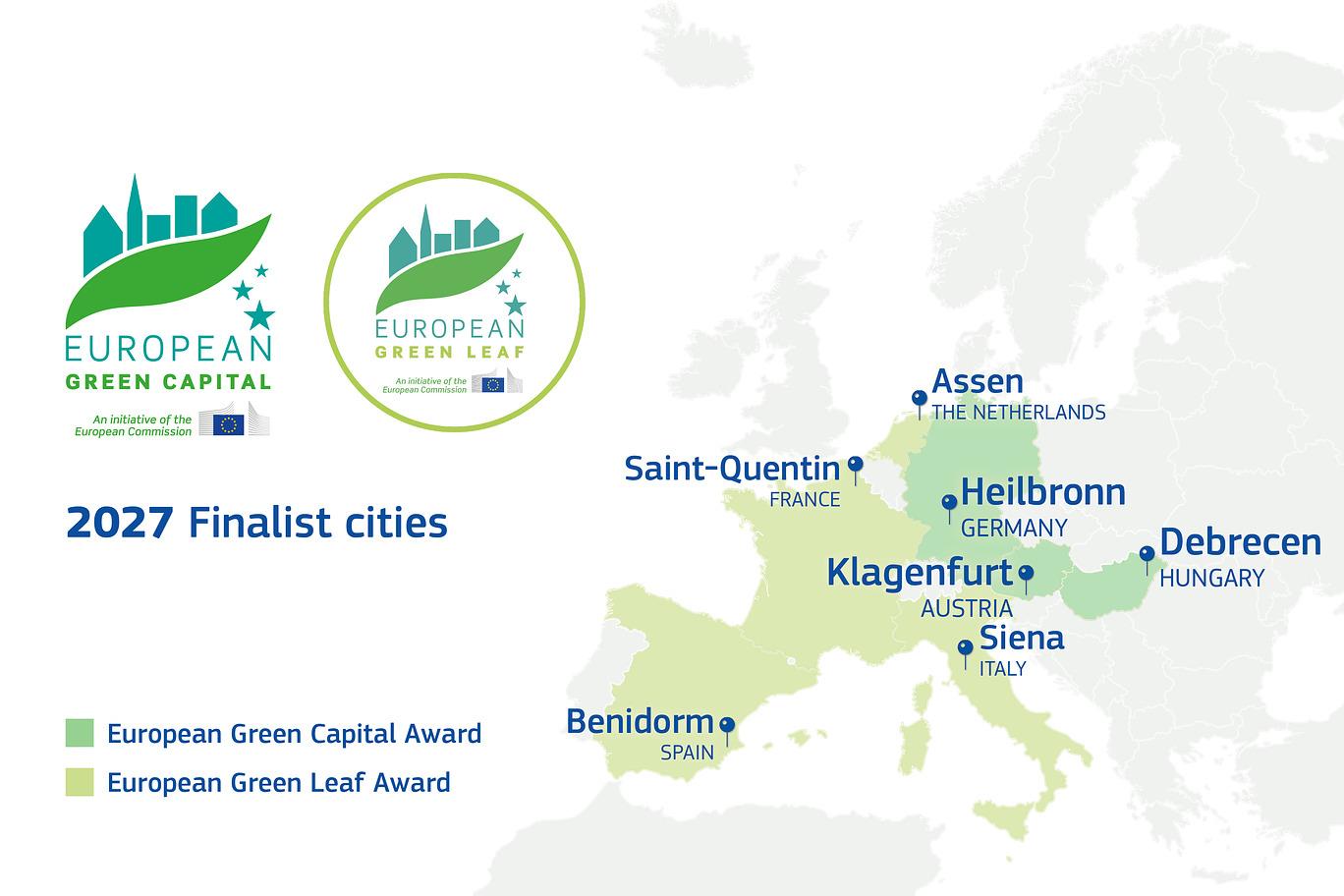
Brussels – Siena is one of the seven most sustainable cities in the European Union. The Tuscan city is among the four finalists for the 2027 Green Leaf Award, joined by three other candidates for the title of ‘European Green Capital’ 2027, selected by the European Commission to enter the final phase of the awards. The judgement was made by a jury of independent experts who concluded that Siena stood out for its biodiversity, green spaces and land use, with outstanding results also in the circular economy and an impressive urban waste recycling rate. Underpinning the selection are the successes that urban centres have achieved in tackling environmental challenges related to the triple global crisis of climate change, pollution, and biodiversity loss. For the jury, these cities are setting new standards, combining innovative solutions with sound governance to create healthier and more sustainable environments for their citizens. Therefore, all of them are recognised as ‘outstanding examples of sustainability’.
There are two awards. Both examine the performance of Europe’s top cities in terms of sustainability across seven environmental areas, but are granted based on population. The finalists for the title of European Green Capital 2027, awarded to cities with a population of over 100,000 inhabitants, are Debrecen (Hungary), Heilbronn (Germany), and Klagenfurt on Lake Wörthersee (Austria). For smaller cities, with a population of 20,000 to 100,000 inhabitants, there is the title of European Green Leaf 2027. The finalists are Assen (Netherlands), Benidorm (Spain), Saint-Quentin (France), and Siena (Italy). For the European Commissioner for Environment, Water Resilience and a Competitive Circular Economy, Jessika Roswall, the candidates “have not only embraced sustainability, but have also promoted innovative solutions for a greener future.”
The seven environmental areas analysed are: air quality, water management, biodiversity, green areas and sustainable land use, waste and circular economy, noise pollution, and climate change mitigation and adaptation. With today’s selection, on 1 and 2 October, the finalist cities will present their environmental vision and governance, as well as their communication strategy, to a panel of judges if they win. On 2 October, the winners will be announced in Vilnius, Lithuania, this year’s European Green Capital, at a ceremony. The European Green Capital winner will receive a financial prize of €600,000 to implement its strategy in cooperation with citizens and stakeholders. The European Green Leaf title, which is awarded to one or two cities, provides a financial award of €200,000 to each winner to help organise activities during the title year and support further transformation.
More specifically, regarding the Green Leaf award, “Siena stood out for its biodiversity, green spaces and land use, with outstanding results in the circular economy as well.” The jury appreciated the fact that “the city has an average of 28 m² of public green space per capita and has achieved an impressive 61.4 per cent urban waste recycling rate, reducing waste sent to landfill to just 1 per cent.”And “with excellent scores in air quality, water quality and climate change mitigation, the city completes a strong case for sustainability.”
Assen, in the Netherlands, “achieved excellent results in terms of biodiversity, green spaces, circular economy and climate change mitigation, receiving top marks from experts in these areas.” Appreciated were “its innovative waste management policies, including optimised separate collection of plastic, metal, and beverage cartons and initiatives such as Repair Cafés, which focus on reducing residual waste and promoting material recovery.” In particular, “with excellent results in terms of air quality, noise and climate adaptation, Assen has demonstrated an all-round commitment to sustainability.”
Spanish Benidorm received high marks “for excellent air quality and solid performance in climate change mitigation.” It is pointed out that, “despite challenges such as heat waves and floods, the city has reduced water consumption by 18 per cent and achieved a reuse rate of 36 per cent.” Benidorm also showed “steady progress towards sustainability, with commendable scores in biodiversity, green spaces, and circular economy.” The French city of Saint-Quentin was praised “for its sustainable management of air quality and noise, as well as excellent achievements in the circular economy and climate change mitigation.” It is highlighted that, “since 2014, the city has achieved significant reductions in air pollution, in particular ammonia emissions from agriculture and particulate matter from transport” and that “its urban waste collection system, featuring colourful bins and the innovative ‘Cliiink’ digital rewards programme, has earned it additional points for sustainability.”
Finally, for the European Green Capital 2027 award, the Hungarian city of Debrecen” excelled in biodiversity, green areas and sustainable land use, as well as in waste and the circular economy,” and “improved its urban environment by increasing green spaces by 16% and planting thousands of trees to improve the city’s microclimate.” Germany’s Heilbronn stood out for “its holistic urban planning, which integrates noise management into a ‘Landscape Plan 2030’ and a ‘Mobility Concept’, with strong citizen involvement, reflecting a high benchmark for a sustainable city.” In contrast, Klagenfurt, situated on Lake Wörthersee, stood out for its excellent air quality, water quality, and climate change mitigation efforts, and was praised for its plans to expand sustainable district heating and invest in green logistics, such as electric cargo bikes, to further improve air quality. Moreover, Klagenfurt’s efforts “in ensuring high drinking water standards through advanced wastewater treatment processes and protected areas” were appreciated.
English version by the Translation Service of Withub


![Il vicepresidente della BCE, Luis de Guindos [Bruxelles, 15 gennaio 2026]](https://www.eunews.it/wp-content/uploads/2026/01/de-guindos-260115-350x250.png)