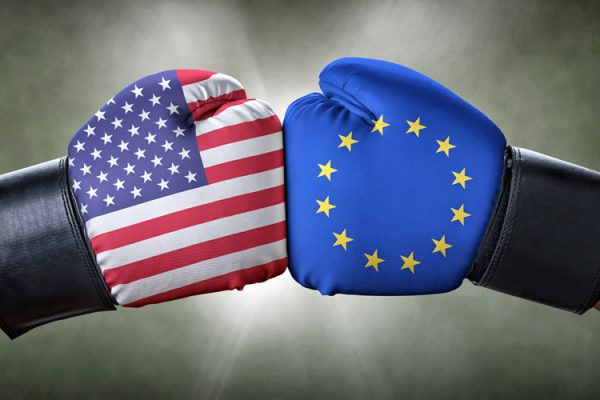
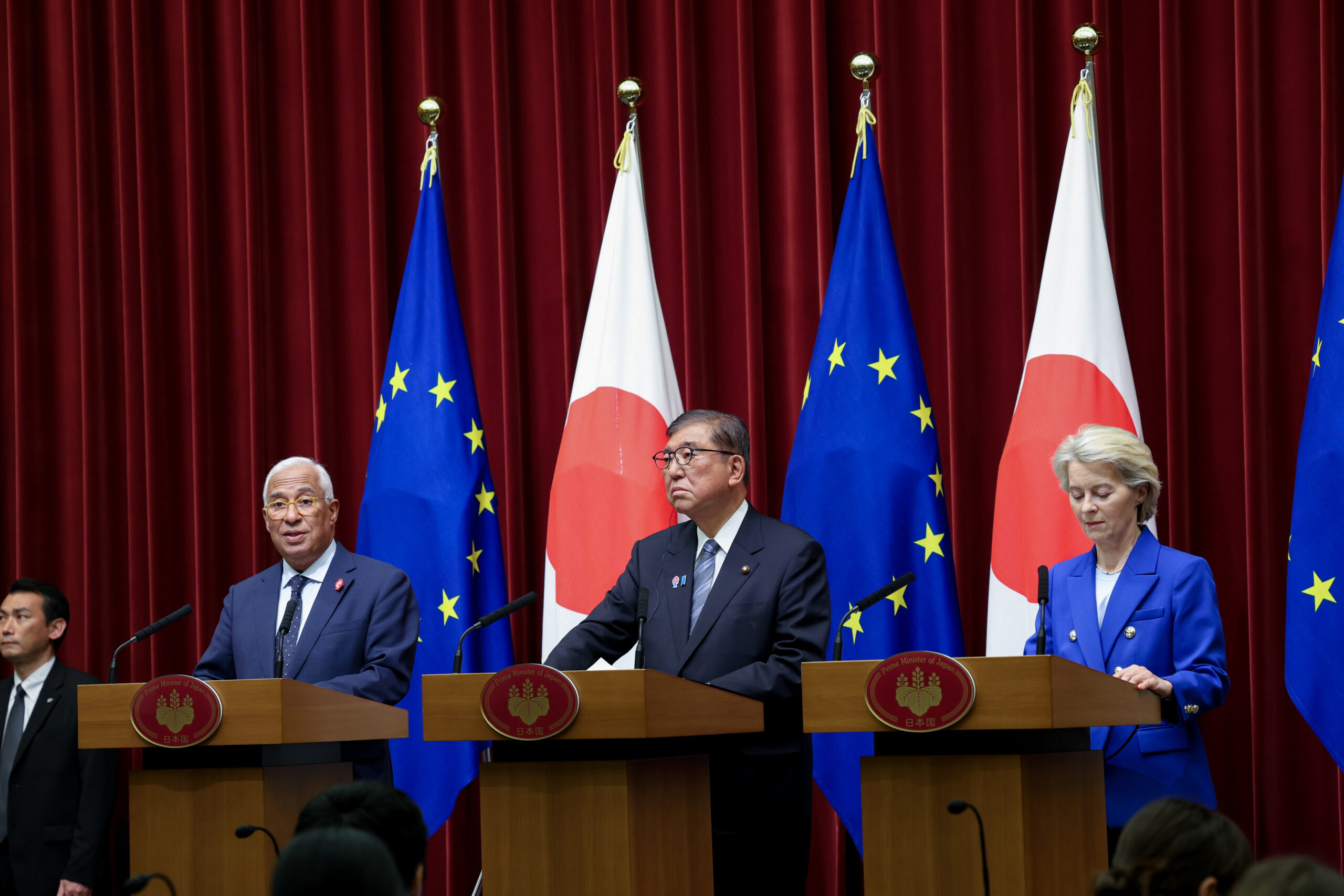
Brussels – “We can change the rules of the World Trade Organization (WTO), to address today’s and tomorrow’s challenges.” It is the President of the European Commission, Ursula von der Leyen, who offers the political, which is then geo-strategic, sense of the EU-Japan summit hosted by the Asian partner. The final statement serves to reaffirm the intent for greater bilateral cooperation, but the document is also an openly anti-Trump manifesto.
Against the anti-trade initiatives of the current US administration, the document reads, “We reaffirm the importance of EU-Japan cooperation to uphold the free and rules-based multilateral trading system with the World Trade Organization (WTO) at its core.” And this is where von der Leyen’s clarification comes in, highlighting Japan’s political role as a member of the Comprehensive and Progressive Agreement for Trans-Pacific Partnership (CPTPP). This free trade area includes Australia, Brunei, Canada, Chile, Japan, Malaysia, Mexico, New Zealand, Peru, Singapore, and Vietnam.
“Together, the EU and CPTPP countries can lead a meaningful reform of the World Trade Organization, so that global trade rules reflect today’s challenges and the risks of tomorrow,” von der Leyen insists. It is the call to arms for a new global order that is clear, certain, and predictable, now more than ever.
The WTO reform is a strategic goal for the European Union, which has been on the twelve-star political agenda for years now, and one it has been discussing with Tokyo for even longer. Now is the time to re-launch the process, the President of the European Council, Antonio Costa, said: “We are united in defending a predictable and rules-based economic order.“ This is a key passage, a message against the approach taken by Trump’s America, to which the EU responds by distancing itself. And it does not end there, because Costa goes on to explain, “A world of growing uncertainty, we are also stepping up joint efforts to boost economic security and resilience.”

The EU and Japan are determined to deepen their existing bilateral relations, encompassing trade, raw materials, and, in particular, defense. The first EU-Japan defense dialogue is planned for next year, in addition to the launch of an industrial platform in the sector. They will thus revitalize the industrial base, because, according to their shared sentiment, greater Japanese-European security contributes to greater stability in the Indo-Pacific region, which is as dear to Japan as it is to Europe.
“Strong and stable relations between the EU and Japan are essential to maintain and strengthen a free and open international order based on rules and the rule of law,” emphasized the Japanese Prime Minister, Shigeru Ishiba. A vision that is particularly relevant to economic and trade aspects. “We agree to work together to maintain and strengthen the rules-based system,” which passes through “multilateralism with the WTO at its core” of this order. The challenge to Trump has thus been launched, while the reform agenda of the World Trade Organization is being revived.
English version by the Translation Service of Withub