




Brussels – The temperature of the domestic political clash in Ukraine is rising. Thousands of citizens took to the streets across the country last night to protest against a controversial piece of legislation passed by parliament, which is seen as an authoritarian crackdown on anti-corruption bodies, marking the first anti-government demonstration since 2022.
However, President Volodymyr Zelenskyy pushes ahead and signs the law anyway, risking a potentially dangerous internal rift in a society already exhausted by almost three and a half years of war. The EU calls on Kyiv to uphold its commitments on democratic guarantees and the rule of law.
Law 12414 comes into force
In the end, the outcome that so many in Ukraine had feared, from parliamentary oppositions to civil society organizations, became reality. Late yesterday evening (July 22), Volodymyr Zelenskyy, the head of state, signed the controversial law that had been hastily approved a few hours earlier by Kyiv’s single-chamber legislature, the Verkhovna Rada, bringing it formally into force.
During the heated session in the House, the president’s party— the Servant of the People (SN), which forms the majority of the hemicycle and forms the government—introduced amendments to Bill 12414, which modifies the Criminal Code. These amendments effectively place the two primary independent anti-corruption bodies – the National Anti-Corruption Bureau (NABU) and the Office of the Special Anti-Corruption Prosecutor (SAPO) – under the authority of the Prosecutor General, a presidentially appointed figure (the post is now in the hands of Ruslan Kravchenko, considered very close to Zelenskyy).

The two institutions involved, which in recent days have ended up in the crosshairs of the Ukrainian Security Service (SBU) for alleged infiltration of Kremlin spies, harshly criticized the move. The mandate of the two bodies, created as part of the post-Euromaidan reforms (what Ukrainians call the Revolution of Dignity, which led to the escape of pro-Russian president Viktor Yanukovych), is to investigate cases of high-level corruption.
The cracks in the inner front
According to Zelenskyy’s critics, activists, NGOs, and a large part of the public opinion, the SBU raids are a politically motivated retaliation against investigations into the former deputy premier Oleksiy Chernyshov, another ally of the president. According to local press reports, the country’s climate is heating up rapidly. The widespread fear is that the government’s blow to the independence of the supervisory bodies, a basic condition of the rule of law, will jeopardize the solidity of Ukraine’s young democracy and its prospects of joining the EU.
As soon as the Rada approved the new law, thousands of protesters took to the streets in the capital and other cities (from Leopolis to Kharkiv, Odesa to Sumy, on which Russian bombs continue to fall) defying bans and curfews imposed by martial law in the first anti-government protest since the start of the Russian invasion in February 2022.
Citizens would like to see an end to the endemic corruption that has plagued the state apparatus since the Soviet era and perceive the president’s move as a grave betrayal of democratic promises, a return to a management of public affairs reminiscent of the Yanukovych era, and a disavowal of the rhetoric that for years has portrayed the Ukrainian resistance as an existential battle of Western civilization against the neo-imperialist aggression of the Federation.

At the political level, the parliamentary opposition forces are collecting the necessary signatures to file an appeal with the Constitutional Court based on alleged procedural flaws in the adoption of Law 12414, hoping that the judges will be able to declare the new rules invalid in whole or in part. The minimum threshold to initiate the constitutionality review is 45 MPs.
In any case, undermining internal unity at such a delicate stage of the war – amids growing fatigue of Western allies and reports of an imminent Russian offensive, while the representatives of the two warring countries
are meeting in Istanbul – risks turning into a very dangerous boomerang for Zelenskyy, potentially to the point of influencing the fate of the conflict. The Ukrainian army, itself struggling on the ground, would generally oppose the reform approved by the president.
Allied condemnation
The condemnation of Kyiv’s international partners appears to be unanimous. Looking ahead, the crackdown on anti-corruption bodies could undermine both military support for the Ukrainian resistance and political support for the leadership of the attacked nation, starting with its membership in the twelve-star club.
Comments openly critical of the Ukrainian leadership from the EU are multiplying for the first time since the beginning of the war. Already yesterday, a spokesman for the EU executive had stressed that the financial assistance from Brussels is “subordinate to progress on transparency, judicial reform, and democratic governance.”
Enlargement Commissioner Marta Kos said she was “seriously concerned” about the latest developments, reiterating that “dismantling of key safeguards protecting NABU’s independence is a serious step back.” Kos stated that she had had “frank discussions” with Ukrainian Prime Minister Yulia Svyrydenko and European Integration Minister Taras Kachka, saying that joint work continues with national authorities “on necessary rule of law reforms and progress” on the path to the EU.
In war trust between the fighting nation and its leadership is more important than modern weapons – difficult to build and to keep, but easy to lose with one significant mistake by the leadership. Transparency & open European dialogue is the only way to repair the damaged trust. https://t.co/LPOmGgCmD8
– Andrius Kubilius (@KubiliusA) July 22, 2025
Defense Commissioner, Andrius Kubilius – who was in Washington yesterday (July 22) precisely to urge the US administration to increase both defense support for Kyiv and pressure Moscow through tougher sanctions (the Twenty-Seven
recently approved the 18th round of restrictive measures) – stated that “In war, trust between the fighting nation and its leadership is more important than modern weapons: difficult to build and maintain, but easy to lose with one significant mistake by the leadership.” He added that “transparency and open European dialogue are the only way to repair damaged trust.”
Moreover, the moves of Zelenskyy’s government leave him – and his European allies – particularly exposed to attacks of those who – from Donald Trump to Viktor Orbán – have never looked favorably on Ukraine’s integration into the Euro-Atlantic family. The White House occupant may have found an excuse to delay further the supply of Patriot missiles. At the same time, the Hungarian prime minister may have found a justification to continue to block the entry of the warring country into the EU.
English version by the Translation Service of Withub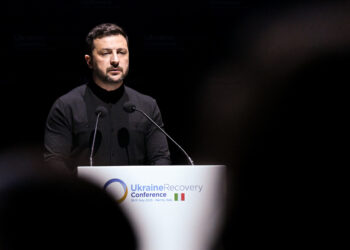






![[foto: Guillaume Baviere/WikimediaCommons]](https://www.eunews.it/wp-content/uploads/2026/01/Cuba_Che-120x86.jpg)
