




Brussels – As widely predicted, the third round of talks between Ukraine and Russia, held yesterday in Istanbul, did not yield any breakthrough toward ending the war, which has been going on for almost three and a half years now. Nor did they pave the way for any face-to-face between Volodymyr Zelenskyy and Vladimir Putin, whose positions on the conflict remain diametrically opposed. The only concrete result, also this time, is an agreement on new exchanges of prisoners and soldiers remains, while the fate of abducted civilians on both sides remains uncertain.
The encounter between Kyiv’s and Moscow’s delegations in Istanbul yesterday evening (July 23) lasted less than an hour. It was the third such meeting in three months, following those in mid-May and early June. Before sitting at the table with their Russian counterparts, Ukrainian emissaries met with Turkish President Recep Tayyip Erdoğan.
I reported to the President of Ukraine on the results of the third meeting with representatives of the Russian Federation during today’s talks in Istanbul.
The Ukrainian side has clearly outlined three key priorities set by the President:1. Full and unconditional ceasefire – from… pic.twitter.com/cCax1AmEq4#
– Rustem Umerov (@rustem_umerov) July 23, 2025#
“Our priorities remain people, the ceasefire, and the leaders meeting,” the head of Kyiv’s National Security Council and Ukrainian chief negotiator, Rustem Umerov, said after the talks. The team also included presidential adviser Andrij Yermak.
However, in line with expectations ahead of the meeting, the parties only managed to secure an agreement on one of these three priorities. Namely, yet another prisoner exchange. The two sides agreed to transfer some 1,200 captive soldiers each, on top of which Russia offered to add the bodies of over 3,000 fallen Ukrainians.
Moscow, which has reiterated the suggestion to observe short breaks of 24-48 hours in the fighting to allow for the recovery of the dead and the wounded from the battlefield, also called for the return of some 30 Russian civilians captured by Kyiv’s armed forces during the Kursk incursion. Russia has reportedly finished working on the list of Ukrainian minors abducted from the occupied territories, but has not yet made clear commitments about their return.

But the proposal to organize a high-level meeting between Vladimir Putin and Volodymyr Zelenskyy (also attended by Erdoğan and Donald Trump) by the end of August, described by Umerov as “the tool that can unblock both political and security issues,” was brushed aside.
For Russia’s chief negotiator, Vladimir Medinsky, regarded as one of the Kremlin’s hawks, this will require much more time. When the two presidents sit down at the table, he argued, it will only be to sign a peace agreement, not to “discuss everything from scratch.” The former Minister of Culture reiterated his previous proposal of creating three working groups that would meet online to discuss the political, military, and humanitarian aspects of the negotiations in further detail.
Any breakthrough regarding the terms of a potential ceasefire also predictably failed to materialize. The positions of the warring countries remain irreconcilable, as made evident from the memoranda that were exchanged at the previous meeting in Istanbul. While Kyiv sees a truce as the key precondition for peace talks, Moscow does not intend to halt hostilities until a comprehensive agreement is ready that can be satisfactory to both sides.
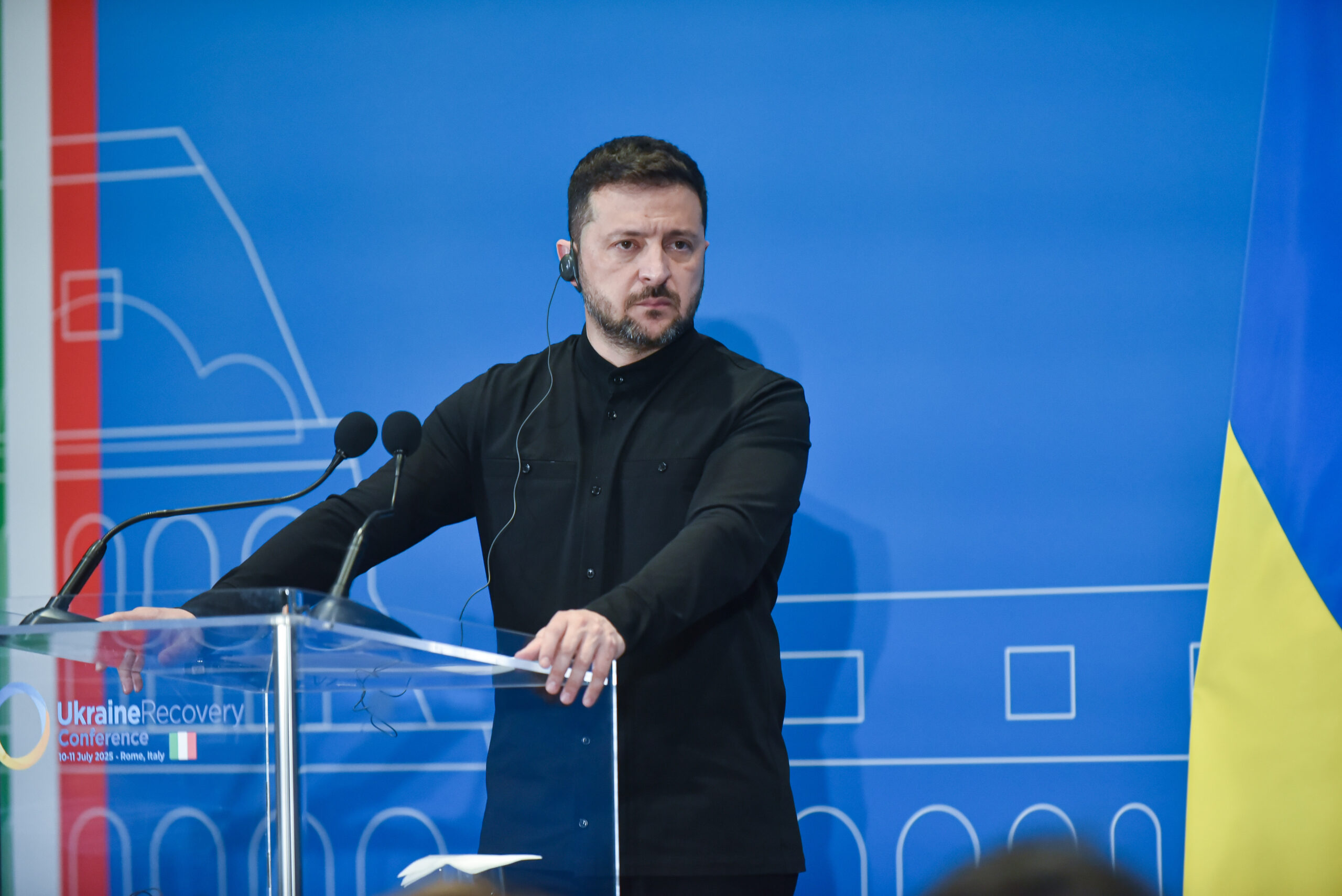
In the meantime, the Western front appears to have realigned, at least momentarily. Last week, after bypassing Slovakia’s opposition, Brussels adopted the 18th sanctions package against the Kremlin, targeting in particular the country’es energy exports as well as its financial sector.
In Washington, the US President appears to have changed his mind once again about the conflict, promising new arms shipments to Kyiv while threatening “severe tariffs” against Moscow if a negotiated solution to the war is not reached by the end of August.
However, the military front is not the only one Zelensky has to watch out for. Over the past few days, an internal crisis has erupted in Ukraine, triggered by his government’s decision (and his own endorsement) to severely restrict the independence of the country’s two key anti-corruption bodies, the NABU and SAPO. In recent hours, the squares were filled with protesters for the first time since 2022, while appeals from international partners are multiplying for Kyiv to take a step back and effectively protect the rule of law.
English version by the Translation Service of Withub






![[foto: Guillaume Baviere/WikimediaCommons]](https://www.eunews.it/wp-content/uploads/2026/01/Cuba_Che-120x86.jpg)
