



Brussels – The digital euro is intended to enhance the security of Europeans. It is, in perspective, a valuable tool in times of emergencies or crises. On this aspect, Piero Cipollone, a member of the Executive Board of the European Central Bank, insists in his speech to the European Parliament’s Economic Affairs Committee to push for the introduction of an alternative to the physical euro.
“The digital euro would in fact support business continuity in times of crisis by providing additional payment rails on top of the existing private solutions,” Cipollone points out. In other words, “by having alternative payment options in place,” the digital euro would end up “improving resilience by ensuring that there is always spare capacity in the system” in case of need. An all-European payment method, accepted in the euro area and the single market, is the best way to avoid exposure to the risks associated with non-European payment circuit providers such as Visa and MasterCard.
“But as society increasingly moves away from cash, and as cash itself may be difficult to access in emergencies, especially if cash distribution networks are disrupted, we need to complement it with a digital version,” the Italian ECB board member added. In this sense, “the digital euro can have a meaningful impact. Not just as a technological innovation, but as a public good that strengthens Europe’s resilience.”
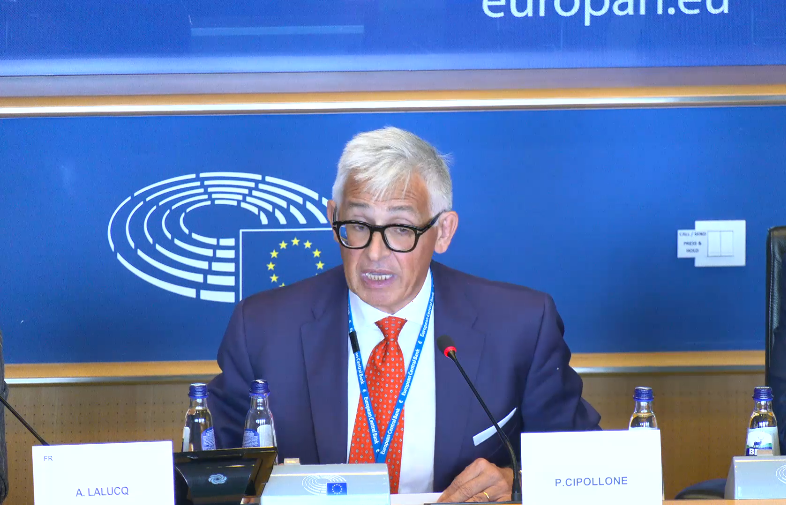
Cipollone offers a glimpse of how and what the ECB is working on: the ECB will develop a dedicated digital euro app, available to everyone, and allowing users to switch easily between payment service providers offering the digital euro. “Under normal circumstances, this fallback option will ensure flexibility. But in the event of a cyberattack on one or more providers, it would guarantee continuity.” Moreover, the technical infrastructure for transaction processing – an alternative to the US circuits – “will be distributed in at least three different regions, each equipped with multiple servers.” Thus, continues Cipollone, ” In the event of a regional disaster or cyberattack, this will allow payments to be automatically rerouted, ensuring uninterrupted operations.”
The response to crises is an aspect that adds to the number one priority of the digital euro project, namely, ensuring European economic and banking independence. “The digital euro is a tool of the European Central Bank, managed by the ECB,” emphasises the Eurotower representative. It means that “instead of money flowing into US banks, it will remain within the Eurosystem.”
Frankfurt’s idea also includes the possibility of making payments in offline mode, without a connection, to avoid being blocked in the event of internet overload or failure. “The ECB will bear the cost of the all-new infrastructure,” he is quick to reassure.
English version by the Translation Service of Withub


