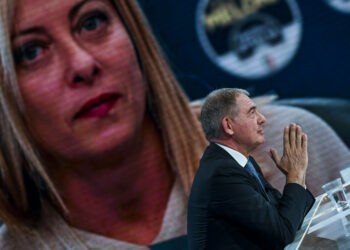
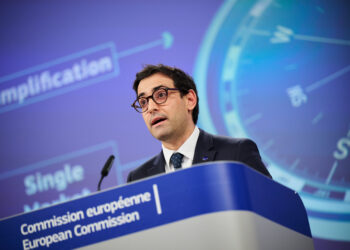
Brussels – An electric hatchback that could cost €15,000–20,000. The initiative anticipated by Ursula von der Leyen for an affordable European electric car is in the pipeline and is expected to take shape by the end of the year. This was confirmed today (September 29) by the European Commission’s Executive Vice-President for Industry, Stéphane Séjourné, to the ministers of the 27 countries gathered for the EU Competitiveness Council. Among them was the Italian Minister for Enterprise and Made in Italy, Adolfo Urso, who immediately added a caveat: “Let it not be only electric.”
Discussions on the automotive sector and the principle of technology neutrality are inevitably intertwined. The European Commission is engaging with stakeholders on one hand and with capital cities on the other. Today, Séjourné updated ministers on the outputs of the Strategic Dialogue on the Future of Automotive, the third meeting of which took place last 12 September. On that occasion, the executive vice-president unveiled to industry representatives the European Commission’s intention to develop a new regulatory category dedicated to small electric cars produced in Europe, with the aim of creating a market segment for the ‘E-car‘.
“Models that can cost, new, between 1€5,000 and 20,000,” she added in her speech to the EU Council. According to Séjourné, “this will also help to support demand and is a real segment that is not considered in the European market today and that could boost production, including the operation of our suppliers.”
This is not the only proposal the European Commission wants to put on the table before the New Year: Séjourné also mentioned an initiative on self-driving cars, one on the decarbonisation of company fleets, a proposal to accelerate battery production and a proposal to reduce administrative costs, as well as the expected revision of the regulation that will impose a stop to diesel and petrol engines from 2035.

Awaiting the Commissioner are the three largest national industries of the EU bloc: Germany, Italy, and France. Urso met in a trilateral meeting with his counterparts Katherina Reiche and Marc Ferracci, with whom—according to the minister—”there is full agreement” to “advance without delay on technological neutrality, flexibility, and European preference.” Speaking afterwards at the meeting with the 27, Urso vindicated the position that Italy had taken “from the outset, with strength and consistency”: the need to “review the rules of the Green Deal,” from the “super-fines” to the revision of the regulation on stopping diesel and petrol engines.
The future of the European car “depends on technological neutrality and flexibility,” the minister continued. That is why, for Rome, although he agrees with it, it is not enough to support the creation of a European E-car market sector. The small electric car initiative “is one of the necessary measures that we have urged so that those who cannot afford it can buy an ecologically sustainable car, a small hatchback,” Urso explained, adding that, however, it will “necessarily also have to be powered by other fuels, not just electric, to be accessible to everyone.”
English version by the Translation Service of Withub