




Brussels – Ukraine may soon participate in the front line of European defence. This is the direction being taken by the Security Forum being held today and tomorrow (29 and 30 September) in Warsaw, where the defence of the Old Continent and support for Kyiv’s resistance against Russian aggression are among the many topics on the table. Two elements that are now inextricably linked, as confirmed by many guests.
The host, Polish Prime Minister Donald Tusk, said it loud and clear in his introductory speech to the two-day event: “The war in Ukraine is also our war, whether we like it or not,” he said. For him, the conflict that erupted more than three and a half years ago would be “just one part of this horrible project“, pursued by Vladimir Putin, to “slaughter countries, take away people’s freedom and make authoritarianism, despotism, cruelty, and the absence of human rights triumph.”

There is no more room for sloth or unawareness, warns the premier. In his perspective, it is now up to the leaders of the self-styled free world to “make the entire Western community, the entire transatlantic community, painfully aware, deep down, in their hearts and minds,”
that peace is over in Europe. And that “if we lose this war, the consequences will affect not only our generation but also future ones”: in Warsaw, across the continent, in Washington, everywhere.
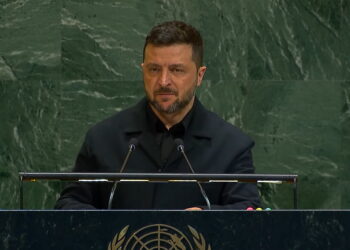
Along the same lines was the speech by Volodymyr Zelensky, projected immediately after Tusk’s on a giant screen in front of the audience. “Without a free Ukraine, there cannot be a free Poland,” the president began, insisting on the inextricable link between the security of Kyiv and that of the entire EU. To the point that—in the wake of the discussions that have emerged in recent weeks following the repeated violations of member states’ airspace by Federation military drones and fighters—the aggrieved country wants to contribute to a massive continental security effort from an anti-Russian perspective.
“Ukraine proposes to Poland and all our partners to build a joint and completely reliable shield against Russian air threats,” says Zelensky, boasting of his army’s capabilities, “to counter all types of Russian drones and missiles.” “If we act together,” he reiterated, “we will have sufficient weapons and capabilities” to protect the skies of Europe from Moscow’s encroachments and provocations.

The one who keeps insisting on the “anti-drone wall” is the EU Commissioner for Defence and Space, Andrius Kubilius, who is in constant contact with the “border” countries (i.e., those sharing land, sea, or air borders with the Federation). The project, a high-tech air defence system to prevent and neutralise possible Russian attacks against the territory of the Union (and NATO), is currently under discussion between the Commission and various chancelleries.
The Kremlin’s “provocations” in recent weeks “have shown that our capabilities to detect and destroy drones need to be enhanced, and this is where we can learn a lot from Ukraine,” Kubilius explains, as Kyiv has “unique know-how in drones.” The point, he argues, is that the capacity of the Twenty-Seven to detect enemy drones is “rather limited.”
Anti-air defences are more effective in detecting fighters and “perhaps missiles,” he continues, but with drones (which “are small and fly very low”) it’s a different story. This is why it is necessary to learn from the innovations implemented by the Ukrainians, starting with the creation of a network of acoustic sensors capable of monitoring the presence and trajectories of hostile drones. Such an operation, Kubilius guarantees, can be implemented “fairly quickly.”

But such a system cannot be created overnight. The cold shower comes from the German Defence Minister, Boris Pistorius. “I very much appreciate the idea and concept of a drone wall along the eastern border,” he conceded, “but we should be careful how we manage expectations” since, he admits, “we are not talking about a concept that can be realised in the next three or four years.”
“We have to think and act according to priorities,” he argues, “and these are others. According to him, we need to accelerate on the “capabilities” side: ‘We need to be faster in the development‘ of the systems we already have without wasting years designing new ones, he adds, calling for a “fluid process” that allows strategic-industrial planning to not lag behind technological developments, which are accelerating in the age of artificial intelligence.
In the meantime, the question remains of what to do with the Russian drones and fighter jets that fly undisturbed over European skies. Kubilius seems to share the suggestion made days ago by Donald Trump: according to the tycoon, the allies could shoot down enemy aircraft that violate their airspace. “It is up to NATO to decide,” the commissioner quibbles, “or even to the Member States,” on their own. The fact remains, he nevertheless concludes, “that Russian provocations or tests on European defence capabilities are increasing” and that this renewed Russian assertiveness must be “reacted to very clearly.”

However, there is still common ground, both in Berlin and Brussels. “We must do and we will do more for defence in Europe,” Pistorius assures, reiterating that the priority is “the strengthening of Ukraine and its defence.” “We will not fall into the trap of Putin’s continued escalation,” he promises, reminding, however, that “Russia is becoming more and more dangerous” to the Alliance, whose “determination and prudence” in handling recent “provocations” he praises.
In stark contrast to the reflections coming from the Warsaw forum are those expressed by Viktor Orbán, according to whom “Ukraine is not an independent and sovereign country” because it would be the European states that would “keep it afloat”, and without Western support it would “collapse”. The vitriolic words from Budapest come after Kyiv accused its Magyar neighbour of violating Ukrainian airspace with some reconnaissance drones.
Zelensky should rather “concern himself with Russian drones on the eastern border,” cut short Orbán, who for years has kept practising systematic stonewalling as much on the dossier of aid to the aggrieved country and of sanctions to the Federation (now reaching the 19th package, currently under discussion among the Twenty-Seven) as well as on that of the accession of Ukraine to the twelve-star club, so much so that the President of the European Council António Costa was forced to consider procedural manouvres to circumvent the Hungarian veto.
English version by the Translation Service of Withub




![[foto: Guillaume Baviere/WikimediaCommons]](https://www.eunews.it/wp-content/uploads/2026/01/Cuba_Che-120x86.jpg)
