




Brussels – Second stop on Ursula von der Leyen‘s Balkan tour. After
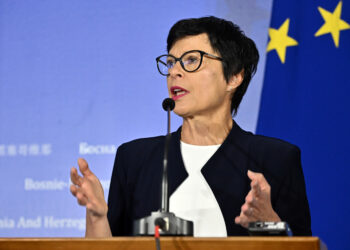
Albania, yesterday evening (13 October), the President of the European Commission travelled to Montenegro. In Tivat, on the Adriatic coast, she met with the head of state, Jakov Milatović, and Prime Minister Milojko Spajić. “Every time I come to Montenegro I feel the heart of Europe beating,” she wrote on X as soon as she arrived, praising the nation for being “at the forefront of the accession process” to the Union.
The head of the Berlaymont once again complimented the rapidity with which Podgorica is advancing along the path of negotiations to join the twelve-star club: “The goal of Montenegro’s accession to the EU is really close to being achieved,” she told the audience, declaring that she sees in the small Balkan country “unbelievable potential.”
To date, Montenegro has opened all 33 negotiating chapters— organised into six thematic clusters, indicating the macro-areas with respect to which candidate countries must align with the acquis communautaire in order to become EU member states—and has provisionally closed seven of them (the last one in June). Spajić aims to close them all “by the end of 2026,” with the goal of “becoming members of the bloc by the end of 2028,” bringing the EU chancelleries from 27 to 28.
No need to wait for accession to invest in Montenegro.
The opportunities are right here, right now.
Montenegro is a great place to do business.
Today we’re launching 14 projects that show just this ↓ https://t.co/L3Cn8qmrwh
– Ursula von der Leyen (@vonderleyen) October 14, 2025
“This is an ambitious goal,” von der Leyen admits, “but we love ambition.” Among other things, Brussels appreciates Podgorica’s alignment with the foreign policy of the Union, as evidenced by “your decision to send Montenegrin soldiers in support of our training mission to Ukraine.” Last week, Montenegro joined the Single Euro Payments Area (SEPA) along with Albania and North Macedonia, whilethe introduction of European roaming for internet traffic from mobile networks is forthcoming.
However, von der Leyen goes on to note, there is still some way to go with regard to reforms in the field of the rule of law, the combating of corruption, transparency in public procurement and the solidity of national democratic infrastructures. The real difficulty, in fact, lies not so much in opening the negotiating chapters as in closing them. The next appointment with Brussels is set for 4 November, when the Commission will publish its annual reports on the progress of the candidate countries.
But there is also an economic dimension of continental integration, which involves extending the European single market to the candidate countries. This morning, from Luštica, near Tivat, the head of the EU executive opened the first EU-Montenegro investment conference, similar to the one held yesterday in Tirana. “Investments are still not up to the potential of the country”, complained von der Leyen, warning that “we should not wait for accession to invest in Montenegro,” otherwise there would be a risk of “missing the opportunities that already exist.”
The host announced an investment cycle of more than €3 billion over the next few years: “Montenegro is open for business and now is the time to invest” in the national economy, Spajić stressed in front of the economic actors in the room, including institutional actors such as the European Investment Bank (EIB) and the European Bank for Reconstruction and Development (EBRD). The Luštica conference was the occasion to conclude 14 investment contracts in various sectors, with a focus on sustainability in tourism and transport.
In addition to private investments, there are also European funds allocated to Podgorica through the Western Balkans Growth Plan,
an ad hoc instrument with a budget of €6 billion—distributed among the six beneficiary countries in proportion to their population and GDP (Montenegro has been allocated a total of 383.5 million, 6.8 per cent of the total)—whose objective is to drive regional economic development even before accession to the EU. Once the conditions for disbursement are met, an 8 million tranche will soon be disbursed to Podgorica, von der Leyen said, urging the government to “continue with the reforms” to access the entire sum.
After the Montenegrin stop, the President of the Commission resumed her journey to Bosnia and Herzegovina. The first place she visited was the Srebrenica Memorial, where she commemorated the victims of the genocide perpetrated 30 years ago in July 1995 by the Serbian army. From there, she headed to Sarajevo, where she met the leaders of the tripartite presidency (representing the three national communities: Bosniacs, Croats, and Serbs) and Prime Minister Borjana Krišto to renew the appeal for internal unity, indispensable for progress along the road to accession.

The situation in Bosnia and Herzegovina remains tense, a result of the friction between the central authorities and the Republika Srpska, where separatist feelings have been rekindled (but never really subsided). Here, on 23 November, elections will be held to choose a new president after the Bosnian federal court disqualified Milorad Dodik from office last August. The outcome of the vote, which keeps Sarajevo and Brussels on their toes, could further complicate Bosnia and Herzegovina’s path towards the EU.
The delay in submitting the Reform Agenda, which the Balkan state must send to the Berlaymont as a condition for receiving EU disbursements linked to pre-accession reforms within the Plan for Regional Growth, has demonstrated this clearly.
The document was delivered on the last day available, 30 September, and will now be examined by the Commission. Sarajevo already lost 100 million last summer, precisely because of its failure to submit the Agenda to Brussels by the deadline.
English version by the Translation Service of Withub




![La video riunione dell'Eurogruppo [27 marzo 2026. Foto: European Council]](https://www.eunews.it/wp-content/uploads/2026/03/eurogruppo-260327-120x86.jpg)
