



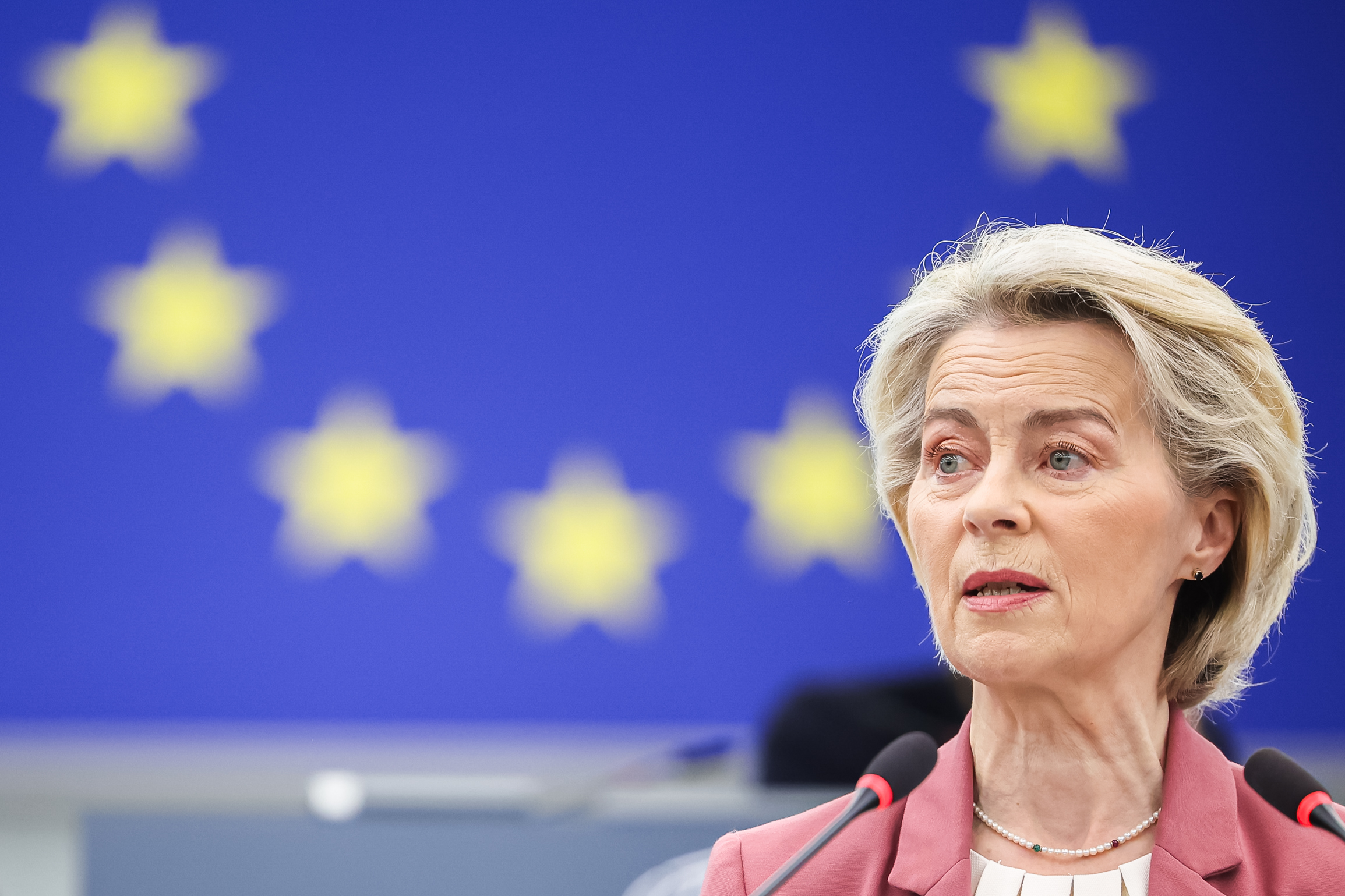
From the Strasbourg correspondent – Competitiveness and decarbonization are two opposing forces that do not attract each other. But it is up to the European Union – starting with the summit of the heads of state and government on the agenda tomorrow (October 23) – to forge an unbreakable link between them. On the eve of the European Council, Ursula von der Leyen presents to the Strasbourg hemicycle the way to solve the equation. And she does so with a question: “The question for us is whether we want to reap the benefits of this global clean tech boom or just let others profit from it.”

Von der Leyen laid out some data. At the EU level, “last year clean technology exports reached EUR 80 billion, almost tripling in six years.” Globally, in 2024 alone, “more than 580 Gigawatts of renewable energy were added,” in the next five years, the global battery market is expected to double, while the wind turbine market “continues to grow by more than 10 percent per year.” And last year, sales of electric cars in Asia, Africa, and Latin America “increased by 60 percent.” In short, “others are not sleeping.”
Who fares even better is China, which “exports almost twice as much clean tech as we do.” It exports them everywhere, including Europe. But as the EU struggles to get rid of Russian fossil fuels once and for all, “we cannot afford to fall into new and dangerous dependencies,” because “at any time, such dependencies can turn into instruments of pressure.” Von der Leyen sounded the alarm: “A crisis in the supply of critical raw materials is no longer a distant risk. It is on our doorstep,” she said in the Hemicycle.
Beijing’s crackdown on the export of rare earths and related technologies is fueling tensions with Washington and Brussels and is frightening. To cope with a possible crisis, the President of the European Commission has three moves in mind. “First, we will introduce a ‘made in Europe’ criterion for public procurement in certain strategic sectors,’ she said. At the same time, “we should ensure that new foreign investments in our industry are truly in Europe’s interest.” Finally, “we will step up support for certain strategic sectors.” These include the battery industry and the automotive industry.
The reactions of the political groups
The European car crisis was the starting point for the chairman of the People’s Party, Manfred Weber, who took the floor after von der Leyen. “In Germany, half of the jobs lost in the last year were in the automotive sector.” The same collapse “applies to France, Spain, Italy, and Romania.” On the path to decarbonization, “we have to be ambitious but pragmatic,” he added. Weber – German and popular like von der Leyen – briefly addressed the other topics of tomorrow’s summit: Ukraine, defense, the Middle East, climate, and competitiveness. “It is the moment of truth about Europe’s global role,” he pointed out.
For the Socialist group leader (S&D), Iratxe Garcia Perez, the EU heads of state and government must “maintain the 2040 90 percent emission reduction target“ and “turn it into law.” The Social Democrat family calls for “a European Climate Adaptation Act,” which prepares member states “for droughts, heat waves, and fires,” and a “more ambitious Social Climate Fund, linking climate justice and social justice.”

The president of the Sovereignist Patriots group, Jordan Bardella, pointed the finger at “the regulatory burden of Brussels,” while for the Greens’ group leader, Bas Eickhout, “to question the Green Deal is to throw the future of Europe to the wind.” The environmental group is on the barricades: “Tomorrow we will witness the biggest attack on the Green Deal by the heads of state and government,” warned Eickhout, according to whom the regulatory simplification agenda launched by Brussels not only “does not help, because it creates uncertainty,” but should be called by its real name, “deregulation.”
In the end, Renew’s liberal group leader, Valerie Hayer, delivered the assist to von der Leyen: “Decarbonization is the key to our competitiveness,” she stated, pledging loyalty to the European Commission’s energy transition agenda.
English version by the Translation Service of Withub





![La video riunione dell'Eurogruppo [27 marzo 2026. Foto: European Council]](https://www.eunews.it/wp-content/uploads/2026/03/eurogruppo-260327-120x86.jpg)
