



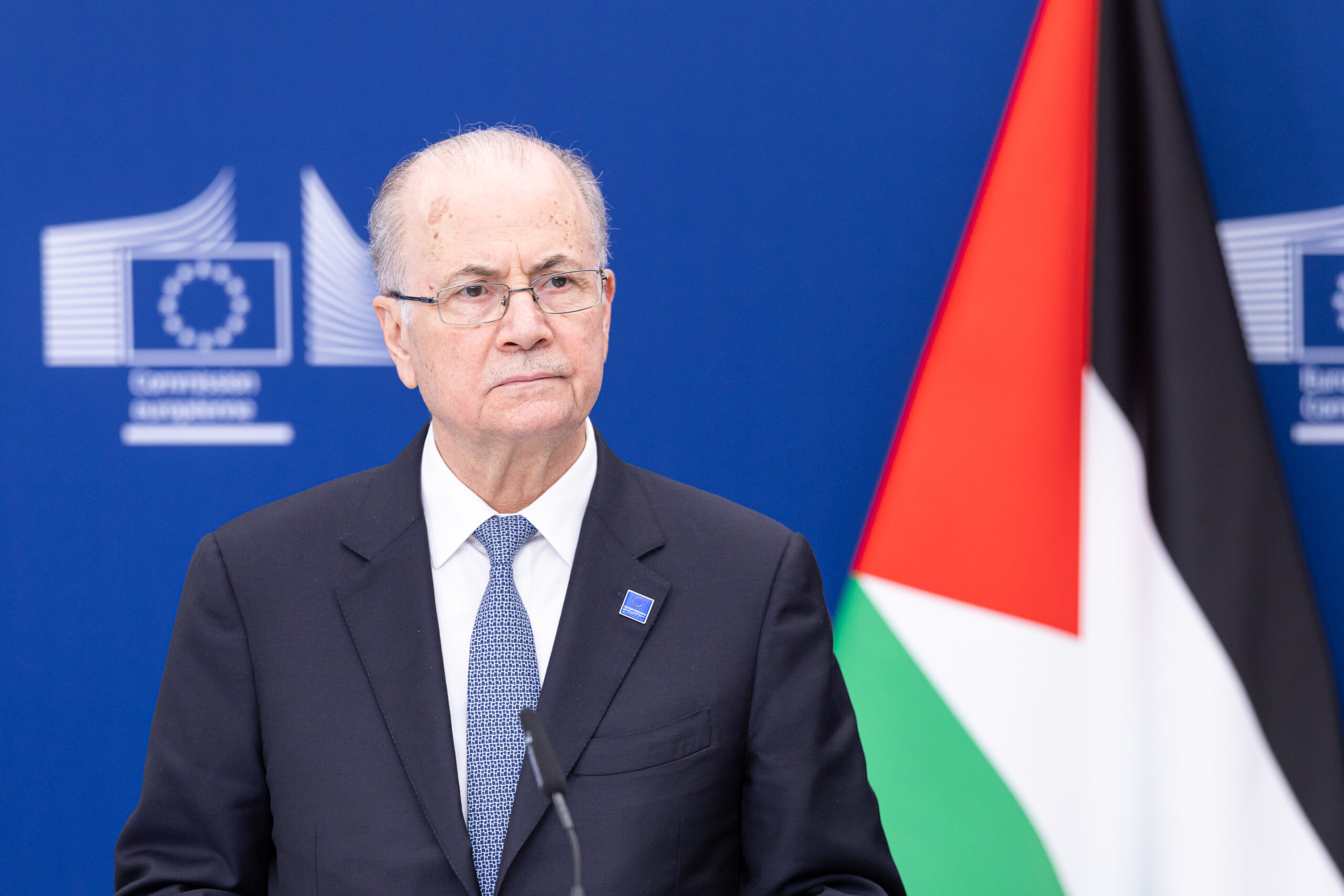
Brussels – According to the Oslo Accords between Israel and the Palestinian Authority, for the past 30 years, Tel Aviv has been responsible for collecting tax revenues in the occupied Palestinian territories and delivering them to Ramallah. A power that Israel has used several times, withholding part or all of that money. This is what has been happening for more than a year, as denounced yesterday in Brussels by the Palestinian Prime Minister, Mohammad Mustafa: “No government can support reforms if it is denied its own revenues,” he said on the sidelines of a conference focused precisely on the path of reforms demanded from Ramallah as part of the peace plan for Gaza.
Some 60 national delegations attended the first meeting of the Donor Group for Palestine in the EU capital. On the sidelines, Mustafa held a joint press conference with the EU Commissioner for the Mediterranean, Dubravka Šuica. Although Brussels established the initiative as “a platform” for the Palestinian Authority to take stock of its reform program, Šuica announced that – together with Germany, Luxembourg, Slovenia, and Spain – the European Commission had signed “over EUR 82 million in new contribution agreements for additional financial support from our member states.” In total, the amount “pledged this year is over EUR 88 million, including earlier contributions from Finland, Ireland, Italy, and Spain,” she added.
IIn April, the European Commission offered a €1.6 billion package over three years to support Ramallah. The support is bound to a series of long-requested institutional and administrative measures by the Palestinian Authority, as a prerequisite for advancing the elusive two‑state solution. Mustafa assured that governance reform is proceeding and the education modernization program “is already being implemented”. On the other hand, however, “this progress is taking place in parallel with the daily fiscal pressure and Israeli policies aimed at weakening the Palestinian National Authority and its ability to function and provide our people with the necessary services.”

Mustafa’s complaint is unequivocal: “The current fiscal crisis is politically motivated. Israel’s blockade of Palestinian Authority revenues threatens salaries, continuity of services, and stability in both Gaza and the West Bank.” We are talking about several billion, against which Brussels’ contributions pale in comparison. “We appreciate the strong partnership with the European Union and the contributing Member States, but we need predictable and upfront funding and action to protect the relevant credit lines and unstable liquidity constraints concerning Gaza,” the prime minister added.
Šuica indicated that Tel Aviv had accumulated, since stopping the transfer of Palestinian funds to Ramallah last spring, “from three to four billion euros, an enormous amount, indispensable for a solid and stable Palestinian Authority.” She assured that “all our diplomatic energy, all our political capital, is invested in trying to push Israel to release this revenue.”
Member States have already shelved the economic and political sanctions on Israel that the European Commission proposed in September, unable to agree and reluctant to raise their voices with their primary Middle Eastern partner. Here lies the paradox: the EU “is investing a lot” in the Palestinian Authority, “to make it stronger and make it an interlocutor at the table as soon as the situation allows,” emphasised Šuica. However, in the meantime, it continues to maintain strong relations with the Jewish state, which has been guilty of the occupation and oppression of the Palestinian territories and their inhabitants for decades.
Now, however, cut off from Trump’s peace plan and taking a back seat to the unconditional partnership between Washington and Tel Aviv, the EU wants a “leading role” because “we are really keeping the Palestinian National Authority alive.”
English version by the Translation Service of Withub



![La video riunione dell'Eurogruppo [27 marzo 2026. Foto: European Council]](https://www.eunews.it/wp-content/uploads/2026/03/eurogruppo-260327-120x86.jpg)
