




Brussels – The EU has made increased military support for Ukraine a new imperative at a time when diplomatic efforts for a solution to the Russian-Ukrainian war are gaining momentum. “We have to put even more pressure on Russia; it is the only way to get Russia to make concessions,” emphasises the Dutch Defence Minister, Ruben Brekelmans, upon his arrival in Brussels for the work of the Defence Council. This passes through more military aid: “If Ukraine has a military force, it also has a deterrent against Russia,” he explained, later announcing the Netherlands’ commitment for an additional 250 million euros.
A stance that Latvia and its Defence Minister, Liene Gatere, share: “We must increase our military aid,” she emphasized, as member states and as the EU as a whole. She pointed out that in 2025 alone, Latvia has committed resources amounting to 0.3 percent of gross domestic product, and that for 2026, 0.25 percent of GDP. Hence, the appeal to partners: “I call on the other Member States to do the same.” 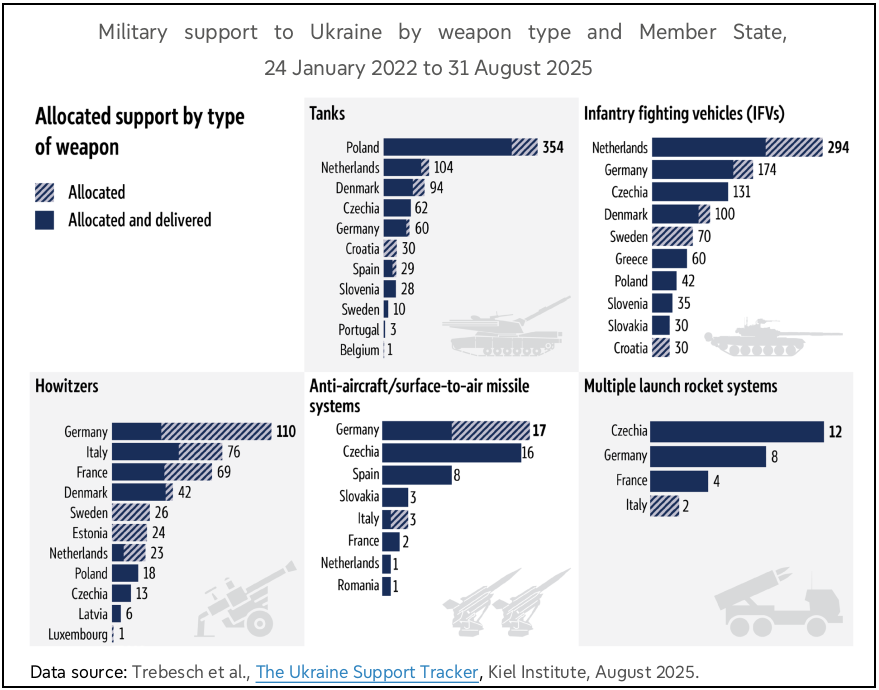
EU member states have so far made substantial bilateral commitments, both financial and military. The European Parliament’s Think Tank, in figures updated in November 2025, noted that, together, all EU states have provided 97.9 billion euros in military support alone (out of a total of 177.5 billion). In terms of equipment, all the various national contributions so far see the supply to the Ukrainian armed forces of 774 tanks (including 427 T-72 tanks and 230 Leopard tanks), 966 infantry fighting vehicles, 409 howitzers (artillery pieces specifically for direct fire on targets), 51 air defense systems, and 26 multiple rocket launch systems.
Significant aid, which could also form part of the personnel assigned to Kyiv. When analyzing or referring to military support for Ukraine, the authors of the parliamentary study note that “some information may be intentionally obscured by donors as well as by Ukraine, due to security and
strategic considerations.”
Based on official data, Italy is the second-largest contributor of howitzers. At the same time, Poland is the largest supplier of tanks, and the Czech Republic is the most significant contributor of multiple rocket launch systems. In various forms, therefore, the EU has already deployed many resources to put Ukraine in a position to counter the Russian advance and weaken any Kremlin’s expansionist-military ambitions.

A howitzer [photo: Looper590/Wikimedia Commons]
From an economic perspective, the ranking changes, but the updated figures reflect the overall contribution, that is, the entire contribution (humanitarian aid, military aid, macro‑financial assistance, and support for Ukrainian refugees in the EU, for whom protection is foreseen until 2027).
Looking at this special list of European countries active in aid to Ukraine, Germany (38.2 billion euros) and France (20.9 billion euros) are the leading contributors to Kyiv’s defence. In the list of donor countries, third place goes to the United Kingdom (18.6 billion euros), followed by the Netherlands (12.8 billion euros). Fifth is Italy, with total economic aid of 12.2 billion euros.
The same list, drawn up in percentage terms, sees the Baltic Republics (Estonia, Latvia, and Lithuania), and Denmark making the most significant contributions in terms of expenditure in relation to GDP: these countries’ contributions range between 2.50 and 3 percent of GDP (from 2022 to date), while the contributions of Germany, France, and Italy range between 0.15 and 0.59 percent of GDP.
English version by the Translation Service of Withub






![La video riunione dell'Eurogruppo [27 marzo 2026. Foto: European Council]](https://www.eunews.it/wp-content/uploads/2026/03/eurogruppo-260327-120x86.jpg)
