




Brussels – “In the current geopolitical and geo-economic context, it is imperative that Europe strengthens its economic security.” The words of Trade Commissioner Maroš Šefčovič anticipate the announcement of a series of initiatives that, according to the European Commission’s plans, will “strengthen the Union’s economic security.” Alongside him at the press conference, Executive Vice-President for Industrial Strategy Stéphane Séjourné outlines concrete actions. The main one is the RESourceEU plan, which aims to free the 27 member states from their strategic dependence on China for rare earth materials.
RESourceEU will secure critical raw materials and boost EU competitiveness. Up to €3 billion to cut dependencies on critical raw materials by up to 50% by 2029.
Discover our stronger supply chain safeguards, circularity measures & global partnerships https://t.co/0EZyrOAiTC pic.twitter.com/wgbxC2hS63
— Internal Market, Industry, Entrepreneurship & SMEs (@EU_Growth) December 3, 2025
A competition that is not (anymore) only economic
The EU’s awareness comes after a strenuous year on the economic front. The Union, the documents read, can no longer turn a blind eye to a “context of increasing geopolitical competition“, where trade dependencies are used as leverage to “jeopardise security, public order, competitiveness, and the EU economy.”
The high-risk areas identified by the Commission are diverse and start from the dependence on imports of critical raw materials. It is then necessary to internalise sensitive sectors such as defence and aerospace. “Our goal,” Šefčovič recalls, “is to prevent short-term disruptions, progressively reducing risky dependencies and avoiding new ones.” In a context of “arming” the economy, foreign investment is also scary. The fear is that foreign entrepreneurs might steal sensitive data and information to later use against the EU.
The unknown factor for success is high, which is why Šefčovič is also calling for private input: “Economic security will only work if Europe acts as a team, with member states and industry moving in synchrony.”
The difficult thing, however, will be to balance a shrewd, security-oriented approach with the preservation of the free market. The paradigm announced by the commissioner is therefore somewhere in between the two options: “Europe remains open for business, but we need investments without hidden risks.”
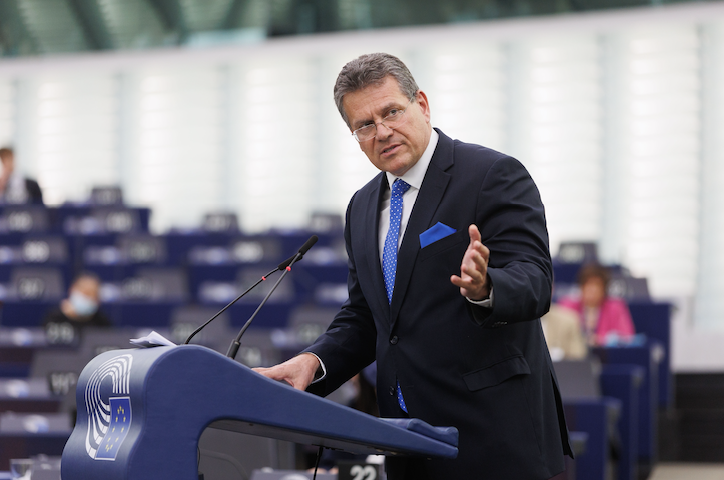
Séjourné’s plan on critical materials
The hidden risks of a foreign-dependent economy are to be combated by a new “operational arm“, announced Vice-President Séjourné. The plan is called RESourceEU and aims to achieve independence in the supply of essential raw materials: a titanic undertaking given that European companies are more than 90 per cent dependent.
The natural result of the risks announced by Šefčovič and the actions of Séjourné is a mix of regulation and the Commission’s centralisation of power. RESourceEU envisages concrete actions, such as the European Centre for raw materials, to be realised by 2026. The aim is to monitor, jointly purchase, and store raw materials on behalf of the Member States. Séjourné cites examples of successful centralisation. “As we did with Russian gas and REPower EU, or with Covid vaccines, we must also do this for essential raw materials,” the vice-president confirmed.
Approximately 3 billion euros in additional funding are to be mobilised for the project to immediately unlock projects in three priority areas: permanent magnets, batteries, defence. The basis for starting is the “European Critical Raw Materials Act” (adopted during the previous parliamentary term), and the basic facilities are the “60 mining, processing, and recycling sites” designated by the Commission as “strategic projects”. Alliances also play a key role in credibility in the global context, with partnerships with Ukraine, Norway, Australia, Canada, and South Africa mentioned. The United States, although not mentioned, is to be regarded more as an adversary than a partner.
Circularity
While the EU’s backwardness on rare earths stems from limited underground resources, Séjourné’s secret weapon is “circularity”.
a “key component of this plan,” for the Vice-President: “We are maintaining the scrapping of essential raw materials in Europe to create a genuine European recycling sector,” she explained.
NEW data from @EU_Eurostat for 2023:
32.2 kg of e-equipment put on the market per person
11.6 kg of e-waste collected per personThe EU’s upcoming #CircularEconomy Act aims to establish a Single Market for secondary raw materials.
More: https://t.co/iPUB0qPNbd pic.twitter.com/eJ8cGC5tsT
— EU Environment (@EU_ENV) October 30, 2025
A soft law that could become harder
To do all this, however, the industry must take the path of strategic autonomy. To speed up this transition process, the Commission will bring forward amendments to the Critical Raw Materials Act. The cornerstone will be the information requirements, i.e., the information needed to make the board aware of the sources of the critical raw materials used by the company. As well as new regulations to facilitate recycling and circularity. This allows for the concrete verification of whether diversification measures are indeed in place.
The soft approach chosen so far by Séjourné could be interrupted, however, as it is not excluded that “if experience shows that diversification efforts are not being made or are insufficient, we will make this diversification compulsory by law.”
English version by the Translation Service of Withub






![La video riunione dell'Eurogruppo [27 marzo 2026. Foto: European Council]](https://www.eunews.it/wp-content/uploads/2026/03/eurogruppo-260327-120x86.jpg)
