



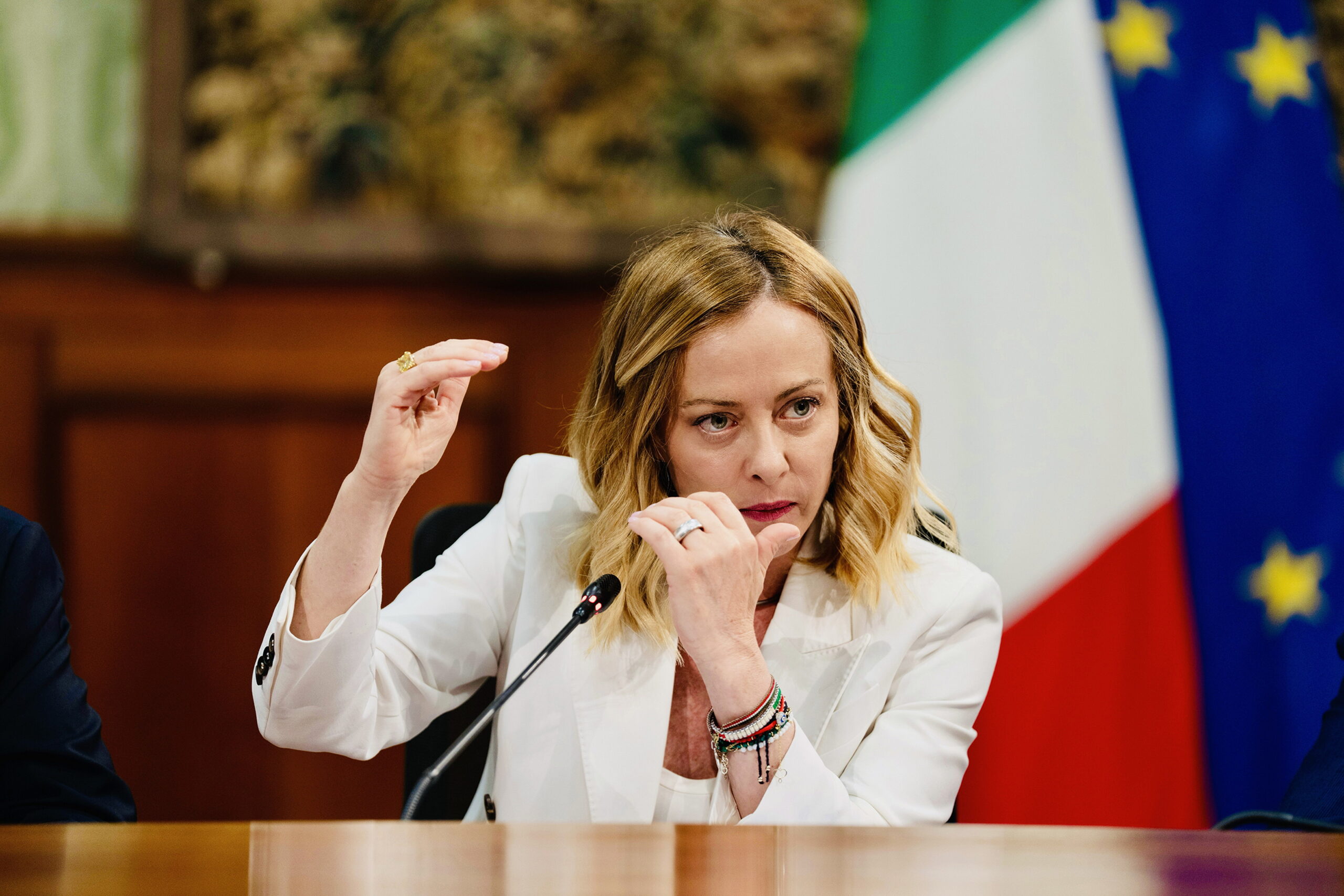
Brussels – A Europe with fewer migrants, more combustion engines and a “pragmatic” Green Deal. These are the characteristics that the Union must have, according to Council President Giorgia Meloni. The occasion for outlining the contours of this (new/old) Europe is the traditional New Year press conference held by the head of government. The EU is rarely mentioned, yet it forms the backdrop to almost every answer on foreign policy, security, and the economy.
Immigration is a source of great pride
The prime minister’s greatest success in Europe is undoubtedly the battle against illegal immigration. “This is the issue on which Italy has made a difference in Europe,” Meloni claimed with satisfaction, aware that she had been one of the key players in the new regulations approved by the EU Council.
“At my first European Council meeting on immigration, there was no mention of this, and the talk was of redistributing illegal migrants, which was impossible to stop. Today, reading the documents produced by the EU on this subject, there is talk of external dimensions, border defence, and more effective rules for repatriation,” Meloni commented. The seal on this new course came in December when more restrictive rules on asylum applications and repatriation were approved. Principles introduced at Italy’s request (but not only).
Backtracking on the Green Deal and electric cars
Even when referring to the decline of the automotive sector, Meloni takes credit for the Union’s change of pace, declaring herself innocent of past faults but ready to correct the mistakes of her predecessors. Meloni takes credit for the Union’s change of pace, declaring herself innocent of past mistakes but ‘ready to correct’ the errors made by her predecessors. This time, the allusion is to the extension beyond 2035 for the registration of cars with internal combustion engines. With these priorities in mind, the logical consequence in the environmental field is a “pragmatic and less ideological” green transition.
Nouvelles flexibilités pour les constructeurs Introduction d’une préférence européenne Renforcement de la filière batterie
Le détail de nos propositions pour la filière automobile, dévoilées le mois dernier → https://t.co/uvdp9zAvYG
pic.twitter.com/Qr1hmghtAE — Commission européenne (@UEFrance) January 3, 2026The EU Special Envoy to Ukraine
Even at the international level, the keyword is pragmatism. For the first time since the start of the conflict in Ukraine, Meloni has opened up to the possibility of direct dialogue with Russian President Vladimir Putin. The problem, however, remains that of having a single voice in Europe: “If we decide to talk to only one of the two sides, I fear that the contribution we can make will be limited, but if we make the mistake of reopening talks with Russia and going in a disorganised manner, we would be doing Putin a favour.”
For this reason, her proposal is “the appointment of an EU special envoy on Ukraine“. This is a new and interesting idea, but very difficult to implement with 27 chancelleries that would have to agree on the appointment of a single individual.
“Trump will not invade Greenland”
Another hot topic is American ambitions on the Danish island of Greenland. The Prime Minister has rejected them outright this time. “I do not believe in the hypothesis that the US will take military action on Greenland, which I would not agree with and which would not be in anyone’s interest.” This line was already taken on Tuesday during the meeting of the willing.
Danish prime minister: “if Donald Trump attacks Greenland, it will be the end of NATO.” pic.twitter.com/HsWlup5f2c
— Other Europe (@other_europe) 5 January 2026
The MERCOSUR opportunity
In the economic sphere, minimum growth (at 0.5 per cent) and frozen wages have been described as a “non-catastrophic” scenario. However, this overlooks the fact that in the next budget law, it will no longer be possible to balance the books with billions from the NRRP. Help, however, could come from new economic agreements with Latin America (Mercosur). The idea, which Italy opposed until a few days ago, has now been given the green light, as negotiations with the Commission have resulted in “new guarantees for our farmers,” Meloni confirmed.

The Italian housing plan resembles that of the EU
The latest connection between Meloni’s words and the European debate concerns the future Italian housing plan. In the coming weeks, an initiative will be presented with the aim of “implementing a project that can provide 100,000 new homes at controlled prices over the next 10 years,” but no further details have been disclosed.
A similar initiative has gained traction in Brussels. In December, at the urging of the socialist family, the Commissioner for Energy and Housing Policy, Dan Jørgensen, presented the European affordable housing plan. At the time, the president of the S&D group in the European Parliament, Iratxe García Pérez, described the commitment as a “€300 billion initiative for affordable and decent housing, with at least €100 billion in subsidies and state aid.” The impression, yet to be confirmed, is therefore that Giorgia Meloni may take credit in the coming weeks for an initiative (for social welfare) that is actually financed mostly with European money.




![[foto: Guillaume Baviere/WikimediaCommons]](https://www.eunews.it/wp-content/uploads/2026/01/Cuba_Che-120x86.jpg)
