




Brussels – European unity is working. A realization, or perhaps even a discovery, confirmed by the EU heads of state and government, who met in Brussels last night (22 January) for a summit urgently convened earlier in the week by President Antonio Costa to address US President Donald Trump’s threats of aggression against Greenland and the imposition of new trade tariffs on those European countries prepared to defend the Arctic island with military contingents.
Beginning at 7.30 p.m. – with a message of condolence from Costa, on behalf of all 27 Member States, to Spanish Prime Minister Pedro Sanchez, and a minute’s silence for the victims of the recent train accidents in Spain – the meeting ended at midnight, leaving the press conference to sum up the outcome to the two presidents of the Council and Commission, Costa and Ursula von der Leyen.

“On Greenland, we are clearly in a better position than we were 24 hours ago. And tonight, we drew the lessons of our collective strategy,” von der Leyen began. The President listed four elements of the EU’s behaviour: “First, there was unequivocal solidarity with Greenland and the Kingdom of Denmark. Second, we also stood firmly with the six Member States that were threatened with tariffs. Third, we engaged very actively with the US on various levels. We did so in a firm but non-escalatory way. Fourth, we were well prepared with trade countermeasures and non-tariff instruments if tariffs had been applied. ” This confirms what was stated before the meeting by some EU sources about the countries’ readiness to use the so-called bazooka, the anti-coercion instrument, if necessary.
“To sum up, we followed four key principles. Firmness, outreach, preparedness and unity and it was effective. Going forward, we should maintain this very same approach,” von der Leyen added. “I want to be very clear: the Kingdom of Denmark and Greenland have the full support of the European Union,” Costa added. Only they “can decide on matters concerning Denmark and Greenland. This is a reflection of our firm commitment to the principles of international law, territorial integrity, and national sovereignty, which are essential for Europe and for the international community as a whole,” he continued.
But even if the situation has changed, with Trump’s backtracking on threats of war and trade tariffs following the intervention of NATO Secretary General Mark Rutte, Brussels knows that risks remain. That is why, upon his arrival, French President Emmanuel Macron stated: “We remain extremely vigilant and ready to use all the tools at our disposal if we find ourselves under threat again.” And the EU wants to take action, not least to remove from the table the reasons the White House has given so far to justify its takeover of Nuuk. “We have collectively underinvested in the Arctic and Arctic Security. So now it is high time to step up. And to build on what we already achieved,” von der Leyen said.

“Right now, we are working on enhancing the EU relationship with Greenland,” she insisted, recalling the opening of the EU office in Nuuk two years ago; the launch, last year, of agreements that will lead to more investment in clean energy, essential raw materials, and digital connectivity; the doubling of EU financial support in the Union’s next multiannual budget (the MFF 2028-2034). “The Commission will soon put forward a substantive package of investments,” she assured. Beyond investments, “we also intend to deepen cooperation with the US and all partners on Arctic security. In particular, I believe we should use our defence spending surge on Arctic-ready equipment, a European Ice Breaker, for instance,” von der Leyen stressed.
On the issue of tariffs, the EU is sticking to the terms of the agreement reached in Scotland at the end of July, which the European Parliament has, however, suspended in light of new threats from the White House. With the crisis now over, however, it was the President of the European Parliament, Roberta Metsola, who announced on her arrival at the informal summit that the European Parliament can now resume its internal discussions on the EU-US trade agreement. This concept was reiterated by Costa in the press conference at the end of the meeting: “Yesterday’s announcement that there will be no new US tariffs on Europe is positive. The imposition of additional tariffs would have been incompatible with the EU-US trade deal. Our focus must now be on moving forward on the implementation of that deal,” he explained, suggesting that, barring any new developments, the suspension of the EU’s 93 billion euros of countermeasures, which were prepared in response to last year’s US tariffs and put on hold after the Scottish agreement, will be extended beyond its 6 February deadline.
On Ukraine, von der Leyen noted that as winter is taking a grip, “Russia is doubling down on vile attacks” and the EU is “doubling down” on its support for Kyiv. “This week we are deploying 447 emergency generators worth EUR 3.7 million to restore power to hospitals, shelters, and critical services,” she said. Furthermore, “work is progressing well on the security and prosperity aspects of the peace talks,” and, with regard to “security guarantees, the Paris meeting brought good progress,” and “we are now waiting for the Russian response.”
With regard to the future reconstruction of the country, Brussels is working with Washington and Kyiv on “a single document representing the collective vision of Ukrainians, Americans and Europe for Ukraine’s post-war future,” which “draws on the important needs assessment work of the World Bank,” and “proposes a response built around five key pillars:” increasing productivity through business-friendly reforms and greater market competition; accelerating Ukraine’s integration into the EU Single Market; significantly scaling up investment; stronger donor coordination; and fundamental reforms.

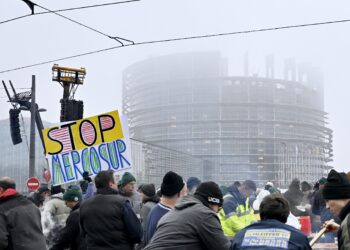
Finally, the unity of the 27 is also evident in the chapter on the EU-Mercosur trade agreement. The European Parliament decided to refer the matter to the Court of Justice to seek an opinion on the conformity of the texts with the Treaties, effectively blocking the ratification process. However, the Treaties themselves provide for the possibility of provisional application of the deal before MEPs ratify it. I don’t want to overdramatize the situation. This wasn’t a vote on consensus, but on legal clarifications,” Metsola pointed out on her arrival, explaining that “provisional application is an option on the table, and I will pursue it also with the leaders of the political groups.”
And at a press conference, Costa confirmed: “The Council decided last week not only to authorise the Commission to sign the Mercosur Agreement, but also to proceed with the provisional application of the Agreement. I invite the Commission to use this Council decision and implement the provisional application of the Mercosur Agreement.” Von der Leyen then clarified: “The issue of provisional application was raised tonight by several leaders” because “there is a clear interest in ensuring that the benefits of this important agreement apply as soon as possible. We have not yet made a decision. A decision will only be necessary when one or more Mercosur countries have completed their procedures and are substantially ready. So, in short, we will be ready when they are.”
English version by the Translation Service of Withub![Viktor Orban e Donald Trump alla cerimonia per il lancio del Board of Peace [Ph: Account X Viktor Orban]](https://www.eunews.it/wp-content/uploads/2026/01/G_Q2lfrWcAAED3X-350x250.jpg)




![La video riunione dell'Eurogruppo [27 marzo 2026. Foto: European Council]](https://www.eunews.it/wp-content/uploads/2026/03/eurogruppo-260327-120x86.jpg)
