



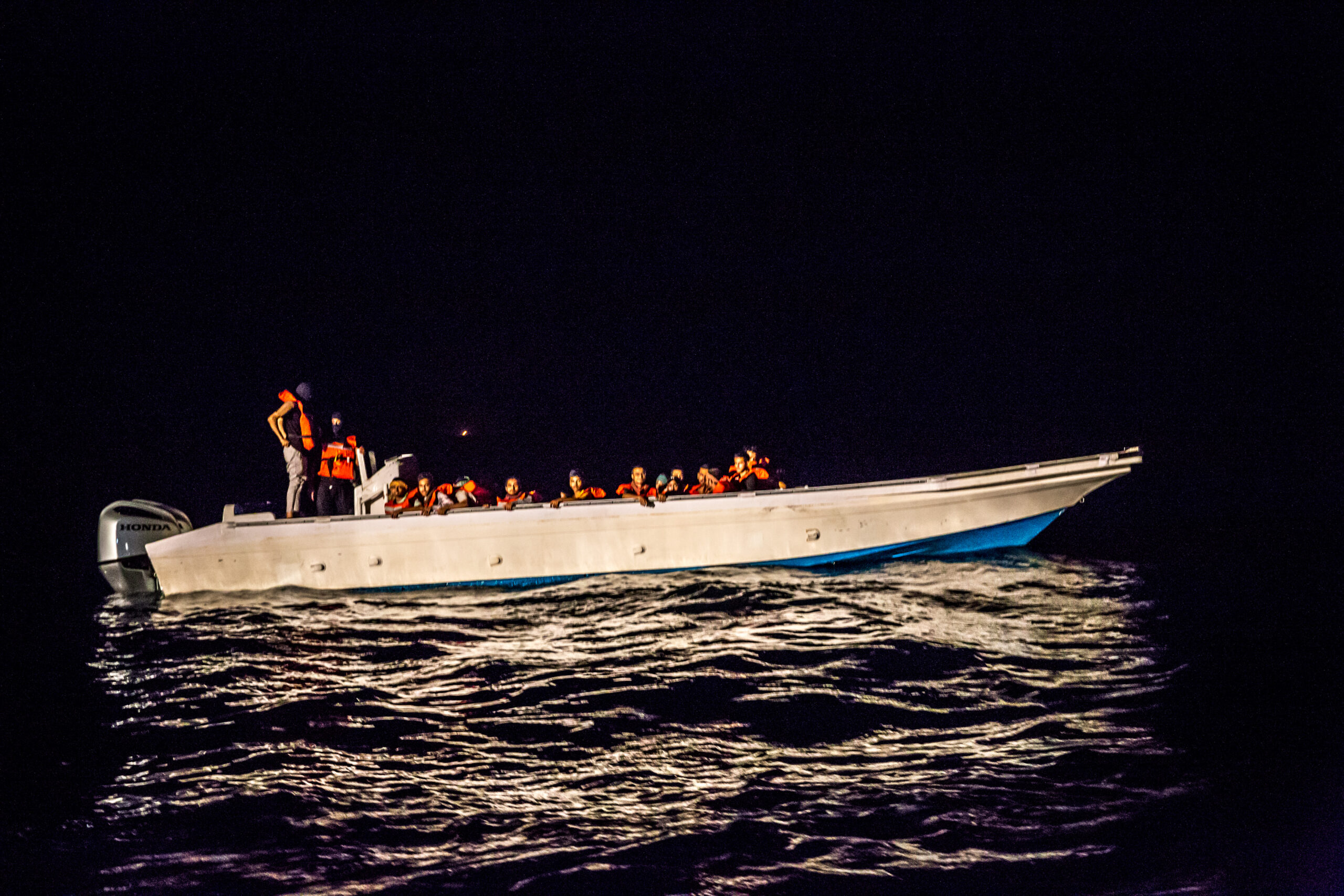
Brussels – Since the second half of January, due to Cyclone Harry, hundreds of migrants have been lost in the Mediterranean Sea. According to information from the Maritime Rescue Coordination Centre in Rome, dated 24 January, there were at least 380. But on 2 February, the NGO Mediterranea, citing estimates released by Refugees in Libya, reported that at least 1,000 people were missing while “the governments of Italy and Malta remain silent and do nothing.” In Brussels, the Democratic Party delegation to the European Parliament is calling for an end to the “intolerable silence” of the EU institutions.
None of the European Union leaders, neither the EU Commissioner for Home Affairs and Migration, nor the EU Border and Coast Guard Agency (Frontex), commented on what could be one of the most serious tragedies along the central Mediterranean route. Yesterday, a spokesperson for the European Commission stated that “every life lost at sea is a tragedy caused by traffickers.” Brussels throws up its hands and rejects any responsibility. The priorities now are different: repatriation and the externalisation of asylum procedures. Search and rescue operations—or rather, patrols to stop boats—have been delegated to the Tunisian, Libyan, and departure country authorities.
However, it is precisely the testimonies collected by Refugees in Tunisia, the Tunisian branch of the NGO chaired by David Yambio, that paint an alarming picture and raise several questions. According to the NGO, since 15 January, “faced with increasing pressure from the Tunisian military, with raids and devastation in the informal camps in the olive groves around Sfax and a relaxation of controls on the beaches, several convoys have left from various coastal points.” This is despite the most dangerous sea conditions recorded in twenty years.
In a statement, Mediterranea points the finger at the “behaviour of Kaïs Saïed’s regime” and questions the “laxity of the Tunisian authorities, who have been very efficient in recent months in preventing departures from the coast of Sfax.” Less than two weeks ago, on 22 January, in the midst of a tragedy whose full extent was still unknown, the EU delivered new search and rescue equipment to the Tunisian Coast Guard, bringing the total value of such aid to £11 million since the collaboration began in 2015.
In a parliamentary question, the 20 MEPs from the Democratic Party – joined by six members from the Green and Left groups – called on the European Commission to “break the deadlock and take immediate action in response to the massacre that took place in the Mediterranean in recent days”. This should be done by “taking a public stance on what has happened”, but also by “obtaining reliable data from the authorities of the countries involved” and “strengthening the search and rescue operations that are still necessary”.
As Sandro Ruotolo pointed out, “This is not an accident, but a collective failure. Europe has a duty to intervene, inform and save lives. Remaining silent and standing by is not an option.” For the president of Mediterranea, Laura Marmorale, “the silence and inaction of the Maltese and Italian governments are chilling: those who have lost their lives at sea must not be talked about, especially when these deaths show the failure of migration policies and cooperation with Libya and Tunisia, and while new brutal measures against migrants and solidarity are being prepared.”
English version by the Translation Service of Withub



![La video riunione dell'Eurogruppo [27 marzo 2026. Foto: European Council]](https://www.eunews.it/wp-content/uploads/2026/03/eurogruppo-260327-120x86.jpg)
