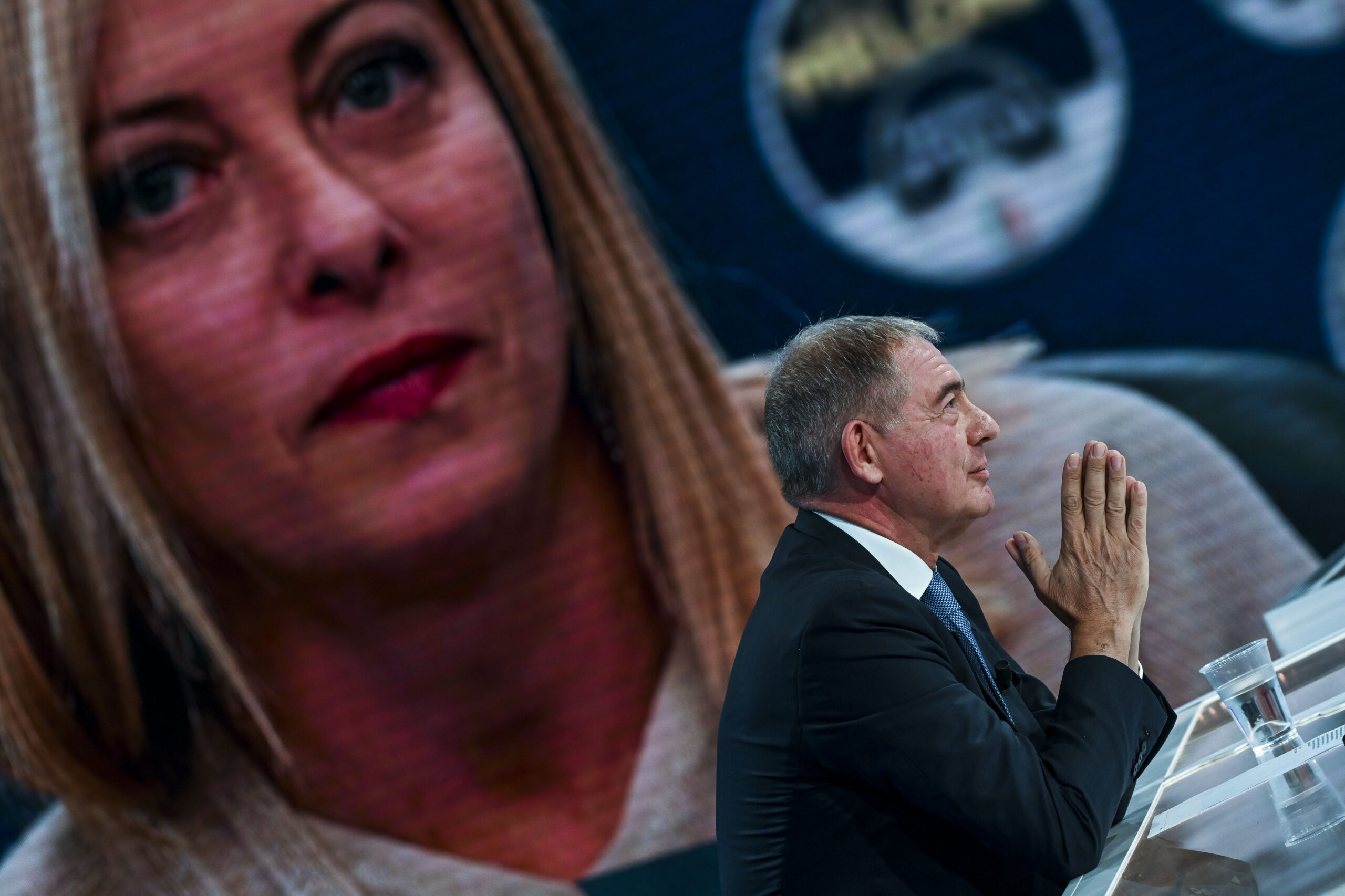
Brussels – Italy is attempting to further delay the European Union’s gradual withdrawal from the pillars of climate transition policies. Yesterday (26 February), the Minister for Enterprise and Made in Italy, Adolfo Urso, played a new card, calling for the suspension of the Emissions Trading Scheme (ETS) “until it has been thoroughly reviewed.” Rome’s move forward has surprised the other ten capitals, which are calling for urgent corrections.
Together with his counterparts from Austria, Croatia, the Czech Republic, France, Germany, Luxembourg, Poland, Portugal, Slovakia and Spain, Urso drafted a joint statement supporting the need for a revision of the ETS “that strengthens the EU’s competitiveness by ensuring an effective price signal, predictability, market stability, and protection against excessive price volatility, together with a pragmatic approach to free allocation that promotes investment in climate-friendly technologies and provides robust safeguards against carbon leakage.”
For the eleven “Friends of Industry” governments, the emissions trading system restricts energy-intensive businesses. In Urso’s words, “it represents an additional tax on European companies, increasing their costs and limiting their competitiveness.” The regulatory framework must “reflect the international competition that European companies face” and “take into account the need for a level playing field,” according to the joint statement. The catch, as pointed out by the EU’s major industrial powers, is that “given the decline in the EU-wide emissions cap, industrial operators risk facing high price levels, increased market volatility and limited liquidity.”
The ETS, which first came into force in 2005, requires energy-intensive industries, power stations, airlines, and shipping companies to pay a price for every tonne of CO2 emitted. This price rose above €90 in January. The key principle of the trading system is that energy-intensive companies can purchase permits through public auctions or on secondary markets. There is also a system of free permits – introduced to prevent companies from relocating outside the EU to avoid environmental costs – but the EU has decided to phase these out by 2034. The reduction in free allowances makes purchasing at auction or on the market increasingly expensive. And less sustainable for businesses.

Adolfo Urso at the EU Competitiveness Council [EU Council]
However, the joint statement does not go so far as to call for suspending one of the pillars of energy policy for climate transition, which, over the past 20 years, has proven its effectiveness in driving the progressive decarbonisation of industries. Since 2005, emissions from the sectors covered by the system have fallen by 39 per cent.
Even Poland, one of the most vocal opponents of the system, is limiting itself to calling for “a freeze on the gradual elimination of free allowances,” Economy Minister Andrzej Domanski said yesterday. Urso, on the other hand, has asked the European Commission, which is planning a review by the end of the summer anyway, to “suspend its implementation until a thorough review of emission benchmarks and quota allocation mechanisms has been carried out, including postponing the phasing out of free quotas.”
During the debate at the EU Competitiveness Council, the Vice-President of the European Commission responsible for Industry, Stéphane Séjourné, responded. “We need to reflect on and re-discuss the ETS,” he admitted, but the point is that “it must return to being an investment tool and not be perceived as a taxation tool.” This perspective needs to be reversed, because “ETS revenues must be used for decarbonisation, investment, and the modernisation of our industries.”
In line with Séjourné, French Industry Minister Sebastien Martin has dampened Urso’s enthusiasm. “I believe we must be cautious,” he said, explaining that “the ETS probably has some aspects that deserve to be re-discussed, particularly in parallel with the carbon border adjustment mechanism (CBAM), but dismantling everything is not France’s position.”
A view diametrically opposed to that of Giorgia Meloni’s government, whose decree to reduce bills by separating the cost of ETS emission certificates from the determination of electricity prices is already under review by the European Commission, was offered by Sweden’s Ebba Busch, Deputy Prime Minister and Minister for Energy and Industry. “The ETS system has been one of the European Union’s most successful instruments because it has made it possible to combine emissions reduction with greater economic growth,” is the premise from which Stockholm is starting, while remaining open to “making minor adjustments.”
However, “if we start to erode the foundations of the ETS, I think we would end up jeopardising the great industrial transition we have seen over the last 10-20 years,” Busch insisted. Such a sharp U-turn “would also call into question the possibility of relying on any decision made by the European Union, if we effectively change the entire economic foundation of the Union and then backtrack,” she pointed out. This effectively exposes the Italian government’s plan, which has been at the forefront of efforts to undermine the Green Deal for months. So far, many EU governments and the Commission itself have followed suit. But if you push things too far, they break sooner or later.
English version by the Translation Service of Withub![Vista satellitare dell'Africa [foto: Wikimedia Commons]](https://www.eunews.it/wp-content/uploads/2024/08/Africa_topic_image_Satellite_image-350x250.jpg)