



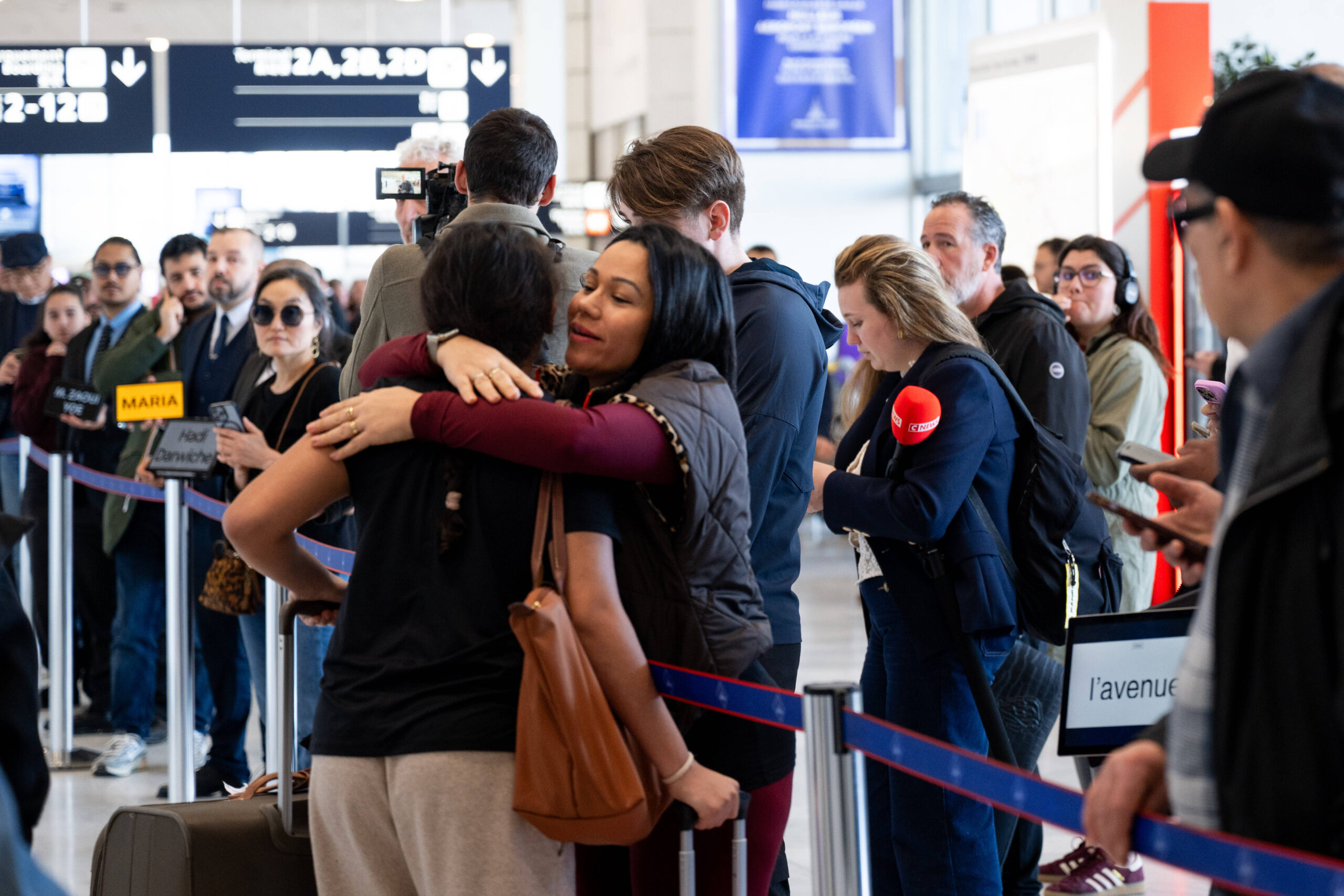
Brussels – “Our priority is the safety of European citizens” in the Middle East, said EU foreign policy chief Kaja Kallas this morning (5 March) upon her arrival in Brussels for an extraordinary meeting of the 27 foreign ministers and representatives of the Gulf Cooperation Council. Since yesterday, the European Commission’s Emergency Response Coordination Centre (ERCC) has organised six repatriation flights to Italy, Austria, Bulgaria, and Slovakia. “Further flights are planned in the coming days,” the Commission said.
Between residents and non-residents, there are hundreds of thousands of European citizens currently in the region, including the Gulf monarchies, Israel, and Jordan. According to figures from the capitals, France faces the most challenging logistical challenge: there are approximately 400,000 French citizens in the Middle East. Italy, which has set up a dedicated task force at the Foreign Ministry, has around 30,000 residents in the Gulf countries, and around 20,000 non-resident Italians are in potentially risky areas throughout the region. The German travellers’ association stated that 30,000 of its compatriots are stranded at airports in the Gulf countries, while Belgium has estimated that there are nearly 26,000 citizens throughout the Middle East, including 2,450 tourists. In addition, there are approximately 30,000 Spanish citizens, 20,000 Irish citizens, 17,000 Austrians (including 2,500 tourists and business travellers), 15,000 Greeks, 14,000 Poles in the United Arab Emirates alone, 5,000 Hungarians, and 2,000 Croatians.
The list is very long. At the beginning of the week, at the Security College meeting convened by Ursula von der Leyen, the Commission announced its intention to “step up support for Member States’ evacuation and repatriation efforts, including through the EU Civil Protection Mechanism and the Emergency Response Coordination Centre (ERCC), in close cooperation with EU delegations.” As of 5 March, ten Member States had already activated the mechanism: Belgium, Bulgaria, the Czech Republic, France, Italy, Cyprus, Luxembourg, Romania, Slovakia, and Austria.
In practical terms, the ERCC coordinates the logistics of flights offered by Member States and is in constant contact with EU delegations and Member States’ consular authorities in the region. In addition to its coordination efforts, the European Commission can cover part of the financial costs of repatriation flights: up to 75 per cent of the costs for flights in which at least 30 per cent of available seats are offered to citizens of Member States other than the one that activated the Civil Protection Mechanism. The Commission can also book flights directly via the rescEU mechanism if none of the 27 Member States can meet a Member State’s request for assistance in evacuating its citizens. In such cases, the Commission can cover 100 per cent of the costs.
English version by the Translation Service of Withub





![La video riunione dell'Eurogruppo [27 marzo 2026. Foto: European Council]](https://www.eunews.it/wp-content/uploads/2026/03/eurogruppo-260327-120x86.jpg)
