



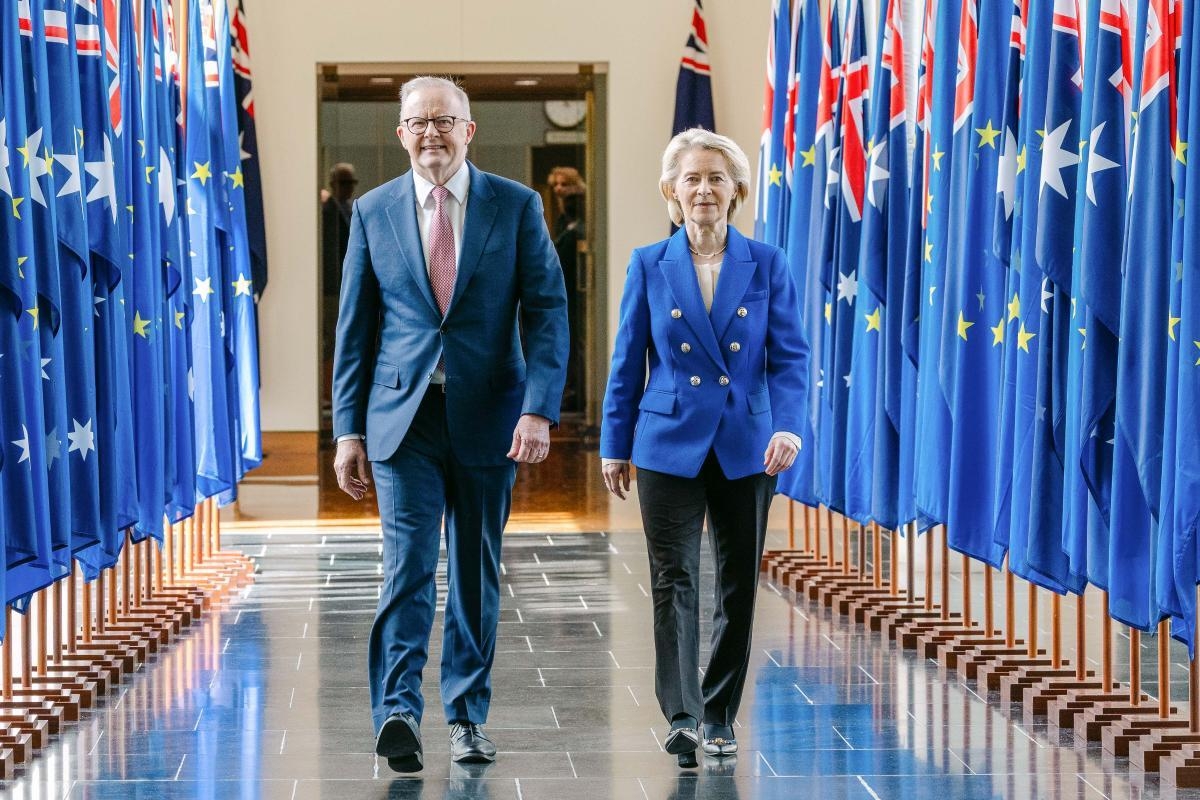
Brussels – The European Union continues to forge partnerships and agreements as part of its strategy to diversify trade, raw material supplies, and defence alliances. This time, it is Australia’s turn. Late last night, in a joint press conference, the President of the European Commission, Ursula von der Leyen, and the Australian Prime Minister, Anthony Albanese, announced that they had concluded negotiations on an EU-Australia Free Trade Agreement and had adopted a new partnership on defence and security. Furthermore, the two leaders also agreed to launch formal talks to discuss Australia’s association with Horizon Europe, the EU’s main research and innovation funding programme. In the official statement from the Commission, the “trade trilogy” is described as a step forward whereby “the EU and Australia are delivering mutually beneficial outcomes and further reinforcing their already close relations in a time of geopolitical uncertainty.”
Discussions on the signing of a new free trade agreement between Brussels and Canberra began in nel 2018, with the latest round of formal negotiations taking place in April 2023. The primary objective of this partnership is to facilitate access for EU products to the Australian market by removing more than 99 per cent of Australian tariffs on European exports (except for certain steel products). Thanks to the massive reduction in tariffs, the Commission estimates a 33 per cent increase in EU exports over ten years and savings for European businesses of around 1 billion euros per year. Key sectors with “strong growth potential” include dairy (expected to increase by up to 48 per cent) motor vehicles (52 per cent), and chemicals (20 per cent). Brussels also announced EU investment into Australia has the potential to grow by over 87 per cent once the agreement is signed.
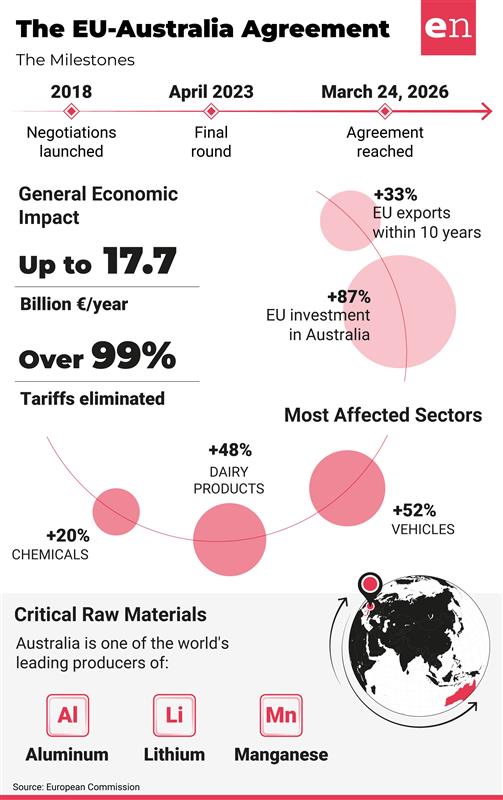
Among the sectors that, according to the Commission, will benefit most from the agreement is the agri-food sector. It is no coincidence – in a reversal of the situation seen during the negotiations for the free trade agreement with Mercosur – the main protests came from Australian farmers. In a context where the EU already records a trade surplus of around 2.4 billion euros (2024 data), the new agreement provides for the complete elimination of tariffs on the main food products that Europe exports to Australia: cheeses, meats, wines and sparkling wines, specific types of fruit and vegetables, chocolate and confectionery will all be able to clear customs without additional duties. As for the food and drink products the EU defines as “particularly sensitive” (beef, sugar, rice, and certain dairy products), the “zero-tariff” regime will apply to limited quotas to protect European farmers once the market is fully open to competition from Canberra. Following the same logic, a bilateral safeguard clause is also envisaged, allowing the EU to take specific measures to protect critical European products “in the unlikely event of a surge in imports from Australia.”
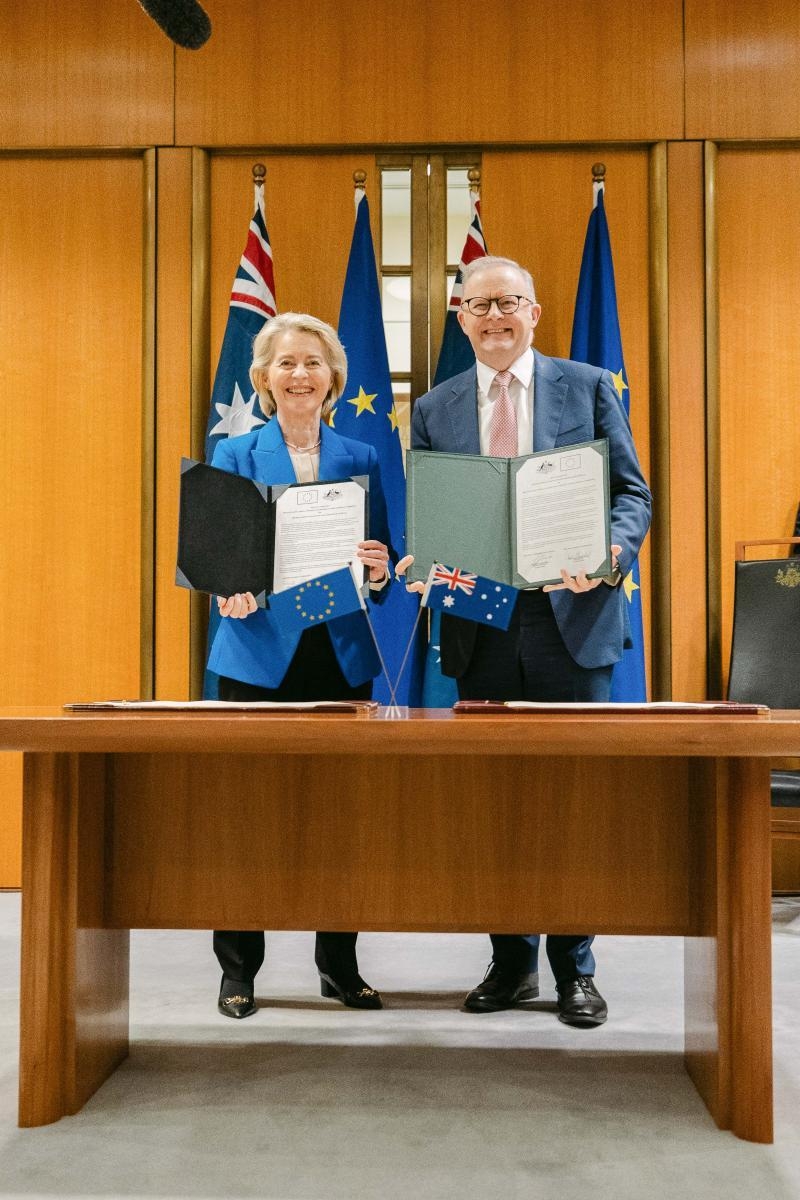
Further measures are planned to ensure the protection of Geographical Indications (GIs), i.e., the protective labels that identify food and wine products from EU countries whose qualities and characteristics depend exclusively on their specific territory of origin. The Commission has given assurances that the agreement will protect the GIs of 165 food products and 231 beverages, including Comté, Irish Whiskey, and Queso Manchego. For some Italian products, however, partial exceptions are planned. This is the case, for example, with Pecorino Romano, whose Australian imitations that use the same name despite not being of Italian origin will be phased out of the market “gradually.” The same fate is expected for Parmigiano and Prosecco, both designations that Aussie companies will be able to continue using freely (in the case of Prosecco, there is talk of the authorisation expiring in ten years’ time): “A solution for protecting the ‘Prosecco’ GI in Australia, preventing Australian producers from exporting wines under this designation after a 10‑year transitional period from the entry into force of the new agreement,” the EU Commission explains.
Turning to EU imports, the agreement contains important provisions on the European supply of critical raw materials, which the Commission has described as “vital for the EU’s overall economic security and competitiveness.” In a context where “demand for these strategic materials is expected to grow significantly, and supply chains are disrupted by sudden economic and geopolitical shocks”, the agreement with Canberra will guarantee Brussels easier access to Australian critical raw materials by lowering the European tariffs currently in force. Capitalising on Australia’s status as one of the world’s leading producers of aluminium, lithium, and manganese, the EU aims to reduce its dependence on China in this sector. Von der Leyen stated this in no uncertain terms in her speech to the Canberra parliament: “Another of the realities that the new world has shown us is that dependencies can be weaponised,” she explained. “Last year, every single EU Member State ran a trade deficit with China…We cannot be overdependent on any supplier for such crucial ingredients. And that is precisely why we need each other,” she added.
Speaking to Australian lawmakers, von der Leyen also explained the reasons behind the EU’s and Australia’s decision to sign the defence and security partnership, which aims to further integrate the defence industry and military cooperation between Brussels and Canberra. “We know that Europe’s security and Indo-Pacific stability are not separate conversations. A crisis in the Indo-Pacific would cripple global trade, directly hitting European industries and growth,” said the head of the European Commission. The broader context in which this partnership is situated – as is also evident from the similar agreement signed with India in January this year – is to place more than one European pawn on one of the most significant regional chessboards of the coming years.
English version by the Translation Service of Withub
![[Credits: AgainErick/Wikimedia Commons]](https://www.eunews.it/wp-content/uploads/2026/02/containers-350x250.jpg)





![La video riunione dell'Eurogruppo [27 marzo 2026. Foto: European Council]](https://www.eunews.it/wp-content/uploads/2026/03/eurogruppo-260327-120x86.jpg)
