



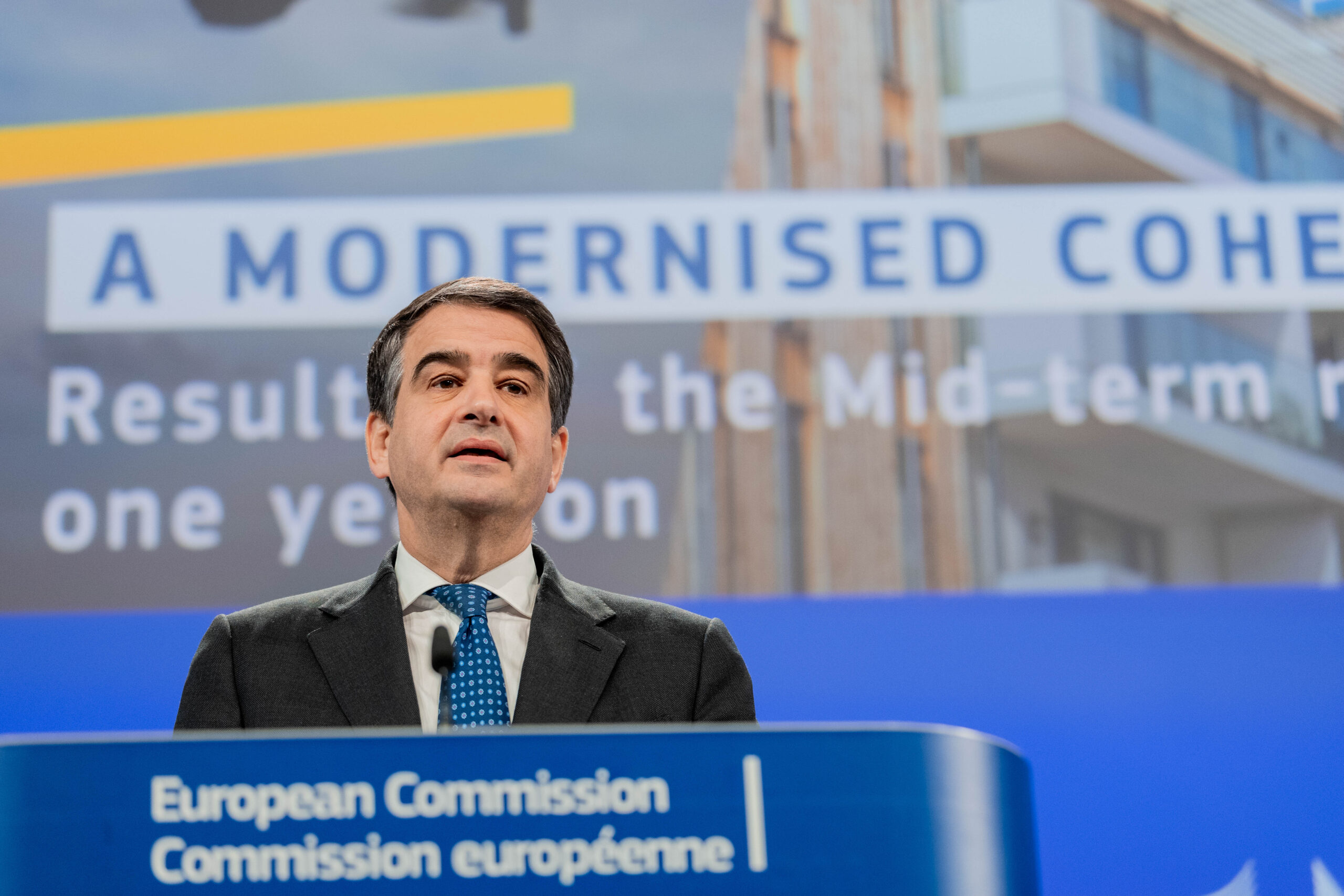
Brussels – The European Union’s Cohesion Policy “is proving its ability to adapt” to a changing world. Raffaele Fitto, Executive Vice-President of the European Commission, outlined today (25 March) the figures of the mid-term review of Cohesion Fund programming for the 2021–2027 period: Member States have amended 186 national and regional programmes, redirecting €34.6 billion towards new priorities. First and foremost, competitiveness and defence: €15.2 billion for the former, €11.9 billion for the latter. The “crumbs” (so to speak) for the housing crisis (€3.3 billion), water resilience (€3.1 billion), and energy security (€1.2 billion).
The possibility of reviewing the allocation of Cohesion Fund resources at the halfway point, thereby adjusting investment priorities over the long term of a multiannual financial framework (seven years), has long been on the agenda. In 2025, however, it has taken on greater significance and urgency: in response to the geopolitical landscape, which has been drastically altered since the programmes were launched in 2021, the European Commission proposed in April 2025 to encourage Member States and regions to redirect investments towards new strategic priorities, offering financial incentives, simplifying policy rules, and extending the implementation period of the amended programmes by one year.
Brussels has set out five priorities: competitiveness, defence (with a particular focus on regions along the eastern border), housing, water resilience, and energy transition. Almost all of them took advantage of this, resulting in the reallocation of almost 10 per cent of the total Cohesion Policy budget, amounting to €367 billion. Only two Member States, Austria and Luxembourg, have not redirected financial resources towards the new priorities.

As for the €15.2 billion reallocated to competitiveness, the Commission explains in a statement that this will enable “increased investment in the STEP platform”, dedicated to clean technologies, in order to “reduce key vulnerabilities and technological dependencies on non-EU countries.” In fact, Brussels had previously included defence among the strategic sectors identified by the STEP platform. Defence already accounts for a third of the reprogrammed funds, of which, as the European Commission further specifies, “a substantial part will strengthen military mobility, particularly along the EU’s military mobility corridors.” The investments “will also support the defence and dual-use industries in the development of technologies, products, and services with applications for both military and civilian purposes,” the note continues.
“This is the right path for cohesion policy,” Fitto declared, urging “Member States to continue making use of these flexibilities”. The countries that made the greatest use of it, in absolute terms, were Poland, Italy, Spain, Portugal, Germany, and Greece. While most funding in Nordic and Eastern European countries bordering Russia, Belarus, and Ukraine has been redirected towards defence, Italy has adopted a different approach.
Out of a total national budget of €42.18 billion for the period 2021–2027, Rome has reprogrammed €7.078 billion: €4.665 billion for the competitiveness of the manufacturing sector, €1.119 billion for housing policies, €629 million for water management, €396 million for the energy transition and €248 million for defence. The reprogramming affected 35 of the 48 active programmes: 28 regional and 7 national.
English version by the Translation Service of Withub






![La video riunione dell'Eurogruppo [27 marzo 2026. Foto: European Council]](https://www.eunews.it/wp-content/uploads/2026/03/eurogruppo-260327-120x86.jpg)
