



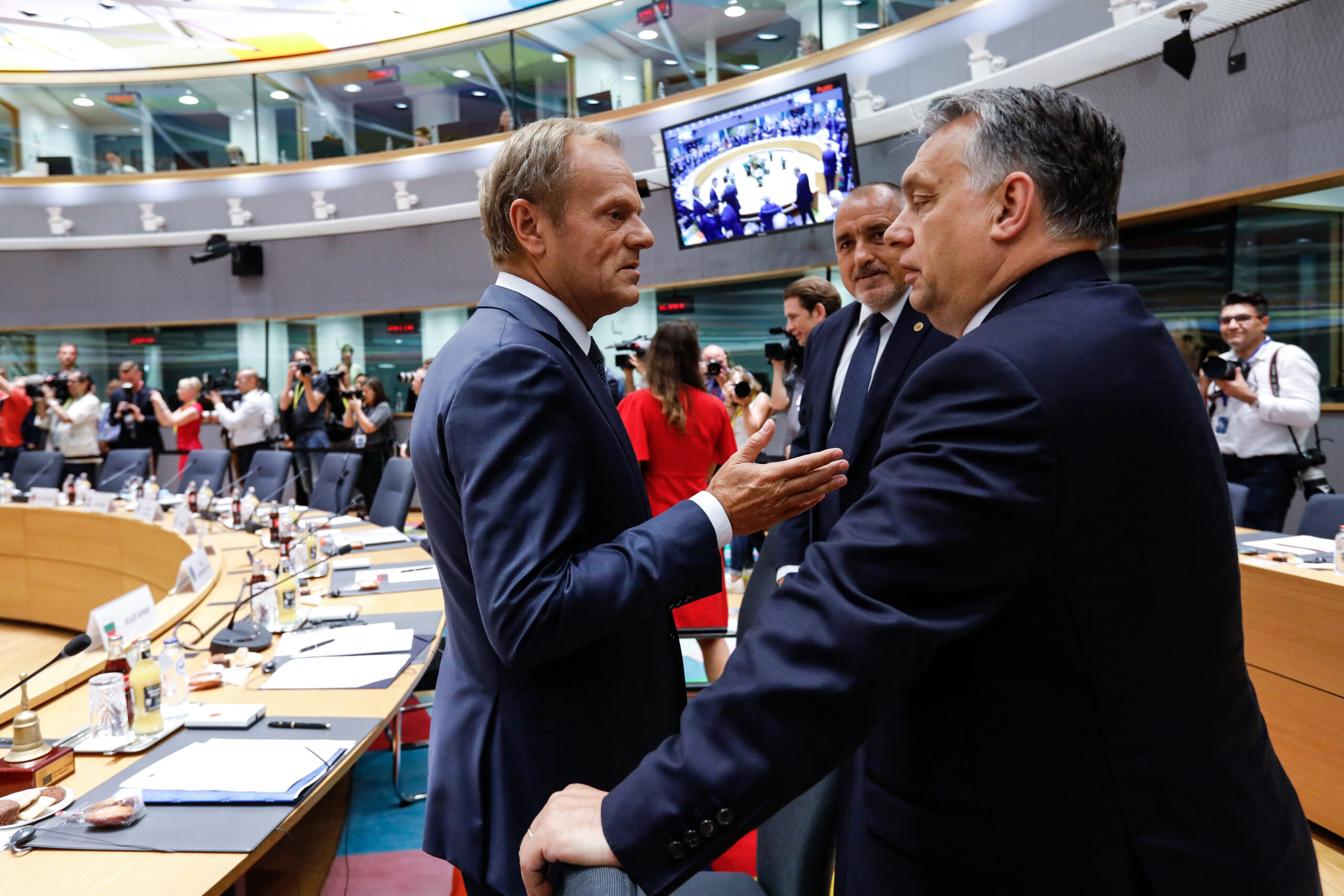
Brussels – Just over a week before the general election in Hungary, the clash between the Polish Prime Minister, Donald Tusk, and the Hungarian Prime Minister, Viktor Orbán, is intensifying. The casus belli is not just the energy issue, with prices and supplies being put at risk by the crisis triggered by the Israeli-US attack on Iran, but, more broadly, Budapest’s veto on EU aid to Kyiv, its whispers of European information towards Moscow, its stance on Russia’s war of aggression against Ukraine and its lack of loyal cooperation with members of the European family. In short, all the dots seem to be connecting, from Ukraine to the Middle East. In a post published this morning (2 April), the Polish leader launched a not-too-veiled criticism of his Hungarian counterpart: “The threat of NATO’s disintegration, the easing of sanctions against Russia, a serious energy crisis in Europe, the suspension of aid to Ukraine and Orbán’s blocking of the loan to Kyiv: it really does seem like Putin’s ideal plan,” wrote Tusk, with a clear reference to the veto that Orbán has been maintaining for several weeks on the new €90 billion package of European aid to Kyiv.
Warsaw’s jab was followed, within a matter of hours, by a response from Budapest. “Europe is facing one of the worst economic crises in its history, and the whole world is grappling with a serious energy crisis,” the Hungarian Prime Minister outlined on X. For this reason, “the only way out is to lift the sanctions imposed on Russian energy sources: we must not think of Putin, but of our country and our people,” he added, before concluding with a provocation directed straight at the Polish leader: “Donald, instead of acting like a warmonger, think about loving and saving your country!”
Today’s post confirms what had already emerged on several occasions in recent weeks, namely that the Hungarian leader’s strategy regarding aid to Kyiv is based on a sort of “quid pro quo“: the green light for the EU loan to Ukraine will only come when Russian oil starts flowing again to Budapest via the Druzhba pipeline, which passes through Ukraine and was damaged by a Moscow drone last January.
In another post on X this morning, the Hungarian Prime Minister reiterated the point. This time, the “scapegoat” was a letter from the European Commission asking Budapest to stop the scheme that ensures Hungarian citizens pay lower fuel prices than those charged to foreigners. After describing the letter from the Berlaymont as “a threatening letter“, Orbán added that “Brussels must understand that Hungary is suffering, both from Ukraine’s blockade of Druzhba and from the global energy crisis knocking at our door.” “We will not allow our families to suffer because of Ukrainian blackmail,” he continued, “and for this reason, Hungary will maintain its fuel price protection scheme: Europe is not an empire ruled by Brussels, and for us, Hungary comes first.”
The incumbent prime minister’s increasingly strident rhetoric coincides with the approach of the parliamentary elections on 12 April, an event at which Orbán will, for the first time, be the underdog after 16 years of unchallenged political dominance. According to a poll published today by the Publicus Institute, Fidesz—Orbán’s party—would secure only 35 per cent of the vote, trailing behind Tisza, the political creation of Peter Magyar, the prime minister’s former ally and now main rival, which is polling at 41 per cent. Despite these figures—confirmed by most polls in recent weeks—the race remains wide open, particularly due to the relatively high proportion of undecided voters (around 24 per cent).
In light of this, it is hardly surprising that the Hungarian election campaign is reverberating far beyond the country’s borders, drawing in political figures and parties at the European level. Today, an event organised by the European Democratic Party (EDP), a transnational, liberal and pro-European group, will be held in Budapest to send a message in defence of Europe against Moscow’s interference in the vote, corruption, and the erosion of democracy. According to the organisers, including the Italian-French MEP Sandro Gozi (Renew Europe), mobilisation is necessary because “non-negotiable values that must be defended” are at stake in this election: sovereignty, security, and the rule of law.
English version by the Translation Service of Withub


![[foto: Wikimedia Commons]](https://www.eunews.it/wp-content/uploads/2026/04/Hormuz_map-120x86.png)

