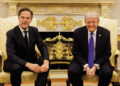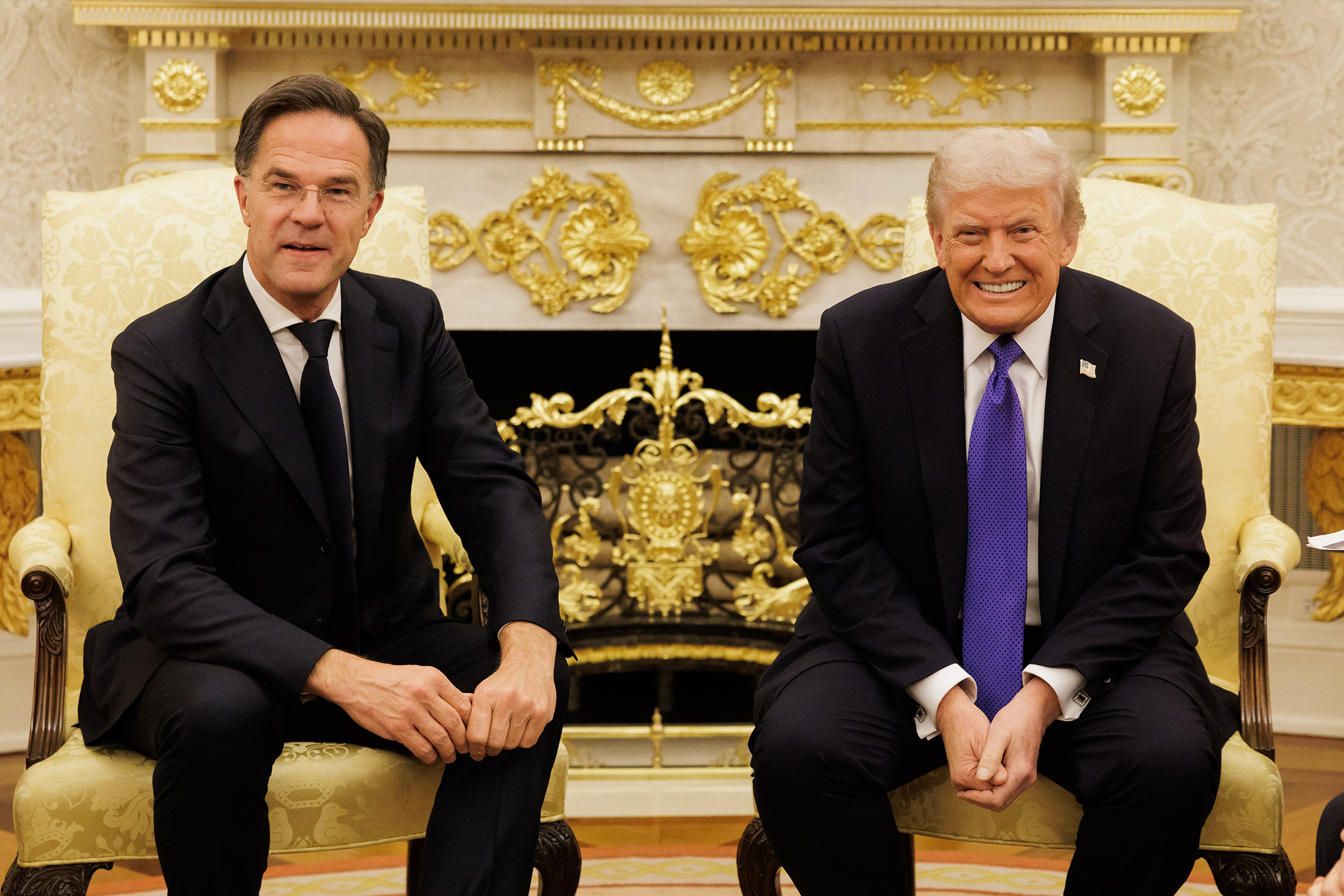
Brussels – Next week will see a face-to-face meeting between the NATO Secretary General and the US President: as announced by NATO, from 8 to 12 April, Mark Rutte will be visiting Washington D.C., where he will meet (on 8 April) Donald Trump, the Secretary of State, Marco Rubio, and the Secretary of War, Pete Hegseth; he will deliver a speech and take part (on 9 April) in a discussion organised by the Ronald Reagan Presidential Foundation Institute; and from 10 to 12 April he will attend the Bilderberg Group meeting.
The meeting will take place against the backdrop of a serious crisis for the North Atlantic Treaty Organisation following Trump’s comments about considering a US withdrawal from NATO. The reason? The allies’ reluctance to join the war launched alongside Israel against Iran on 28 February. Last Wednesday (1 April), Trump told Reuters news agency that he was “seriously considering withdrawal from NATO,” which he had previously described as a “paper tiger” in an interview with The Telegraph. “I’ve never been convinced by NATO. I’ve always known they were a paper tiger,” he stated. And he did not mince his words in making it clear that Washington’s consideration of withdrawal is an “irrevocable” matter due to the allies’ refusal to join the Israeli-American war against Iran. “Ukraine wasn’t our problem, yet we were there for them, but they weren’t there for us,” he said. And Kremlin spokesman Dmitry Peskov, responding at a press conference to a question about a possible US withdrawal from NATO, pointed out that for Moscow it is “a hostile alliance.” “As for NATO, it is a hostile alliance for us. An alliance that regards us as its enemies and adopts hostile measures accordingly,” he explained.
Although Alliance sources are urging calm, pointing out that Trump is no stranger to such provocations, the fact remains that his threats and attacks—ranging from those directed at the British Prime Minister, Keir Starmer, regarding the Royal Navy (“You don’t even have a navy. You’re too old and you had aircraft carriers that didn’t work”) to personal attacks against the French president, Emmanuel Macron (“His wife treats him terribly; he’s still recovering from the punch he received in the face”)—are already fracturing the Atlantic Alliance and prompting responses and reactions from his counterparts on this side of the Atlantic. And Rutte will also have to take this into account in his face-to-face meeting with the tycoon.
In response to Trump’s accusations, Starmer pointed out that NATO is “the most effective military alliance the world has ever seen.” He added: “It has kept us safe for many decades and we are fully committed to NATO.” Meanwhile, Macron stressed that “if doubts are cast on its commitment every day, its substance is undermined”. He pointed the finger at the White House: “It is a responsibility that the American authorities are taking on today by saying every morning that we will do this, that we will not do that, or whatever else.” For the French president, “there is too much talk, and there is confusion”, whilst “we all need stability, calm, a return to peace; this is not a spectacle.” In particular, “we must be serious, and when you want to be serious, you do not say every day the opposite of what you said the day before.”
In any case, for Trump, leaving NATO could prove more complicated than he imagines, given that, although there remains some uncertainty regarding the President’s constitutional powers in matters of foreign policy, he would need a two-thirds majority in the US Senate to withdraw from the Atlantic Alliance. Article 13 of the 1949 NATO Treaty, however, provides that each member state has the option to withdraw after the first twenty years following the Treaty’s entry into force. In practical terms, any member state may formally notify the United States, which is the depositary of the Treaty, of its intention to withdraw, which will take effect one year after notification. Despite Article 13 and internal criticism, and despite tensions or even political parties calling for withdrawal from NATO, no country has ever completed its withdrawal from the Alliance. At least not until now.
English version by the Translation Service of Withub
![[foto: Wikimedia Commons]](https://www.eunews.it/wp-content/uploads/2026/04/Hormuz_map-350x250.png)
![Il commissario per l'Energia, Dan Jorgensen [Bruxelles, 31 marzo 2026. Foto: European Council]](https://www.eunews.it/wp-content/uploads/2026/03/jorgensen-260331-350x250.jpg)