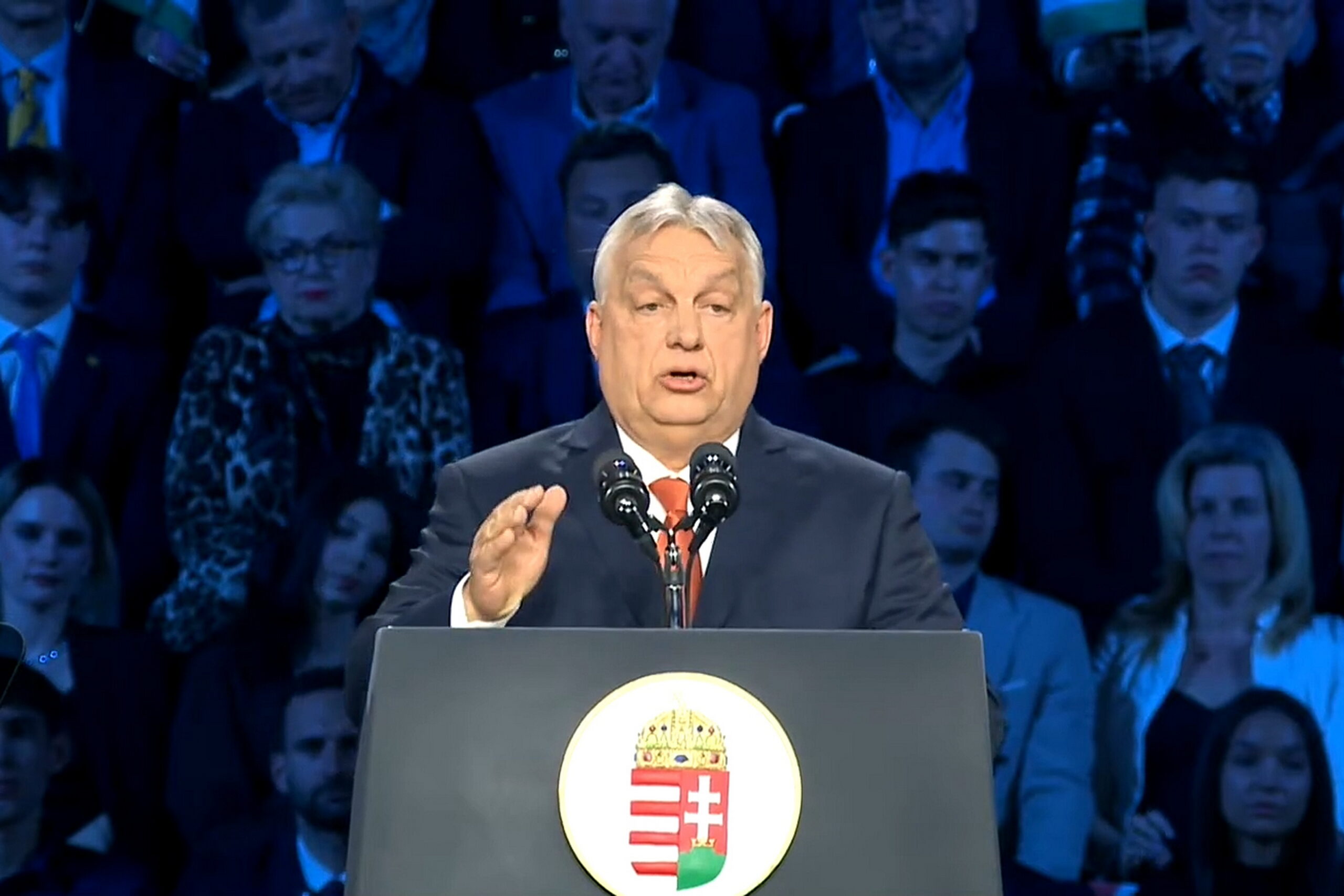
Brussels – Ahead of the Hungarian elections this coming Sunday (12 April), concerns are growing within the European Union that the vote will not be conducted in accordance with the principles of democracy, freedom, and fairness enshrined in the EU treaties. And putting this in writing, in a letter addressed to the President of the European Commission, Ursula von der Leyen, and the Commissioner for Democracy, Justice, the Rule of Law and Consumer Protection, Michael McGrath, are five members of the European Parliament: the rapporteur for the report on the rule of law in Hungary, adopted by the European Parliament last November, the Dutch Tineke Strik (Greens), and the shadow rapporteurs Michal Wawrykiewicz (Polish, EPP), Krzysztof Śmiszek (Polish, S&D), Sophie Wilmes (Belgian, Renew Europe), and Konstantinos Arvanitis (Greek, The Left). “We wish to bring to your attention,” the MEPs begin, addressing von der Leyen and McGrath, “a series of recent developments in Hungary that raise serious doubts as to whether the parliamentary elections in April can take place in a genuinely free and fair electoral environment, in line with the principle of democracy enshrined in Article 2 of the Treaty on European Union.”
The first issue addressed in the letter—and one of the matters that has dominated the final weeks of the election campaign—is that of possible Russian interference in the Hungarian election, aimed not only at “providing covert support for the election campaign of the ruling party Fidesz (the political party founded and led by Viktor Orbán, Prime Minister of Hungary since 2010, ed.),” but also to weaken that of TISZA, the party led by opposition leader Péter Magyar. “All signs,” the letter continues, “of an unbalanced electoral contest and of genuine interference in the opposition’s ability to conduct a campaign safely and effectively.”
Limiting themselves to reporting information cited by “reputable journalistic investigations based on national security sources from various European countries,” MEPs emphasise that the operation is allegedly being run entirely by Russia’s military intelligence service, under the supervision of President Vladimir Putin’s first deputy chief of staff. Indeed, the officials behind the operation are said to be acting directly from the Russian embassy in Budapest, “under diplomatic or service cover.” As Strik pointed out during a press briefing, “this is a scheme very similar to the one Russia already used during the Parliamentary elections in Moldova” in September 2025.
According to the signatories, what is particularly serious in this case is the treatment meted out by the Orbán government to the investigative journalist Szabolcs Panyi, author of the major investigation that uncovered the hidden links between Budapest and Moscow and, according to MEPs, “the subject of state intimidation of unprecedented severity.” A report by the Office for the Protection of Sovereignty (a controversial Hungarian body with powers to investigate potential foreign interference in the country’s political life, which was already the subject of an infringement procedure launched by the European Commission in February 2024, ed.) has designated him as a public enemy, thereby allowing the government to launch criminal proceedings against him for alleged espionage. “All of this,” argue the MEPs, “was accompanied by a public campaign portraying him as a threat to the nation,” despite “Panyi’s long and solid track record of credibly documenting the infiltration of Russian interests into Hungary’s decision-making and political processes, including recent high-level contacts between Hungarian and Russian officials regarding EU sanctions” against certain figures close to the Kremlin.
Another phenomenon that, according to today’s letter, risks undermining the integrity of the electoral process is vote-buying, a practice which Fidesz is said to be carrying out, primarily targeting individuals who are “economically vulnerable and marginalised.” This quid pro quo is said to occur not only through the classic offer of money, but also through “the provision of basic foodstuffs, livestock, or drugs, as well as other forms of coercion such as threats to cut off water or electricity or take away children.” Speaking to journalists, Strik described these behaviours as outright “mafia-like practices that have been going on systematically for a long time” and highlighted the combined effect they produce alongside the numerous electoral reforms that Orbán has implemented over sixteen years of political dominance in order to transform Hungary into an “electoral autocracy”.
“The voting system,” explained Strik, “has been so heavily skewed in favour of the ruling party that TISZA would need to secure at least 3–4 per cent more votes than Fidesz to match its number of seats, and between 5 and 6 per cent to have a sufficient number of MPs to secure a simple majority.”
In light of all this, MEPs argue that the Commission has a duty to ensure that Sunday’s elections are “free, fair, properly monitored, and fully in line with democratic principles. There are many ways to achieve this, ranging from the “immediate use of the
European Centre for Democratic Resilience
and all EU structures for monitoring and analysing disinformation and foreign interference” to “close cooperation with the OSCE (Organisation for Security and Cooperation in Europe) and its Office for Democratic Institutions and Human Rights
(ODIHR).”
“The EU,” the five MEPs conclude, “cannot credibly defend democracy beyond its borders unless it takes action when the integrity of elections within its own borders is seriously called into question.”
English version by the Translation Service of Withub



![[foto: imagoeconomica]](https://www.eunews.it/wp-content/uploads/2023/02/Imagoeconomica_400022.jpg)