
- Europe, like you've never read before -
Friday, 5 December 2025
No Result
View All Result
  • it ITA
  • en ENG
Eunews
  • Politics
  • World
  • Business
  • News
  • Defence
  • Net & Tech
  • Agrifood
  • Other sections
    • Culture
    • Diritti
    • Energy
    • Green Economy
    • Finance & Insurance
    • Industry & Markets
    • Media
    • Mobility & Logistics
    • Sports
  • Newsletter
  • European 2024
    Eunews
    • Politics
    • World
    • Business
    • News
    • Defence
    • Net & Tech
    • Agrifood
    • Other sections
      • Culture
      • Diritti
      • Energy
      • Green Economy
      • Finance & Insurance
      • Industry & Markets
      • Media
      • Mobility & Logistics
      • Sports
    No Result
    View All Result
    Eunews
    No Result
    View All Result

    Home » Politics » Germany faces advance of far-right parties and farmer protests

    Germany faces advance of far-right parties and farmer protests

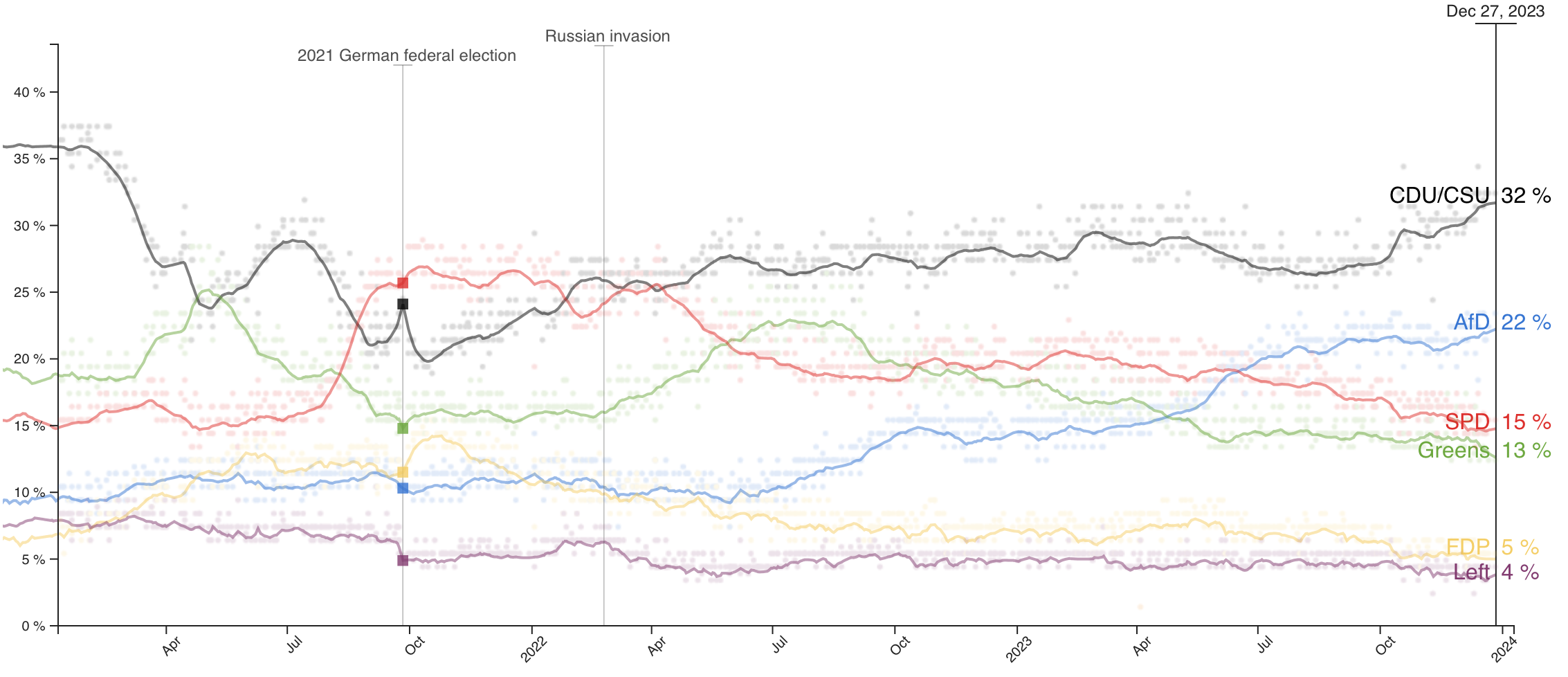
    Germany's ruling 'traffic light coalition' (Social Democrats-Liberals-Greens) is in crisis, with polls showing the Alternative für Deutschland at 22 percent of voting intentions. Political fragmentation increases with new parties seeking support from the disgruntled electorate, primarily the agricultural sector

    Federico Baccini</a> <a class="social twitter" href="https://twitter.com/@federicobaccini" target="_blank">@federicobaccini</a> by Federico Baccini @federicobaccini
    9 January 2024
    in Politics
    Germania Proteste

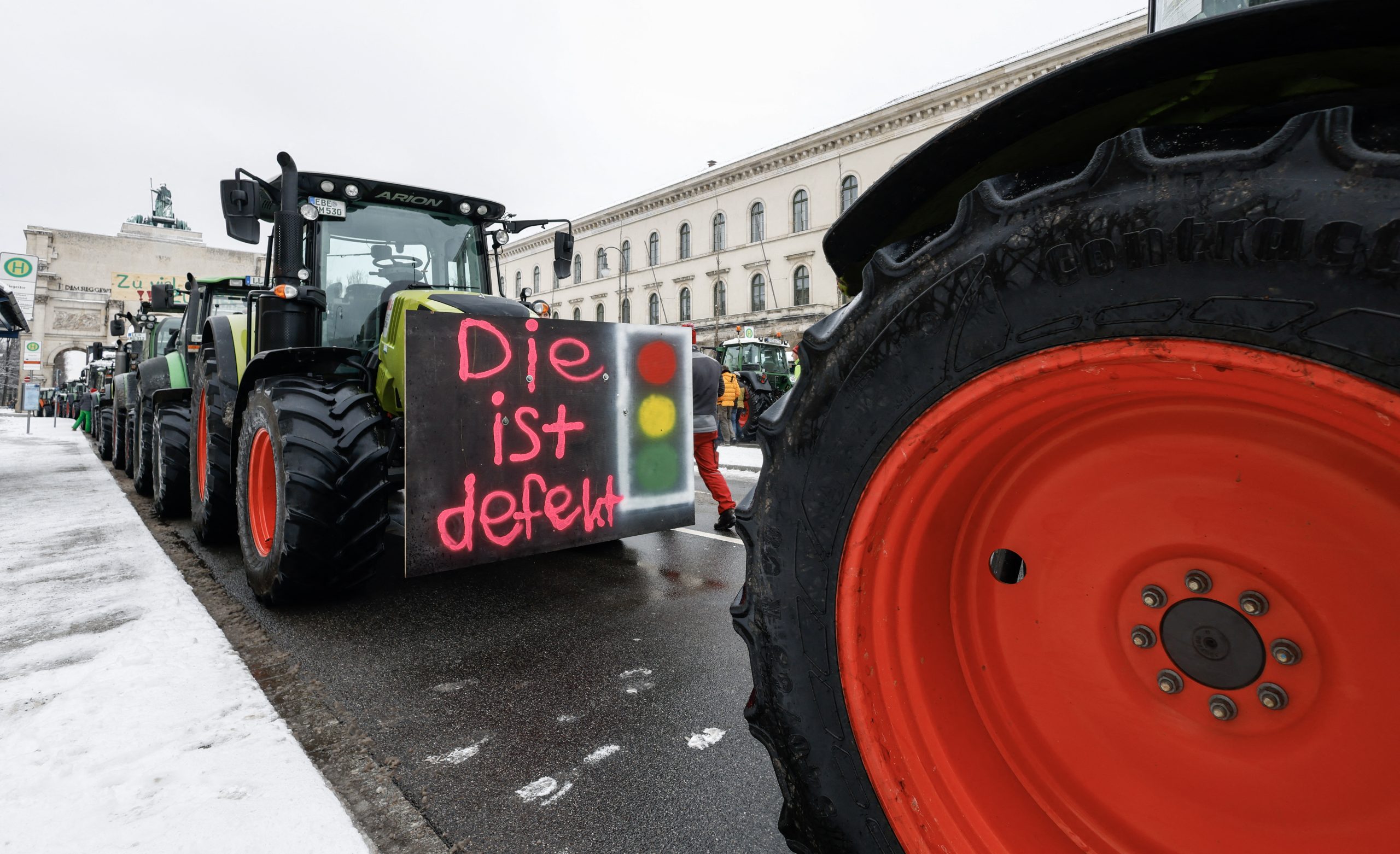
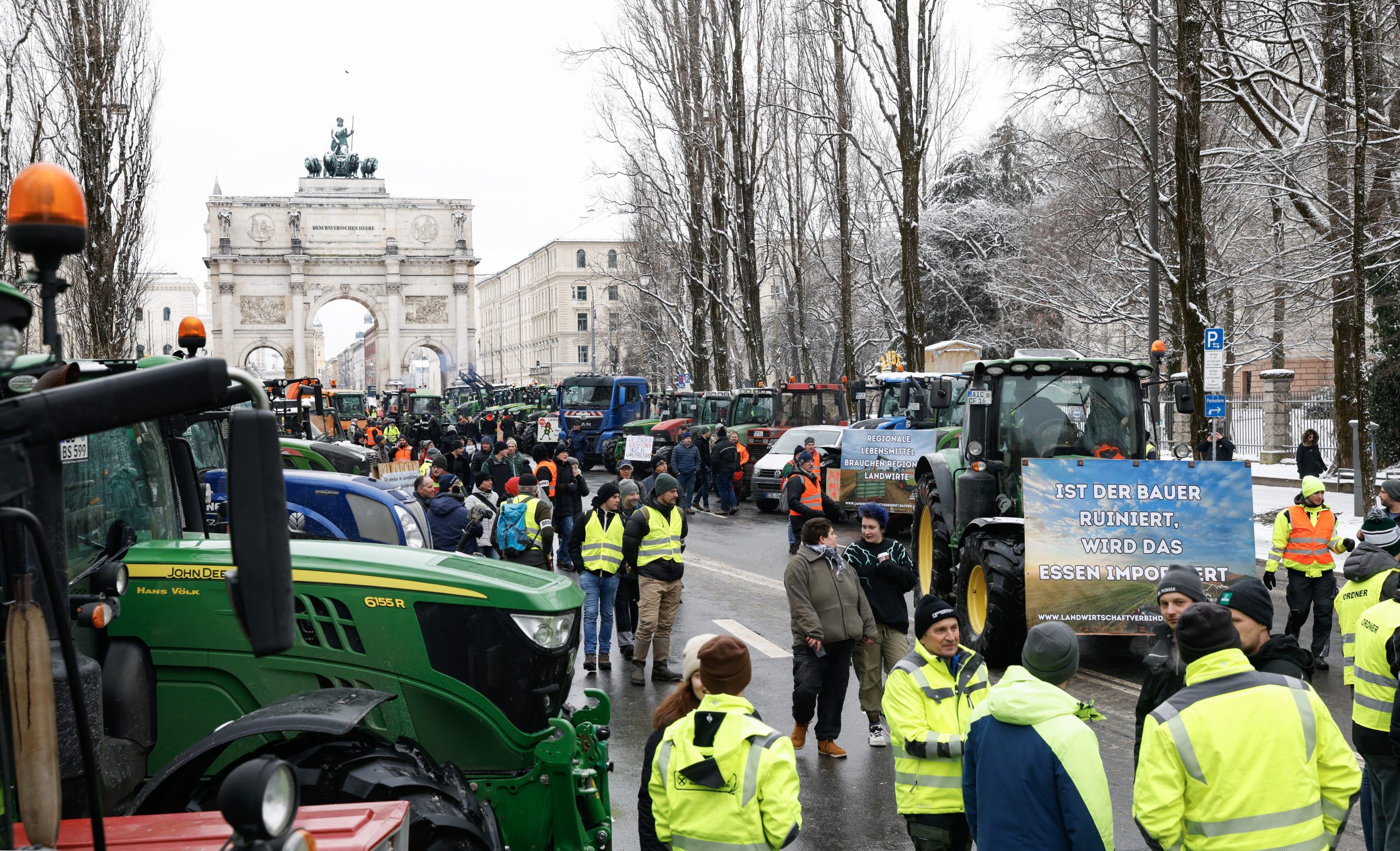
    Farmers have attached a placard reading "The redlight is broken (refering to the "Ampel", meaning the coalition government)" on a tractor standing at Odeonsplatz square in the city center to take part in protests against the federal government's austerity plans in Munich, southern Germany, on January 8, 2024. The German government on January 4, 2024 had dropped part of its plans to cut agricultural subsidies in the face of massive protests from farmers. Contrary to the initial plans, a discount on the vehicle tax for agricultural machinery would be maintained, the government's spokesman said in a statement. (Photo by MICHAELA REHLE / AFP)

    Brussels – “The traffic light is broken.” Germany enters the European election year with one of the most worrying slogans for pro-European forces, as reported by posters of German farmers who took to the streets in most parts of the country yesterday (Jan. 8), the first day of a week of protests against the government led by Olaf Scholz. A very harsh protest that comes in the midst of not only an economic but also a political crisis for the so-called traffic light coalition – comprising the Social Democrats of the SPD (red), the Liberals of the FDP (yellow), and the Greens. In a fragmented picture on the German political chessboard, with elections for the renewal of the European Parliament five months away, all three governing parties collapsed since the fall  of 2021, while the popularity of the popular but especially the extreme right is skyrocketing.
    Germany Protests Berlin
    German farmers’ protests in Berlin on Jan. 8, 2024 (credits: Michaela Rehle / Afp)

    The farmers’ protest against the traffic light coalition’s plan to phase out diesel tax breaks clearly demonstrates the difficulties the Scholz government has in intercepting and responding to the demands of the electorate in Germany. The executive had to introduce the cuts in the 2024 draft budget after the Supreme Court halted the previously approved one in November. The government toned down initial proposals to cut all tax breaks for farmers but, despite this, there continues to be controversy from the agricultural sector, which denounces the risk of survival for professionals with low profit margins due to the elimination of diesel tax breaks. Chancellor Scholz, however, refused to receive further demands, sparking discontent among farmers and fueling street protests.

    German authorities, however, fear that the far right could exploit these protests to rekindle social tension in Germany. “Right-wing extremists and other enemies of democracy are trying to infiltrate and instrumentalize the protests,” Interior Ministry led by Social Democrat Nancy Faeser warned, just days after one of the most disturbing episodes in the country’s recent history. On Thursday (Jan. 4), farmers prevented Germany’s vice-chancellor and minister of economic affairs, Robert Habeck, from getting off a ferry in Schlüttsiel (Schleswig-Holstein) as he was coming back from vacation. “There is a risk that the debate could become more and more brutal, undermining the law and the rule of law,” the German Greens’ co-chair warned. The Farmers’ Association distanced itself from the episode, condemning the incident involving Minister Habeck and ruling out collaboration with the far right: “At our demonstrations we do not want radical groups who wish to overthrow the government. We are democratic,” the organization’s president, Joachim Rukwied assured.

    The fragmented political scenario in Germany

    Yet it is to the right that one must look if one wants to analyze the political and social tension in Germany, which is dealing with the consequences of rising energy prices and economic recession. After decades of stability led by the traditional center parties – Christian Democrats and Social Democrats – since the establishment of the unprecedented traffic light coalition, the political scene has become increasingly fragmented, and it seems that the extremist forces can take advantage of the German crisis. The collapse of the three governing parties is striking if one compares the results of the September 26, 2021, national elections with the polls two and a half years later: The Social Democrats collapsed to 15 percent (-11 percentage points), the Liberals to 5 (-7) and the Greens to 13 (-2), which would bring the coalition as a whole to a -20 percent of voter preferences. Only the popular center-right of the Christian Democratic Union progressed — at 32 percent according to polls (+8 points) — but, more importantly, the far-right nationalists of Alternative für Deutschland, now considered  the second-largest party at 22 percent (+12).

    semaphore coalition germany

    Middle: German Chancellor, Olaf Scholz, on the day the traffic light coalition was established (Nov. 24, 2021)

    Although these polls will have to be tested at the ballot box, this trend has now been going on for months in Germany and already in elections of some Länder, votes increasingly turned to the right: at the Hesse and Bavaria elections on October 9, the AfD made its first political leap forward, while the Social Democrats, Liberals, and Greens all suffering significant defeats. Three former East German states – Brandenburg, Thuringia, and Saxony – will go to the polls this year and the far-right party is leading in all three. But the main focus should be on the European Parliamentary elections in June, when not only the AfD will test its electoral strength, but also new emerging parties looking to fish in the same vote pool.

    The latest is – paradoxically – the one launched yesterday by one of the best-known faces of the German far left, Sahra Wagenknecht, former leader of Die Linke. She promises to save democracy in the European Union’s largest economy from the threat posed by the exponential growth of far-right parties by trying to intercept the same voters who are abandoning traditional centrist parties. The new party – the Sahra Wagenknecht’s Alliance (BSW), named after its founder – aims to reverse Germany’s course on unpopular initiatives of the Scholz government, such as environmental ones, but also on arms supplies to Ukraine, reducing the number of migrants, and improving State services. Then, on the other side of the political chessboard, there are the words of the former head of Germany’s national intelligence agency and former CDU,  Georg Maaßen, who is ready to launch a new party (on the right) with a program that is not too different from that of the parties from which it wants to subtract voters. “What I notice with Wagenknecht, but also with the AfD, is that they talk freely about the problems we have in Germany,” Maaßen said. While the federal and regional elections have a 5 percent threshold, this obstacle does not exist in European elections. “They are very important because they will send a political signal at the national level,” Wagenknecht explained.
    Sondaggi Germania 2024

    English version by the Translation Service of Withub
    Tags: alternative for germanyfarmersgerman rightolaf scholztraffic light coalition

    Related Posts

    No Content Available
    map visualization
    US President Donald Trump gives a thumbs up as he departs the stage during the signing ceremony of a peace deal with the President of Rwanda Paul Kagame and the President of the Democratic Republic of the Congo Felix Tshisekedi at the United States Institute of Peace in Washington, DC, on December 4, 2025. Trump on Thursday brings the leaders of Rwanda and the Democratic Republic of Congo together to endorse a deal that Trump has hailed as his latest peace triumph despite ongoing violence on the ground. Trump hopes the agreement will pave the way for the United States to gain access to critical minerals in the eastern DRC, a violence-torn region home to many of the key ingredients in modern technologies such as electric cars. (Photo by ANDREW CABALLERO-REYNOLDS / AFP)

    The US wants to “cultivate resistance” to Europe’s decline. No comment from Brussels

    by Simone De La Feld @SimoneDeLaFeld1
    5 December 2025

    The National Security Strategy outlined by the Trump administration is a slap in the face to Europe, which risks the...

    OPERAIO ANZIANO OPERAI ANZIANI LAVORO FABBRICA PRODUZIONE GENERATE AI IA

    Italians to Meloni: ”No to raising retirement age”

    by Emanuele Bonini emanuelebonini
    5 December 2025

    The latest Eurobarometer survey sees a clear opposition to working more. Majority called for reforming work and health, strengthening the...

    Italian, EU, NATO and Latvian flags are lined up ahead of the mmeeting of the Italian and Latvian Prime Ministers in Riga on July 10, 2023. (Photo by Gints Ivuskans / AFP)

    ICE listens to Europe: “NATO’s new procurement policy and procedures”

    by Redazione eunewsit
    5 December 2025

    For the director of the Brussels Office, Tindaro Paganini, "it is essential that Italian companies are fully aware" of the...

    ANDREJ BABIŠ MEMBRO DELLA CAMERA DEI DEPUTATI DELLA REPUBBLICA CECA LEADER ANO

    Czech Republic: Andrej Babiš solves his conflict of interest; he’s no longer ‘Babisconi’

    by Enrico Pascarella
    5 December 2025

    The future prime minister has announced that he will dispose of the shares in his multinational company Agrofert. One hundred...

    • Director’s Point of View
    • Letters to the Editor
    • Opinions
    • About us
    • Contacts
    • Privacy Policy
    • Cookie policy

    Eunews is a registered newspaper
    Press Register of the Court of Turin n° 27


    Copyright © 2025 - WITHUB S.p.a., Via Rubens 19 - 20148 Milan
    VAT number: 10067080969 - ROC registration number n.30628
    Fully paid-up share capital 50.000,00€


    No Result
    View All Result
    • it ITA
    • en ENG
    • Newsletter
    • Politics
    • World politics
    • Business
    • General News
    • Defence & Security
    • Net & Tech
    • Agrifood
    • Altre sezioni
      • European Agenda
      • Culture
      • Diritti
      • Energy
      • Green Economy
      • Gallery
      • Finance & Insurance
      • Industry & Markets
      • Letters to the Editor
      • Media
      • Mobility & Logistics
      • News
      • Opinions
      • Sports
    • Director's Point of View
    • L’Europa come non l’avete mai ascoltata
    • Draghi Report
    • Eventi
    • Eunews Newsletter

    No Result
    View All Result
    • it ITA
    • en ENG
    • Newsletter
    • Politics
    • World politics
    • Business
    • General News
    • Defence & Security
    • Net & Tech
    • Agrifood
    • Altre sezioni
      • European Agenda
      • Culture
      • Diritti
      • Energy
      • Green Economy
      • Gallery
      • Finance & Insurance
      • Industry & Markets
      • Letters to the Editor
      • Media
      • Mobility & Logistics
      • News
      • Opinions
      • Sports
    • Director's Point of View
    • L’Europa come non l’avete mai ascoltata
    • Draghi Report
    • Eventi
    • Eunews Newsletter

    Attention