- Europe, like you've never read before -
Thursday, 16 April 2026
No Result
View All Result
  • it ITA
  • en ENG
Eunews
  • Politics
  • World
  • Business
  • News
  • Defence
  • Health
  • Agrifood
  • Other sections
    • Culture
    • Diritti
    • Energy
    • Green Economy
    • Finance & Insurance
    • Industry & Markets
    • Media
    • Mobility & Logistics
    • Net & Tech
    • Sports
  • Newsletter
  • European 2024
    Eunews
    • Politics
    • World
    • Business
    • News
    • Defence
    • Health
    • Agrifood
    • Other sections
      • Culture
      • Diritti
      • Energy
      • Green Economy
      • Finance & Insurance
      • Industry & Markets
      • Media
      • Mobility & Logistics
      • Net & Tech
      • Sports
    No Result
    View All Result
    Eunews
    No Result
    View All Result

    Home » Politics » Disinformation boom threatens European elections. EU sanctions four more Russian media outlets

    Disinformation boom threatens European elections. EU sanctions four more Russian media outlets

    With one month to go before the election, there is "a noticeable increase in both the quantity and quality of disinformation campaigns" related to EU policies and its institutions. According to the Digital Media Observatory, they account for 11 per cent of the total disinformation in Europe

    Simone De La Feld</a> <a class="social twitter" href="https://twitter.com/@SimoneDeLaFeld1" target="_blank">@SimoneDeLaFeld1</a> by Simone De La Feld @SimoneDeLaFeld1
    15 May 2024
    in Politics
    disinformazione

    This photograph shows a giant poster announcing the upcoming European elections, stucks on the facade of the European Parliament building, in Strasbourg, eastern France, on May 8, 2024. (Photo by SEBASTIEN BOZON / AFP)

    Brussels – The EU has never been such a target of disinformation. Nor has it ever been so afraid of it. A senior EU official sounded the alarm: “We see a noticeable increase in both the quantity and quality of these campaigns.” With the European elections less than a month away, Brussels has deployed its bodyguards: the European External Action Service in the forefront, but also the Digital Media Observatory (EDMO) and entry into force of the Digital Services Act, the European law regulating the management and removal of illegal content online.

    “There is a risk, and we want to be prepared,” the source explains. The threat has a name and a surname: it is the Kremlin’s propaganda machine, the main disinformation actor, according to EU intelligence. Just today (May 15), the ambassadors of the 27 member countries approved new sanctions against four Russian media in light of their disinformation activities. These are reportedly the Voice of Europe, Ria Novosti, Izvestia, and Russia Gazeta, joining 14 others affected by broadcast bans (including cable, satellite, Internet Protocol TV, platforms, websites and apps) and suspension of licenses in member countries. Some EU states, however, don’t have implemented the sanctions yet, not even those decided against Sputnik and Russia Today in the aftermath of the invasion of Ukraine.
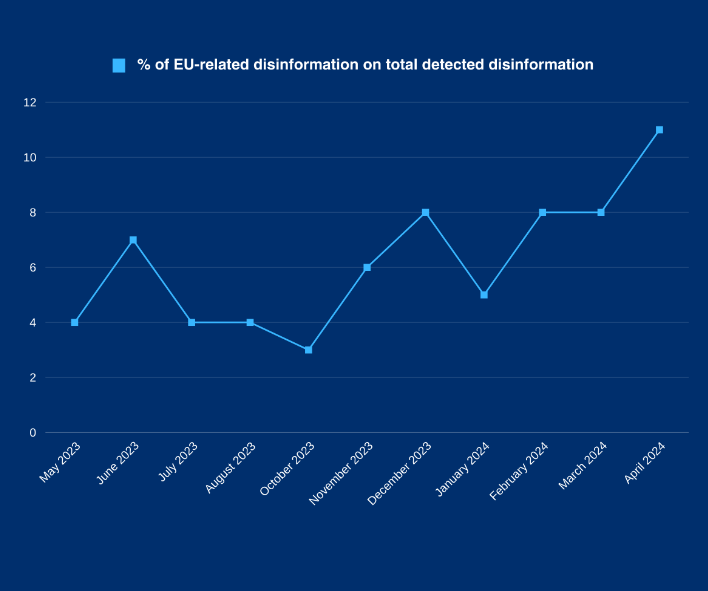
    Source: Edmo

    Although preventive actions taken by the EU suggest otherwise, “we do not assume, at least from today’s indicators, that there will be such a massive information manipulation campaign for the elections,” the source further explains. The fact remains that the EU Digital Media Observatory has found, from January onward, a growing trend in disinformation related to EU policies or its institutions. In April, according to Edmo, it amounted to 11 per cent of total detected disinformation, “the highest value for EU-related disinformation since our dedicated monitoring began in May 2023.”

    In recent years, the EEAS reportedly identified more than 17 thousand cases of misinformation, a “growing trend,” but “only the tip of the iceberg” because “the more you look, the more you find.” In general terms, disinformation campaigns “are never built on a totally invented issue” but “exploit an existing debate” and “internal discontent.” Indeed, the most frequently used narratives are those related to Ukraine, climate, migration, and the LGBTQI+ community. And “we expect them to increase in the coming days.”

    The problem is that, along with the EU’s ability to detect information manipulation campaigns, “techniques have also improved for disinformers. Who are increasingly using more powerful tools such as artificial intelligence” and launching cross-campaigns “simultaneously on multiple platforms.” One example is the Russian-influenced operation unmasked back in May 2022, codenamed Doppelganger, which consisted of cloning several authentic media websites—including Build, Ansa, and The Guardian—on which to offer articles, videos, and generally fake news. Edmo’s investigations also revealed the affair of “Pravda” domains, activated within a week in 19 member countries and in Spanish, English, German, French, Czech, and Italian. A network of coordinated publications always using the same type of sources, the Moscow-controlled news agencies.

    The European Commission has also raised the alert to the highest level, building its policy against disinformation on three pillars: in addition to Edmo, there is a code of practice on disinformation currently signed by 44 stakeholders, including online platforms, trade associations, and advertising industry players, and most importantly, since February the EU Digital Services Act has come into force which deals not only with possible foreign influences but with all “systemic risks.”

    English version by the Translation Service of Withub

    Tags: european electionseuropean2024misinformation

    Related Posts

    Mercati Digitali Social Media influencer
    General News

    EU Council: “Train influencers to protect them, and citizens, from fake news”

    14 May 2024
    sputnik
    Politics

    Sputnik and other Russian propaganda sites still active in the EU a month before the elections, despite being prohibited two years ago

    8 May 2024
    Roberta Metsola Parlamento Ue Elezioni Europee
    Politics

    Metsola against disinformation and extremists at European elections: “We know how to stop them, we are not afraid”

    3 April 2024
    moscagate
    Politics

    “Moscowgate,” another scandal rattles the European Parliament two months before European elections

    2 April 2024
    map visualization

    Bulgaria votes again: Rumen Radev leading amid anti-corruption rhetoric and allegations of pro-Putinism

    by Giorgio Dell'Omodarme
    16 April 2026

    In what will be the eighth election in five years, the coalition led by the former President of the Republic...

    Tabacco, mercato illecito, Parlamento europeo

    Clash in the European Parliament over the illicit tobacco market: a real problem or an overreaction?

    by Annachiara Magenta annacmag
    16 April 2026

    Experts Hana Ross and Kristijan Fidanovski argue that "the only annual estimates of illicit rates we have are commissioned by...

    I vigili del fuoco lavorano tra le macerie di una sezione di un condominio di nove piani nel quartiere di Sviatoshynskyi, distrutto dall'attacco missilistico e con droni russi a Kiev, il 31 luglio 2025. Sei persone sono morte nella capitale, tra cui un bambino di sei anni e sua madre, e decine sono rimaste ferite. Fonte: Ipa Agency (Foto di Danylo Antoniuk/Ukrinform) (Foto di Ukrinform/Ukrinform/Sipa USA)

    The EU following Russian attacks on Ukrainian cities: “We will step up the pressure on Moscow”

    by Giulia Torbidoni
    16 April 2026

    A delegation of European Commission officials will be in Budapest tomorrow to discuss various issues with the incoming post-Orbán government....

    Christine Lagarde arrives at the Governing Council meeting prior to the ECB press conference on 19 March 2026 in Frankfurt.

    ECB: “Rates unchanged in March, a decision driven by prudence and responsibility”

    by Emanuele Bonini emanuelebonini
    16 April 2026

    In the minutes of its latest meeting, the Governing Council of the European Central Bank emphasises the importance of its...

    • Director’s Point of View
    • Opinions
    • About us
    • Contacts
    • Privacy Policy
    • Cookie policy

    Eunews is a registered newspaper
    Press Register of the Court of Turin n° 27


    Copyright © 2025 - WITHUB S.p.a., Via Rubens 19 - 20148 Milan
    VAT number: 10067080969 - ROC registration number n.30628
    Fully paid-up share capital 50.000,00€


    No Result
    View All Result
    • it ITA
    • en ENG
    • Politics
    • Newsletter
    • World politics
    • Business
    • General News
    • Defence & Security
    • Health
    • Agrifood
    • Altre sezioni
      • Culture
      • Diritti
      • Energy
      • Green Economy
      • Gallery
      • Finance & Insurance
      • Industry & Markets
      • Media
      • Mobility & Logistics
      • Net & Tech
      • News
      • Opinions
      • Sports
    • Director’s Point of View
    • Draghi Report
    • Eunews Newsletter

    No Result
    View All Result
    • it ITA
    • en ENG
    • Politics
    • Newsletter
    • World politics
    • Business
    • General News
    • Defence & Security
    • Health
    • Agrifood
    • Altre sezioni
      • Culture
      • Diritti
      • Energy
      • Green Economy
      • Gallery
      • Finance & Insurance
      • Industry & Markets
      • Media
      • Mobility & Logistics
      • Net & Tech
      • News
      • Opinions
      • Sports
    • Director’s Point of View
    • Draghi Report
    • Eunews Newsletter

    Attention