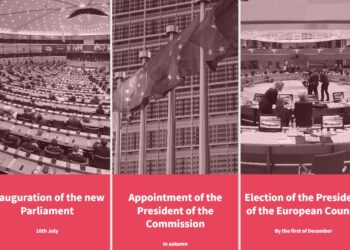
Brussels – Europe’s most anticipated election week has begun. Between June 6 and June 9, citizens of the 27 EU member states will go to the polls in European elections to determine the new composition of the EU Parliament during the 10th legislature. However, for a third of the member states, the focus will be on the power relations and internal balances that will emerge not only from this election but also from a whole range of national, regional and local votes. In Belgium, Bulgaria, Cyprus, Germany, Ireland, Italy, Malta, Romania, and Hungary, the national parties have much at stake, both for the MEPs who will be elected in Brussels and those who will lead the institutions in their countries after the elections.
Belgium
Belgium will be the special focus for political balances throughout the Union, particularly the European electorate’s progressive slip toward the far right (as demonstrated in the neighbouring Netherlands). June 9 will see federal and regional elections to choose the 150 representatives of the Chamber of Deputies and those of the Flemish Parliament, the Walloon Parliament, the Brussels-Capital Parliament, the German-speaking Community Parliament, and the French Community Parliament.

On the eve of the elections, the far-right Flemish nationalist party Vlaams Belang is polled at 27 per cent of voting intentions in Belgium’s most populated region, with the possibility of becoming the leading party in the Chamber of Deputies—and thus decisive for the next federal government—appearing increasingly likely. Vlaams Belang, a close ally at the European level of the French Rassemblement National and the Dutch Party for Freedom (within the Identity and Democracy Party), wants to push the conservatives of the New Flemish Alliance to support Flanders’ independence.
Bulgaria
After not even a year of apparent political calm, Bulgaria has plunged into the black hole of early elections for the umpteenth time since late March. Next June 9, legislative elections will be held for the sixth time in just over three years, seeking a sufficiently solid majority in the National Assembly to ensure the formation of a long-lasting government. In reality, polls show little change in terms of power relations between parties, with the centre-right of GERB (Citizens for the European Development of Bulgaria) at around 27 per cent and the liberals of Let’s Continue the Change – Democratic Bulgaria at 15, on a par with the pro-Russian and anti-European nationalists of Vazrazhdane (who would like to form a new far-right group with the Germans of Alternative für Deutschland in the EU Parliament).
Cyprus
In addition to the European elections, Cyprus will also go to municipal elections on June 9 to appoint mayors, deputy mayors, city councillors, and presidents of district local government organizations. After the local government reform awaited since December 2021, the scenario on the European side of the island remains somewhat uncertain, with the party of the President of the Republic, Nikos Christodoulides, trying to forge alliances to cut off both the far left of Akel (Progressive Workers’ Party) and the far right of Elam (National Popular Front). However, according to polls, the populars of DISY (Democratic Regrouping) are vying for first place in a 28 per cent head-to-head with the far left of Akel. In the country’s various cities and municipalities, the electoral performance of the centre-left of DIKO (Democratic Party) and the liberals of DIPA (Democratic Alignment) will be decisive.
Germany
There are seven German
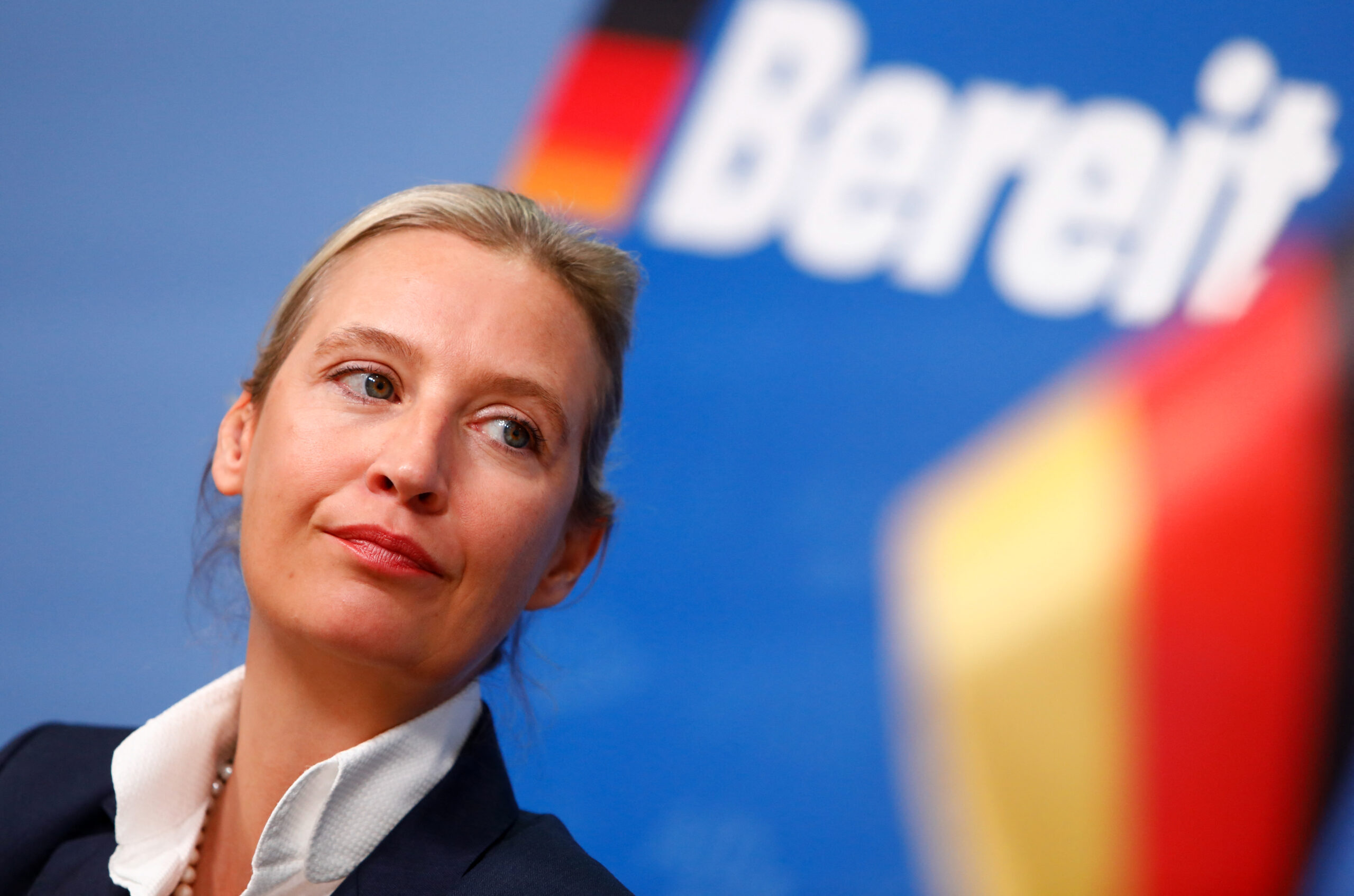
Länder (federal states) that will see their citizens go to the polls for the municipal elections on June 9: Baden-Württemberg, Brandenburg, Mecklenburg-Western Pomerania, Rhineland-Palatinate, Saarland, Saxony, and Saxony-Anhalt. None of these will be state-level consultations (the next one will take place on Sept. 1 in Saxony). Still, attention must be paid to the electoral performance of the far-right Alternative für Deutschland, especially in four of the five states that once made up former East Germany (Brandenburg, Mecklenburg-Western Pomerania, Saxony, and Saxony-Anhalt), where AfD has found a particularly solid pool of votes. After reaching 22 per cent at the end of 2023 and stumbling both at the national and European level, the party led by Tino Chrupalla and Alice Weidel has dropped, according to the latest polls, to 15 per cent. A defeat at the local level in some of its strongholds could be a major blow at the political level.
Ireland
Ireland will also see a parallel vote to the European elections: the local elections on June 7 will determine the distribution of the 949 city and county council seats. Two thousand one hundred sixty-nine candidates will compete in 166 constituencies across the Republic, with the polls predicting a head-to-head contest between the centre-right Fine Gael party of the new Taoiseach (head of government), Simon Harris, and the left-wing opposition Sinn Féin party (first at 25 per cent).
Italy

There is great attention in Italy for the outcome of the ballot box between June 8 and June 9, when all citizens will be called to vote for the composition of the new European Parliament, but nearly 17 million also for the election of mayors, city councillors and the new President of the Piedmont Region (any runoffs in municipalities with more than 15,000 inhabitants will take place between June 23 and 24). Nearly half of Italy’s municipalities (3,715 out of 7,896) will go to the ballot, including 27 provincial and six regional capitals (Bari, Cagliari, Campobasso, Florence, Perugia and Potenza). This will be the first strong indication of the overall party performance after the September 2022 national elections, in which the Democratic Party will try to close the gap with Fratelli d’Italia (according to the polls today at 21 and 27 per cent, respectively).
Malta
For the second time since the 2015 electoral reform, on June 8 in Malta, all local councils will be elected simultaneously in a single election. The distribution of the 476 seats in 68 localities will represent a crucial electoral test for the island’s two main parties—the Labor Party of the Prime Minister, Robert Abela, and the Nationalist Party of the Chairwoman of the EU Parliament, Roberta Metsola—which for the first time in a decade find themselves separated by a few percentage points according to polls. An overtaking of the centre-right in the elections (missing for 11 years) at the local and European levels could reshuffle the entire political picture in Malta, leading to a possible government crisis.
Romania
They will also have more than local significance in Romania’s June 9 local elections. The vote to elect Romania’s 33 MEPs intersected during the campaign with the appointment at the polls where 41 county council presidents and 3,176 mayors will be appointed. The focus is on the performance of the far-right AUR (Alliance for the Union of Romanians), which, according to the latest polls, is running for second place behind the Social Democratic Party in a head-to-head with the centre-right Liberal National Party. AUR is the only party in Romania unaffiliated with a European political family and is struggling to gain acceptance in the Party of European Conservatives and Reformists (ECR) because of a long-standing political feud with Hungary’s ruling Fidesz party – vying to join the same European party – brought about by strained relations with the Hungarian minority in Transylvania.
Hungary

Speaking of Hungary, voters will also be called upon to cast an important vote in the municipal elections scheduled for June 9 nationwide. While in the capital, Budapest, the outgoing progressive mayor, Gergely Karácsony, is the favourite for re-election, the real political battle will be waged in Debrecen, Hungary’s second-largest city and a historical stronghold of Fidesz. It is here that the most insidious challenger to Prime Minister Viktor Orbán (that is, the former leader of the ruling party and leading politician of the centrist Respect and Freedom (TISZA) party, Péter Magyar) on May 5 gathered about ten thousand people on the culminating leg of his tour of the country’s rural heartland, throwing down the gauntlet to Hungary’s father-master. At the moment, the polls give Fidesz still firmly in the lead with 48 per cent of the vote, but the rapid climb of TISZA (now at 25 per cent) could lead to big surprises not only in the European elections but especially in the local ones, putting Orbán’s power in crisis for the first time in 14 years.
English version by the Translation Service of Withub