
Brussels – More than three years after the start of Russia’s neo-imperialist war in Ukraine, the EU is trying to give itself a strategic perspective in the Black Sea region, to counterbalance Moscow’s influence and consolidate its own. Keywords: security, connectivity, and investment. Brussels hopes that all this will be possible without using new budgetary resources, but simply by ‘rationalising’ existing ones.
Today (28 May), the European Commission presented its new strategy for the Black Sea region, with which it aims to project itself in the area that serves as a natural link between Eastern Europe, the Southern Caucasus, and Central Asia. In the EU executive’s view, it will serve to strengthen the EU’s geopolitical role through deepening cooperation with all the countries in the region: Ukraine, Moldova, Georgia, Armenia, Azerbaijan, and Turkey.
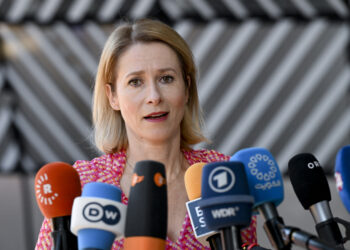
According to the Berlaymont, the initiative should hinge on three main pillars. The first, needless to say, concerns regional security, the responsibility for which, as emphasised by High Representative Kaja Kallas, “cannot fall solely on the shoulders of the member states.” To this end, Brussels plans to establish a “maritime security hub” open to the participation of all countries in the region.

As explained by the twelve-star diplomacy chief, it will be “a European early warning system to increase situational awareness and protect critical infrastructures” of Member States and third countries from hybrid threats, including disinformation campaigns and various electoral interferences (see under Moldova and Romania), posed by malicious foreign actors, primarily Russia.
This hub, the location and ‘operational model’ of which will be agreed upon at a later stage, and which will cooperate with NATO and Coalition of the Willing structures, will also have to contribute to ‘monitoring any peace agreement concluded between Russia and Ukraine‘ and to ensure safe navigation in the Black Sea, taking part in both the fight against the Moscow shadow fleet and the deep-sea demining operations once the conflict is over.
Finally, it will also serve as the coordination centre for regional military mobility, participating in an undefined manner in the modernisation of ports, railways, roads, and any other means that can be used to “move troops and equipment.”
The second pillar is connectivity. The Black Sea, in the words of Enlargement Commissioner Marta Kos, is “a bridge to the South Caucasus and Central Asia, a vital artery for trade, energy flows and food exports” and therefore the EU feels “the need to diversify the ties” with partners in the region to reduce its dependence on Moscow further.
When dependencies are weaponised, we must diversify.
The Black Sea is the bridge to the South Caucasus & Central Asia – vital for trade, energy flows, & food exports.
Our new strategy offers partnerships & better connectivity stepping up our collective security & prosperity. pic.twitter.com/HJNzkKHl6b
– Marta Kos (@MartaKosEU) May 28, 2025
New energy corridors, transport networks, and digital infrastructures connecting the region with the Baltic and Mediterranean basins on the one hand and the Caspian on the other must be developed. According to Kos’ forecasts, Kyiv and Chisinau could be “completely decoupled from Russian energy sources by the end of 2027.” In parallel, Brussels aims to “improve cooperation in the energy sector with Armenia and Azerbaijan”.
The final cornerstone of the strategy concerns preparedness and resilience, particularly in relation to climate change and the environmental impacts of the Ukraine war. Special attention will be paid to coastal communities, with a focus on the blue economy and sustainable growth opportunities.
But one does not become a geopolitical power with triumphalist proclamations. Where will the money come from? “We will not resort to new financial instruments,” Kallas and Kos clarified. The resources will come from existing funds, such as the Ukraine facility or the growth plans agreed by Brussels, for example, with Armenia and Moldova. Another contribution could come from reviewing the functioning of the Guarantee for External Action, the backbone of the Global Gateway with which Brussels has attempted to respond to Beijing’s New Silk Road.

As explained by the Commissioner for International Partnerships, Jozef Síkela, it is about stimulating the sustainable growth of partners but also improving the effectiveness of development aid. “The success of the strategy will depend on the financial firepower we are able to bring to bear,” he said. The truth, however, is that the deck is short, and the game will be in full swing in the autumn when the negotiations between Council and Parliament on the new Multiannual Financial Framework (MFF) begin.
The goal, says Síkela, is to make “a more dynamic use of EU resources without the need for additional budgetary resources.” In his calculations, it is possible to mobilise up to 10 billion additional investments without adding an extra penny to the EU budget. To achieve this, the investment rules in third countries will need to be revised, risk coverage by the European Investment Bank (EIB) will be reduced, and further simplification of the sector will be necessary. Will this be enough?
English version by the Translation Service of Withub