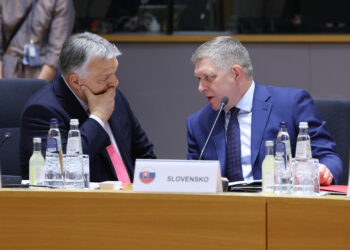
Brussels -Everything went smoothly in the end, and the sanctions that the European Union imposed on Russia for the past three years will remain in place. It went more smoothly than expected because the anticipated clash with Hungarian Prime Minister Viktor Orbán did not take place. The political agreement on extending the 17 sanctions packages for another six months came, somewhat surprisingly, late in the evening at the end of yesterday’s European Council meeting (26 June).
In January, the last time the 27 member states had to go through the six-month extension exercise of the restrictive measures against Moscow, Budapest had held everyone in suspense until the last minute, only to step aside and allow the unanimous go-ahead, though hinting that it could stand in the way in the future. However, Orbán is looking to Washington, and right now, Trump not only seems unwilling to suspend the sanctions imposed at the G7 level but has called for Europe to push further. The Hungarian premier “does not have the backing of the United States,” a diplomatic source said.
Indeed, pressed by the President of the European Council, Antonio Costa, the sovereignist leader, raised no objections. The EU thus secures the 17 packages already in place while it seeks agreement, again with Hungary, on the 18th package. Following the political endorsement by heads of state and government, the ambassadors of member states will initiate the procedure for renewing sanctions, with a view to formal adoption on the agenda as early as Monday, 30 June. Well ahead of the 31 July deadline, which would have led to the lifting of a wide range of sectoral measures, including restrictions on trade, finance, energy, technology, and civil/military dual-use goods, as well as industry, transport, and luxury goods.
The economic sanctions also include a ban on the import or transfer of oil by sea from Russia to the EU as well as the exclusion of several Russian banks from the SWIFT system. Without an extension, the approximately EUR 210 billion of Russian Central Bank assets frozen by Brussels would be lost.
English version by the Translation Service of Withub