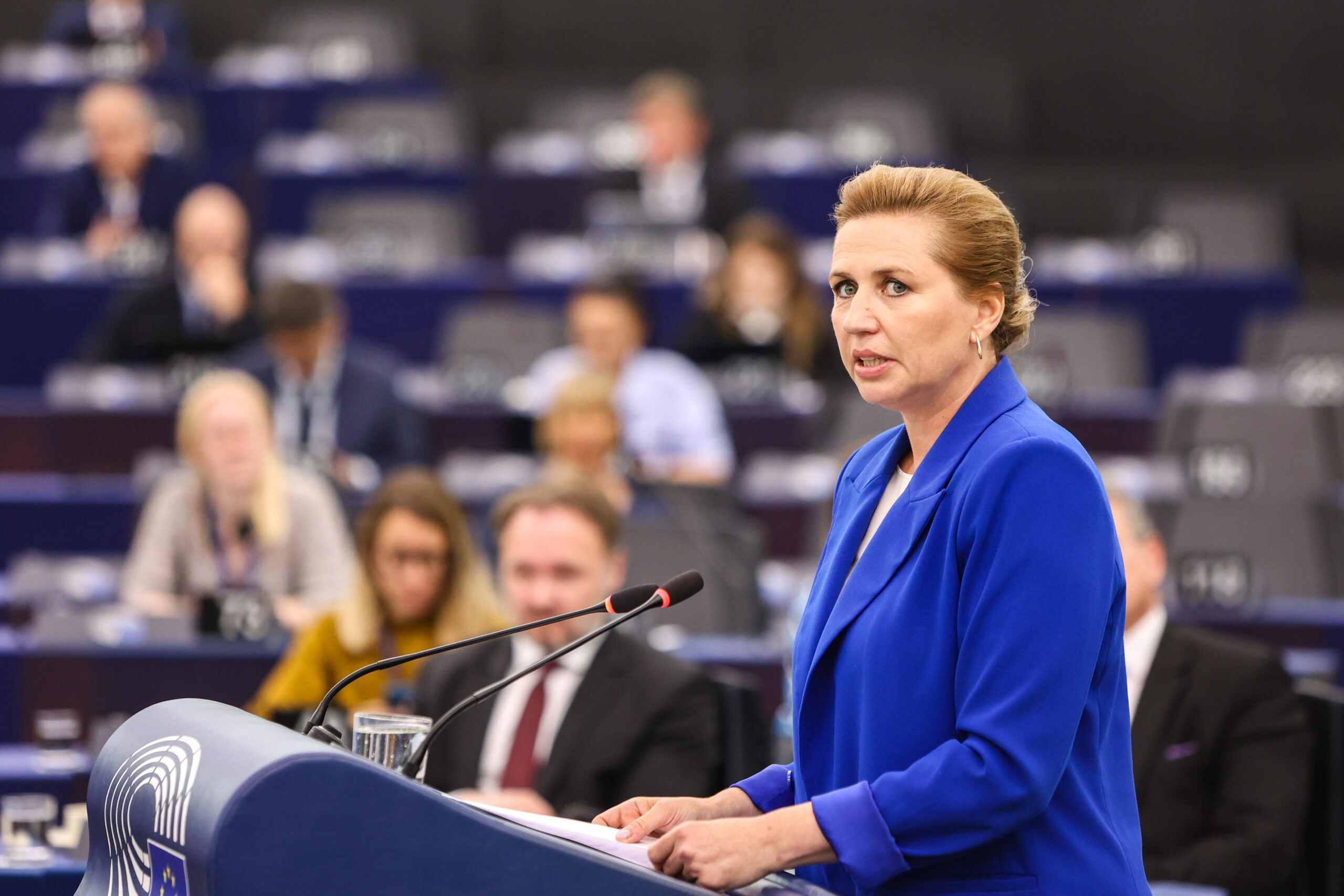

Brussels – A successful debut for Mette Frederiksen in the European Parliament. Presenting the priorities of the Danish presidency of the EU in Strasbourg (a substantial photocopy of the Commission’s agenda), the Social Democrat premier won praise from almost all groups in the chamber. However, the Parliament is divided: on the migration issue, the hard line of Copenhagen pleases the forces of the right (both moderate and radical) but embarrasses the progressives, who prefer to focus on the Green Deal.
Mette Frederiksen’s speech this morning (8 July) in the Strasbourg chamber might have sounded like one by Ursula von der Leyen. The Social Democrat premier reiterated in front of MEPs the priorities of the Danish semester, already highlighted last week in Aarhus: defence and security on the one hand, and competitiveness and a green economy on the other.
“Europe is facing its greatest challenges since 1940,” began the Copenhagen prime minister: the conflict in Ukraine, the migration issue, the Middle East crisis, the trade war with the United States, competition over strategic technologies, and the climate crisis. Thus, the responsibility of the Danish presidency is to “find the right compromises,“ both among the co-legislators (EU Parliament and Council) and the member states. With the tirelessly repeated aim of “building a safer, greener and more competitive Europe.”
.

Defence and Security
Copenhagen defines the dimensions of security along two lines of defence: the military and the border. For Frederiksen, “cutting defence spending over the past 30 years was a gigantic mistake that we cannot repeat,” and now it is time for Europeans to take responsibility for their own security. The one posed by Russia (which, she warns, will not stop at Ukraine) is a “credible military threat to Europe and NATO.” “Europe is not at peace,” she argues, “and therefore we must re-arm.”
After all, as she herself admits, rearmament is the top priority for her government, which in 2022 did backtrack on the opt-out jealously maintained for decades in defence matters and, has abandoned the club of the so-called “frugals” with another historic turn to free its hands when it comes to military spending (possibly joint). “Europe must be able to defend itself by 2030,” the premier reiterated.
The migration node
But the real focus of the debate was combating irregular immigration, which generated a political short-circuit between the Strasbourg benches. “A challenge for Europe, which has an impact on people’s lives and the cohesion of societies,” Frederiksen defines it in a passage indistinguishable from the traditional workhorses of nationalist right-wingers. “Citizens have a right to feel safe in their own countries,” she pressed, adding that “we need to strengthen external borders, reduce the influx of migrants into Europe and help stabilise the EU’s neighbouring countries by making the return process easier and more efficient.”
 MEP Jeroen Lanaers (photo: Fred Marvaux/European Parliament)
Notwithstanding her balancing act, on this point Frederiksen gained cross-party support to the right of centre. From the ranks of the Populars, Jeroen Lenaers was pleased to “see a serious and pragmatic socialist leader and willing to commit herself” to implementing a “firm and effective system“, which is then that proposed by the von der Leyen.2 (the rightmost College ever where half of the seats are in the EPP quota).
The co-chairman of the Conservatives (ECR) group, melonian Nicola Procaccini, promoted the Copenhagen line because it echoes the Italian government’s hard-line approach: “I appreciate the intentions on the fight against illegal immigration, the protection of external borders, the need to facilitate the repatriation of those who do not have the right to asylum,” he said, then lashing out at the left that “continues to pursue a no-border immigrationist doctrine as in Spain or Italy“.

Even members of the Patriots (PfE) and the far-right ESN praised the “right direction” taken by Frederiksen’s executive on the issue, suggesting that “this firm stance should be promoted at the European level.” On the other hand, there was no mention of the crackdown on illegal entry in the speeches of the Liberal, Social Democrat, and Ecologist representatives. An embarrassed silence, especially in the ranks of the socialist family, heavier than many proclamations.
Green Economy and Competitiveness
In contrast, the applause from the progressive wing of the hemicycle came mainly on the subject of climate action. Frederiksen emphasises the need to pragmatically combine environmental protection and economic growth: “Europe must continue to push for the green transition” by assuming global leadership, she says, while also maintaining the bar high for the “ambitious 2040 climate targets.”
Although, she admitted, “all decisions on green issues will be difficult“. On this last point, the warning came from the President of the European Parliament, Roberta Metsola, that “we need to close the circle between climate action and competitiveness, because focusing only on one of the two makes it difficult to find the numbers in the Chamber.”
The Socialist group leader, Iratxe García Pérez, emphasised social justice: “Competitiveness is not a competition between unequals but depends on the ability to build an economy that innovates without excluding,” she recalled. “Great expectations” are held by the Greens, at least according to Kira Marie Peter-Hansen, a fellow countrywoman of Frederiksen, who believes it is “important that Denmark pushes for the ecological transition.”

Even so, the Danish Prime Minister also urged the European Parliament to accelerate the von der Leyen simplification agenda, dear to the right-wingers but considered smoke and mirrors by the European centre-left. “We need to simplify rules and reduce burdens for citizens, businesses, and public administrations,” noted Frederiksen, but also “promote innovation to improve competitiveness in the long term.”
The 2028–2034 budget
Finally, the last priority enunciated by Frederiksen is to chart “an ambitious and responsible course” for the negotiations on the next multiannual financial framework (MFF), the EU budget for the seven-year period 2028–2034. Denmark, the prime minister reiterated, wants “a more flexible, simpler budget, with more private capital and more focused on our strategic priorities“: the last negotiations (those in 2020, post-Brexit and in the Covid era) were “the most difficult,” she recalled, while the next “will be the most important.”
According to the Social Democrat leader, there is only one solution within the reach of the Twenty-Seven to respond to the crises of this convulsive historical phase: “Europe, Europe, Europe,” she repeatedly chanted in front of MPs and journalists. Translated, this means more money in the twelve-star budget. Frederiksen therefore calls for a “flexible and pragmatic” budget, with the multidimensional issue of security at its core..
English version by the Translation Service of Withub