
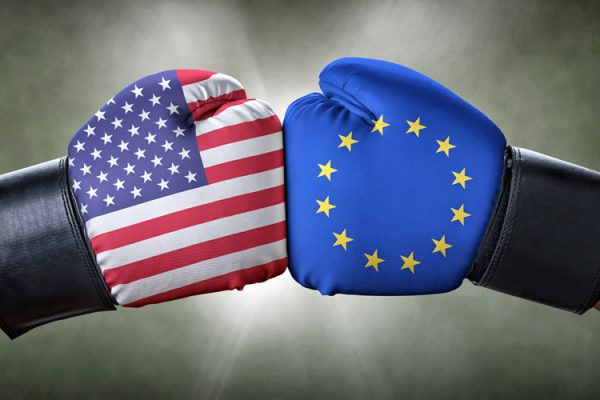
Brussels – Less tariffs and more trade: the EU wants to find trade alternatives to the US in Asia, but the Americans are getting there before the Europeans. The EU has recognized that it needs to intensify its efforts, but the US appears to be ahead of the game. Just when the Presidents of the European Commission and Council, Ursula von der Leyen and Antonio Costa, set foot in Japan, the White House announced an understanding for new trade relations with Tokyo. In a nutshell: for Japanese goods, “only” 15 percent tariffs, but $550 billion worth of Japanese investment opportunities in the US.
The Trump administration’s moves aim to create an entirely new kind of competition that leans toward an anti-European sentiment, just as the EU is attempting to expand its global presence, as von der Leyen herself has acknowledged. “We are, of course, working to reset our trading partnership with the US on a stronger footing. But we also know that 87% of global trade is with other countries – many of them looking for stability and opportunity,” the president of the EU executive said in her speech on the occasion of the conferral of an honorary degree from Keio University. In this race, Trump’s announcement beats the EU to the punch with all the resulting consequences.
If Japan yields to Trump’s understanding, the Europeans may risk losing a potential ally in the new future trade idea. “Both Europe and Japan see a world around us where protectionist instincts grow, weaknesses get weaponized, and every dependency exploited,” von der Leyen said, convinced that “So it is normal that two like-minded partners come together to make each other stronger.” However, the Japanese government may have contradicted her, with the complicity of the Trump administration’s actions.
The European Commission and its president certainly enjoyed a few months’ advantage. Before Trump’s inauguration, the EU sealed trade agreements with Mercosur countries (Argentina, Bolivia, Brazil, Paraguay, and Uruguay) and Mexico, both of which were closed precisely in anticipation of the return of the current US president to the country’s leadership. Two blows scored in what the US historically and traditionally considers its own zone of interest, if not influence. Now that Trump is firmly in place, the EU has lost its initial advantage, and the blow dealt under the Europeans’ noses – with the EU summits leaders present on site – is proof of this.
There is a lot to lose, and von der Leyen is well aware of this: “I am of the view that the period we are in now – and the way we handle it – will define the rest of this century,” she told the audience at Keio University. Trump’s America continues to advance and gain ground, laying the foundations for this new order, which, however, is significantly different from what the Europeans have in mind. Von der Leyen doesn’t give up, and tries to reason with her partners: “We simply cannot accept to be shaken around by the seismic change that we are facing. Or yet again fall for the fallacy that the storm will pass. That things will go back to before – if only a war in one region ends, or a tariff deal is struck, or an election goes a different way next time.” Too bad Trump is announcing a US-Japan agreement, while the EU has to wait.
English version by the Translation Service of Withub

![I ministri responsabili per il Commercio riuniti per discutere la risposta ai dazi di Donald Trump [Lussemburgo, 7 aprile 2025. foto: European Council]](https://www.eunews.it/wp-content/uploads/2025/04/commercio-250407-350x250.jpg)



![[Copyright: European Union]](https://www.eunews.it/wp-content/uploads/2026/10/euco-261015-120x86.png)