




Brussels – In the EU, nine out of ten young people say they feel very good. At least that is what they say, according to data collected and updated by Eurostat. These are self-assessments, in other words, straightforward answers to the most classic of questions: “How are you?” Among men and women aged between 16 and 29, the overall result is one of sound health, with Italians ranking among the top, even above many others. At the end of 2024, 90.1 percent of young people reported doing well or very well, while in Italy, the rate was 95.3 percent. Only in Romania, Greece, Croatia, and Slovakia do under-30s report feeling better. 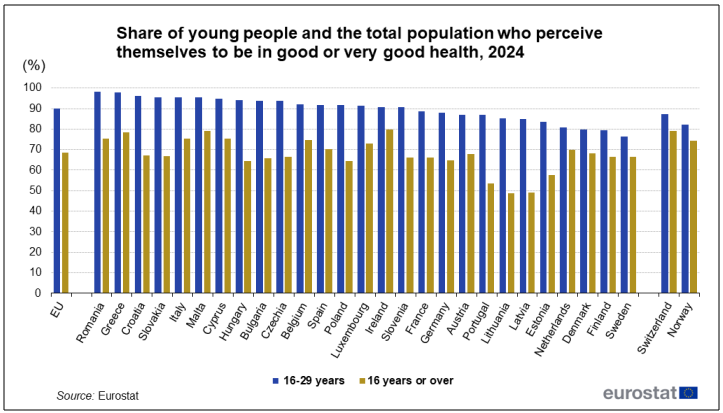 The European Statistical Office looks at the perceived health, one of three indicators of health status (the others are: diseases or long-term health problems, and disability), which helps understand whether people are healthy according to the World Health Organization (WHO) definition, i.e. whether there is “a state of complete physical, mental, and social wellbeing and not merely the absence of disease or infirmity.”
Health and economic well-being, a correlation
According to Eurostat, wealth is synonymous with psycho-physical wellbeing. Examining the relationship between the individual’s perceived state of health and income situation, one can observe “a clear pattern in almost all EU countries: higher income is associated with better perceived health.” The more you earn, therefore, the healthier you are.
Sun and sea, the wellbeing of the Mediterranean
The data suggest another correlation between better health perception and a favorable living environment. The statistical institute does not provide a reading regarding the relationship between one’s place of residence and one’s wellbeing. However, examining the data, young Europeans who feel best are those who live in sun-and-sea countries, such as Greece, Croatia, Italy, Malta, and Cyprus. While at the bottom of the of the table are men and women under 30 from the Baltic republics (Estonia, Latvia, and Lithuania), as well as the Netherlands and the Scandinavian states (Denmark, Finland, and Sweden). The cold and grey Northern Europe, in essence, would seem to affect one’s perception of their wellbeing negatively.
English version by the Translation Service of Withub





![Ilze Brands Kehris [foto: European Council]](https://www.eunews.it/wp-content/uploads/2026/10/ilze-120x86.png)
