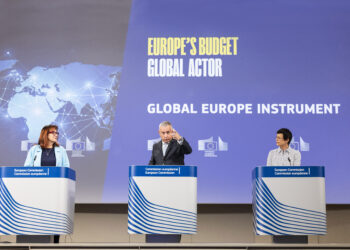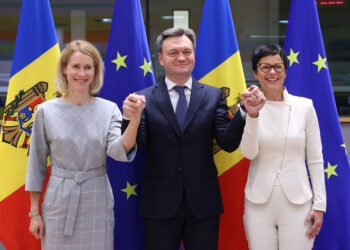


Brussels – Enlargement? Politicians want it, but society doesn’t. That is what emerges from a special Eurobarometer conducted on behalf of the European Commission, which reveals a disconnect between institutional Europe and the Europe of its citizens. EU executive and member states — in other words, national governments — are pushing to allow the candidate countries, including Ukraine, Georgia, Moldova, and the Western Balkans (Bosnia and Herzegovina, Serbia, Montenegro, North Macedonia) to join the EU. However, when it comes to substance, EU citizens seem unconvinced.
The question of enlargement is a divisive one: slightly more than one in two (56 percent) feel that increasing the number of Member States is a good idea, and would bring positive returns to the European Union as a whole. This means that 44 percent of Europeans are doubtful or even opposed to the idea of welcoming new states. It must also be said that the pro-enlargement majority is anything but solid: of this 56 percent in favour, only a fraction, 10 percent, say they are “very much in favour,” with the rest saying they are “somewhat in favour.”  There is a sense of doubt mixed with fear in civil society and among the people of Europe. They fear the national fallout from a possible new enlargement of the European Union. They look to the national interest, and this prevails over the rest. It is the case in Italy, where 51 percent of those interviewed view the entry of Ukraine, Moldova, and the Balkan countries as a benefit for Italy, compared to 49 percent who do not. Even more so in France, another founding country of the EU, where public opinion sees only one problem in the EU of more than 27 countries.
So, enlargement is on the political agenda but not at the centre of people’s concerns. Martha Kos, the Commissioner for Enlargement, purposely seems to want to ignore the general outcome of the survey, which sounds like a rejection of the choices made so far, to dwell on one detail of the almost 100-page document, namely the support for the idea of enlargement among men and women aged between 15 and 24 (66 percent).  “The results show that EU citizens, and in particular younger people, support enlargement,” says Kos. A comment that contains a partial truth, and glosses over the fact that enlargement is more a subject of doubt than enthusiasm. In the end, even the Commissioner has to recognise that something is wrong and that something needs to be done about it, when she adds that “together with the Member States, we will engage directly with citizens, address their concerns, and show how enlargement delivers peace, prosperity, and a more united Europe.” This suggests that it remains unclear how and to what extent the accession of new countries would be beneficial.