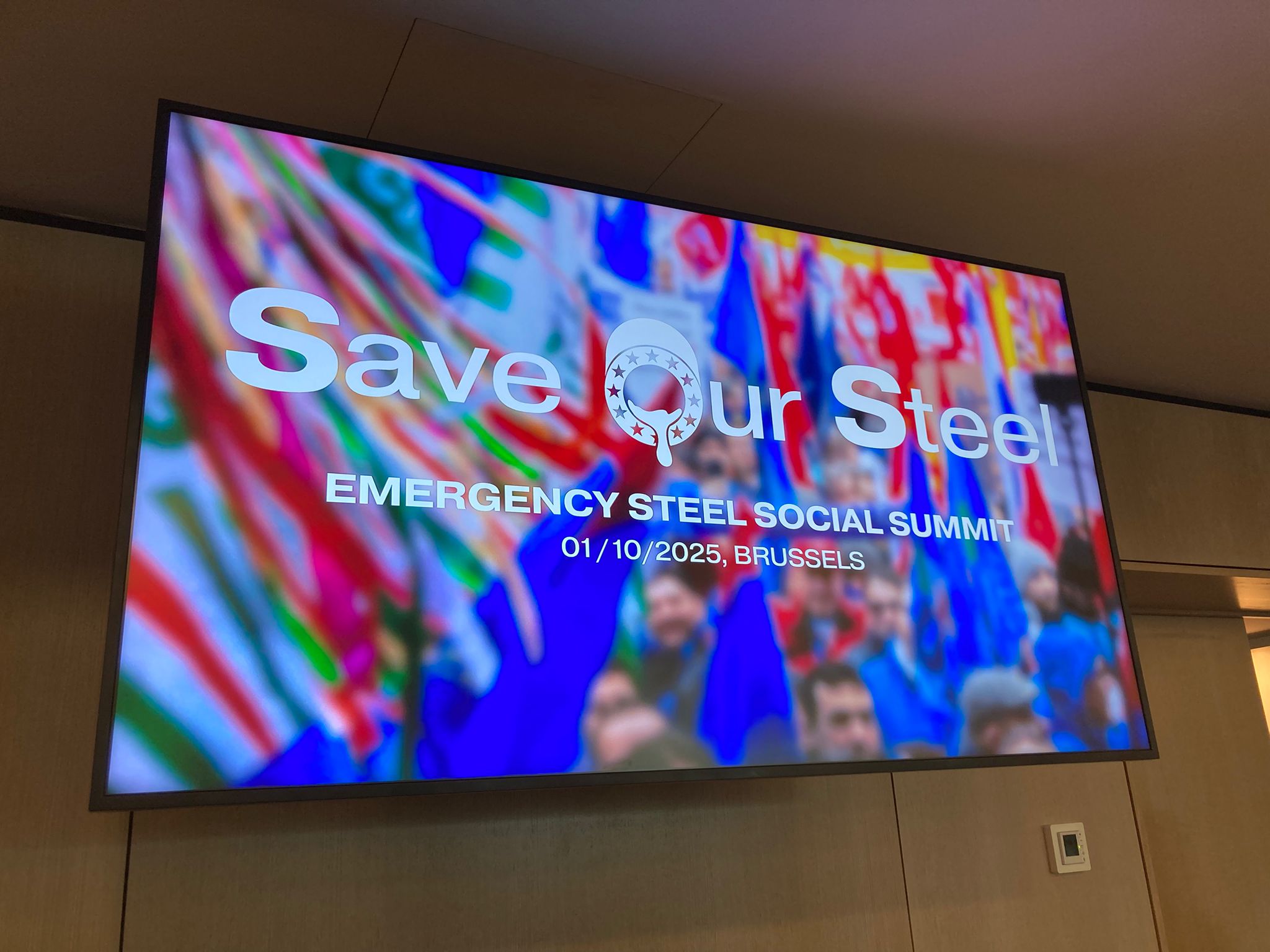
Brussels – The European Commission will commit to providing the steel industry with a protection package for the sector. Today, October 1, the European Commissioner for Prosperity and Industrial Strategy, Stéphane Séjourné, met with trade unions and steel company associations from across Europe to present this new project.
The Union’s proposal
The promise secured by the steelmakers from the EU Commission, an informed source told Reuters, is a reduction of steel import quotas by almost half and an increase of tariffs on volumes above those levels by up to 50 percent: decisions that seek to counteract 50 percent US tariffs on European steel. The measures announced are very similar to, but more protective than, those already announced on March 25. The new package will be presented on October 7, during the Plenary Assembly of the European Parliament in Strasbourg.
No further details on the project emerged, as Commissioner Séjourné did not wish to attend the press conference at the end of the work. In any case, Henrik Adam, President of EUROFER (the association that brings together all steel producers in the European Union), was satisfied: “The commissioner seems to have understood what the needs of the sector are.”
Both trade unions and businesses asked for speed in making concrete decisions. Former British MEP Judith Kirton-Darling, secretary of the European trade union federation for the steel industry (IndustriAll Europe), clarified the sense of a joint will between the two categories: “We made a united request for a faster reaction.”
The industry’s crisis
There are several critical elements. Global overcapacity in steel production is at record levels, and it is spilling over into the European market, jeopardizing 300,000 direct jobs and 2.3 million indirect jobs. Last year, 18,000 redundancies were announced, with a record 12 million tonnes of closed capacity. According to Adam, the crisis in the sector “is an ecosystem issue. Not having a competitive European steel makes the development of the whole supply chain that uses it in Europe complex.”
Words that hit a nerve with the Union: it should be remembered that steel and heavy industry are pivotal segments for the development of a European war industry. Therefore, the arrival of more competitively priced steel from India and China is, for the President, a strategic issue: “If they own the supply of raw materials like steel, they indirectly own the industries that use it.”
The green transition
The trade issue is EUROFER’s priority, but the matter becomes even more complicated when it comes to the green transition. The managing director of the European steel producers’ association, Axel Eggert, reiterated that “we are doing everything to get back on target.”
From the workers’ side, Judith Kirton-Darling, adopting a political as well as a trade union stance, recalled how “decarbonisation must take place gradually, to prevent job losses and social crises that would lead to political upheaval.”
English version by the Translation Service of Withub


![Da sinistra: il presidente del Consiglio europeo, Antonio Costa; il presidente dell'Ucraina, Volodymir Zelensky: la presidente della Commissione europea, Ursula von der Leyen [Bruxelles, 18 giugno 2024. Foto: European Council]](https://www.eunews.it/wp-content/uploads/2026/06/euco_ua260618-120x86.jpg)
![[foto: Saverio De Giglio/imagoeconomica]](https://www.eunews.it/wp-content/uploads/2026/10/cpt-120x86.png)