Brussels – The big names in European industry say they are ready to invest 50 per cent more in Europe over the next five years. However, the money will not arrive in any case, but will only become available under certain conditions. What the 28 large European companies (e.g. Airbus, Maersk, and Vodafone, no Italian ones) are asking for are ambitious reforms that promote technological innovation and competitiveness, cutting red tape and bottlenecks that still hold back the single market.
According to the 28 brands, following this road map of investment by the private sector and reform by the political side, we could “be on our way to closing much of the gap of around €800 billion of investment per year identified by Draghi.”
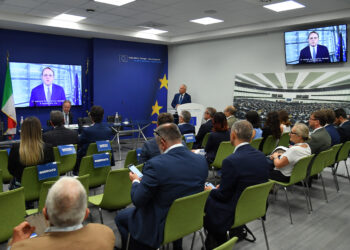
The commitment made by the companies was announced on the sidelines of the European Summit, held in Copenhagen on 1 October. The conditions put forward by the industrialists in more detail are: unlocking innovation and removing barriers in the single market, incentivising private investment, strengthening the effort towards a green industry, building a competitive base for the new defence industry, and reducing strategic dependencies in technology.
Strong call by our President Fredrik Persson for urgent delivery on European #competitiveness at today’s Copenhagen Competitiveness Summit organised by @DanskIndustri.
The European business leaders’ declaration handed over to @vonderleyen, @EmmanuelMacron Mette Fredriksen &… pic.twitter.com/nSbp2CgnIH
— BUSINESSEUROPE (@BusinessEurope) October 1, 2025
Europe’s Achilles’ heels
The list made by industrialists to the EU touches on points that the President of the European Commission, Ursula von der Leyen, called today “Achilles’ heels”. One of these is bureaucracy, which slows down competitiveness. The president was very clear on the issue, stating that “we have to keep the awareness of urgency alive”, adding how the six existing ‘Omnibus’ procedures (a legislative method in which a series of amendments are grouped together in one act) “have not reached the end of the road because the co-legislators (Parliament and Member States, ed.) have not come to an agreement.”
Another weakness of the European Union, von der Leyen reminded us today, is the absence of “a single market for financial services.” This often makes instruments produced in Europe unattractive, causing private savings to fly to other shores, such as Wall Street or Shanghai. This is why the Union is trying to reverse this trend through the Saving and Investment Union, a project that aims to channel private savings more effectively towards European companies. An effort welcomed by the 28 big names who signed the appeal today.
European tech may have turned a corner.
ASML ($382B) and SAP ($308B) are now the EU’s most valuable company, topping real continental OGs including LVMH ($305B), Hermes ($261B) and L’Oreal ($229B). pic.twitter.com/ZKbKdW627p
— Trung Phan (@TrungTPhan) September 29, 2025
English version by the Translation Service of WithubWhere the money goes
Industrialists want to direct these investments towards new technologies, such as artificial intelligence, 5G and 6G telephone networks, and growth sectors such as defence and research. As far as the Union’s technological development is concerned, President von der Leyen highlighted the main critical issue: “Europeans are talented at innovating. The problem is to make this innovation capable of growing and asserting itself in the European market.”
To do this, a double contribution is needed: that of businesses, which make these projects feasible, and also economic incentives, such as Horizon Europe, which pave the way for innovative start-ups. “In the new five-year plan for Europe we have proposed a doubling of funds. This is a key point for fostering innovation,” commented Ursula von der Leyen. However, the regulatory process for Horizon funds still has a long way to go. At the same time, the industrialists might withdraw their proposal for collaboration.