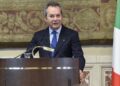
Brussels – “The Europeans hesitated when they could have supported our country. So Russia extended its hand to us.” The harsh words pronounced in the plenary session of the Strasbourg Parliament come from Sergei Tikhanovski, a Belarusian dissident, who had to serve five years in prison for that hesitation. The moment when the EU could have done more was in 2020, when the Belarusian president Aleksandr Lukašenko arrested his political opponents (including the journalist who was awarded the Sakharov Prize 2025) to prevent fair presidential elections. Tikhanovski paid the consequences of his political activism and was imprisoned in the middle of the election campaign. Only a few months ago, he gained his freedom thanks to US mediation.
Next to him is his wife, Svetlana Tikhanovskaya, who transitioned from being an English teacher to advocating for her husband’s demands and became the primary opponent of the Belarusian status quo. After the 2020 elections, she was forced to flee to Lithuania to avoid political arrest.

Democratic Belarus
The story of Mr. and Mrs. Tikhanovski, as told today, October 22, in Strasbourg, helped the democratic side of Belarus re-emerge from its mantle of silence. The same one that, in August 2020, had filled squares to counter yet another Lukašenko victory. “We are a wonderful nation, with strong Western European values, ready to become a member of the EU,” says Tikhanovski. However, he acknowledges that, after five years, “the situation has worsened.”
The Appeal to the Union
They did not come here, however, to remember that democratic pride. They make a strong appeal for a more active European Union. “Europe must not only become an active player, it must become one in Belarus,” Tikhanovski goes on to say. “Lukašenko is an astute survivor, but he is not immortal. The transfer of power in Belarus is imminent.”
Svetlana Tikhanovskaya responds with a list of priorities to facilitate the democratic process in the so-called Little Russia: “We would like more contacts and visas for Belarusian citizens, stronger support for independent media, and the strengthening of relations with democratic institutions that are emerging outside the country (in Lithuania, ed.), to make dialogue possible once the Lukašenko era is over.”
The proposal put forward by the opposition leader is that of a double western stranglehold: on the one hand the United States, which “focuses on the humanitarian track, on freeing people and ending repression,” on the other, the leader continues, “the European Union, which must remain firm and consistent in its principles, maintaining and strengthening the sanctions already in place.” In fact, punitive measures remain the most effective weapon to get the Belarusian nomenklatura, now running low on funds after thirty-one years in power. “Their effect is being felt,” Tikhanovskaya confirms without hesitation.

Border Defence
Her husband echoes her on the issue of European action, focusing, howeve,r more on the aspect of border defense. “For decades, the US has saved you hundreds of billions of dollars by offering the security umbrella,” says Tikhanovski. “But today, America cannot fight on three fronts at once. It must be Europe, not the US, to take the lead on its eastern borders. It must be Europe’s main partner in helping Belarus move towards democracy. You can do it, you are big and strong.”
The firm tone did not excite members of parliament, who rarely applauded in the moments of pause. Tikhanovski, however, warned his listeners at the beginning of his speech: “I am not a professional diplomat; I am learning.” His words, incisive and direct, nonetheless have a strong symbolic value.
The New Finland
The final idea brought forward by the dissident and promoted by the Belarusian Democratic Movement is to make the country “a new Finland,” capable of coexisting alongside “a difficult neighbor”, but determined to “build an independent and prosperous state without going to war.” He is confident that the European Union has “the resources and the strength to make it a reality.” It remains to be seen whether there is also the will.
English version by the Translation Service of Withub