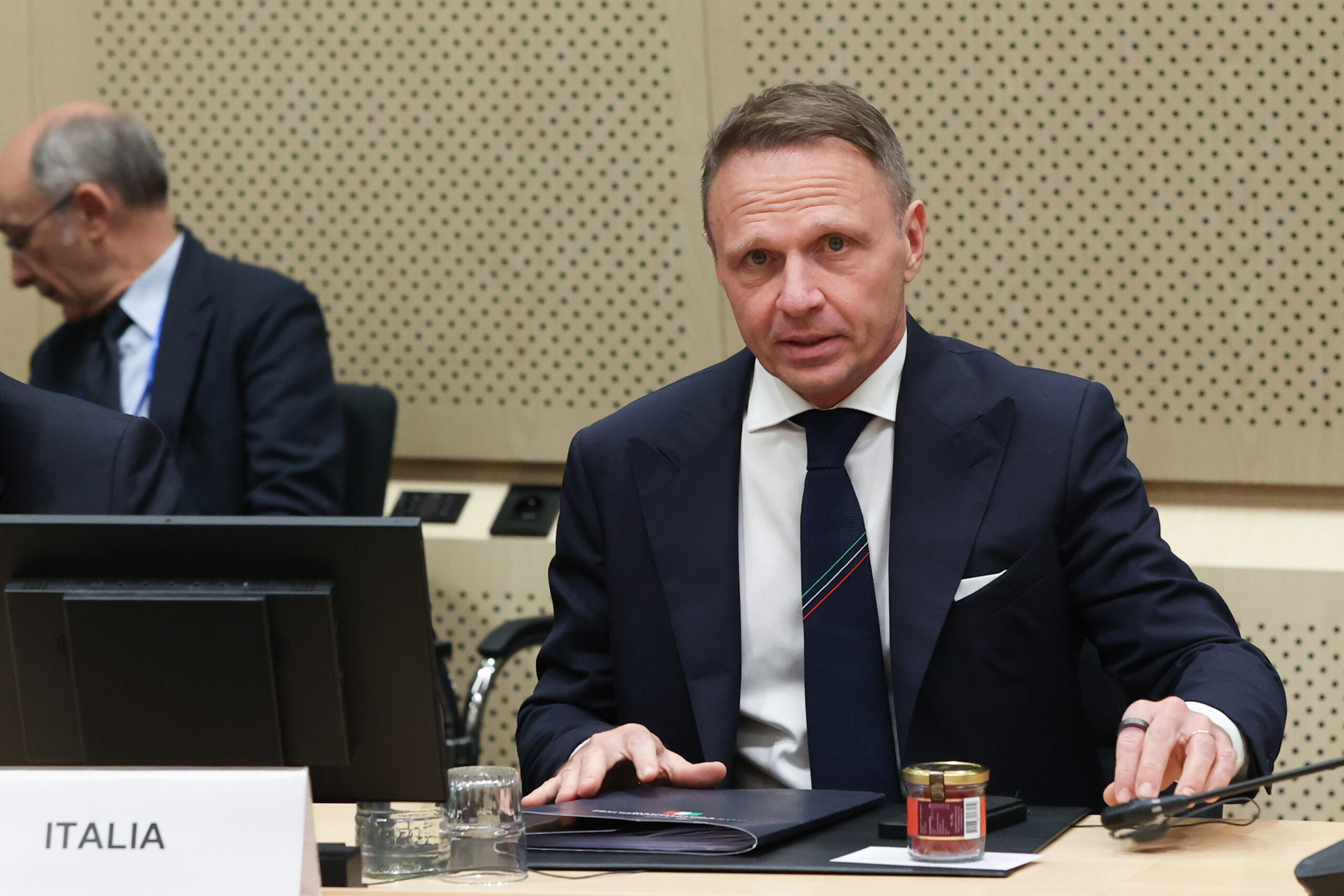

Brussels – Ursula von der Leyen’s adjustments to the EU’s multiannual budget proposal are not enough: the Commission must review the structure of the single fund and maintain the Common Agricultural Policy (CAP) “as a separate policy.” Italy’s opinion on the draft MFF put on the table by the President of the European Commission does not change, and the Minister of Agriculture, Food Sovereignty and Forestry, Francesco Lollobrigida, brings it back to the EU Agriculture and Fisheries Council, presenting a document supported by 6 other countries—Bulgaria, Czech Republic, Hungary, Poland, Portugal, and Slovakia.
“The Italian position has been very clear from the beginning: we have said no when it comes to an indistinct single fund” in the next EU multiannual budget. “We have already achieved some steps forward that are, however, unsatisfactory. So, there is still work to be done,” Lollobrigida explained at a press point. “We will see whether the Commission, realising that it has based its reasoning on incorrect assumptions, will make satisfactory changes. If not, the government will determine accordingly,” the minister says. A game that has only just begun and which, as early as December, will see the return of the tractors to the streets, as announced last week by the president of Coldiretti, Ettore Prandini. “I think it is legitimate, in the face of a cut in farmers’ resources and, in our view, a substantial change in the commitments made in the Treaties,” Lollobrigida comments.
In the document presented today, Italy and the six countries underline that the CAP is “the main instrument through which the European Union supports the competitiveness of the agricultural sector,” preserving the single market and ensuring essential income support for farmers, food security, environmental sustainability, and the protection of rural areas. Objectives that “remain fully relevant” in the current geopolitical and socioeconomic context. On the other hand, “the proposals for regulations on the National and Regional Partnership Plans (NRPs), as well as those on the 2028–2034 CAP presented by the Commission on 16 July 2025, do not appear to be consistent with the orientation indicated by the Union itself” and “the idea of merging the 2028–2034 CAP into a single plan and fund that, both from a management and financial point of view also includes Cohesion Policy, Fisheries and even migration and security instruments, while inspired by the objective of improving the effectiveness of EU spending, does not meet the needs expressed by the Member States, nor does it achieve the simplification repeatedly requested in this Council and needed by farmers,” they write.
Because “concentrating all policies in a single heterogeneous programming framework would leave the actual quantification of the resources allocated to agriculture to the internal decisions of each member state, with the real risk of renationalising the CAP, increasing the disparities in payment levels and ultimately weakening the principle of fairness,” they observe. In particular, for Lollobrigida, “renationalising European agricultural policies is a step backwards with respect to that type of perspective” defined by the Treaties, “with very serious damage that we are carrying into the present, in a global context that is clearly visible to all, characterised by instability and instability in supply chains, and also a further risk of deterioration of environmental protection also in the face of what are the effects of climate change and which puts farmers in an even more important role in this phase of history.”
For these reasons, Italy, Bulgaria, the Czech Republic, Hungary, Poland, Portugal, and Slovakia “consider it necessary to thoroughly review the Commission’s proposal for a single plan and fund.” And they “call on the Commission to maintain the CAP as a distinct policy, based on two pillars, financed by a budget commensurate with the challenges ahead, guaranteeing evolutionary and ameliorative continuity with the current programming period, within a stable and comprehensible regulatory framework for administrations and beneficiaries, and avoiding overlaps between support schemes and institutional reorganisations that risk adding further complexity.”
English version by the Translation Service of Withub