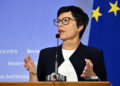
Brussels – Montenegro and Albania, then Ukraine and Moldova. On the horizon, by the end of the decade, a new enlargement of the European Union is looming. A club that already, at 27, suffers from centrifugal movements, breakaways, or lonely resistances that wear down its decision-making process. With the prospect of more than 30 members, “we need to discuss openly what kind of guarantees we will include in future accession treaties to assure our citizens that the integrity of our Union is protected,” said EU Commissioner in charge of the enlargement, Marta Kos.
The momentum for accelerating the entry of new member states was reiterated today in Brussels at the Annual Enlargement Forum, which was attended – in addition to Kos – by the EU High Representative for Foreign Affairs, Kaja Kallas, the Commissioner for Defence, Andrius Kubilius, the Prime Ministers of Montenegro and Moldova, Milojko Spajić and Alexandru Munteanu, the Ukrainian Deputy Prime Minister for European Integration, Taras Kachka. The President of the European Commission, Ursula von der Leyen, emphasised in a video message that “in times of geopolitical uncertainty, enlargement is more than a choice for peace.” It is an “investment in our collective security and freedom.”

So that it does not risk becoming a burden, “the EU must prepare itself” to welcome new members, warned Kos. Above all, it will have to revise the treaties and limit the use of unanimity to avoid dangerous deadlocks. For now, the European Commission “is working on a pre-accession readiness assessment” to know “the impact that future enlargement will have on key policy areas, on our budget and on our governance structures.”
There will be no first- and second-class countries. Still, the EU is considering “guarantees that will go unnoticed by our new member states when they all fulfill their responsibilities, but that can have a strong impact when the new member states do not abide by the same rules,” Kos explained.
The direction is the one already indicated by the European Parliament, which, on 22 October, approved a report on the institutional consequences of the enlargement negotiations by a large majority. Sandro Gozi, MEP from Renew and rapporteur of the report, immediately echoed the words of Kos: “To move forward credibly, we need solid guarantees, capable of protecting the integrity of the Union and strengthening its decision-making capacity. If we want a Union that really works, we must overcome vetoes and rigidities and build a more effective, more powerful, and more democratic system.”
The mechanisms in place, Gozi further specified, “must be discreet when everything works, immediate when fundamental values are called into question.” To “maintain the integrity” of the Union, but “at the same time, allow the most determined countries to move forward without being blocked by those who want to slow them down.”
English version by the Translation Service of Withub


![La Commissione presenta il pacchetto allargamento 2025 [Bruxelles, 4 novembre 2025]](https://www.eunews.it/wp-content/uploads/2025/11/allargamento-25-350x250.png)