![Il castello di Alden Biesen, in Belgio, dove si riuniranno i leader dell'UE per il vertice informale dedicato a mercato unico e competitività [foto: European Council]](https://www.eunews.it/wp-content/uploads/2026/02/aldenbiesen.jpg)

Brussels – The objective and the imperative address the same need: to accelerate. The European Union has decided on its path, but it is seeking ways to relaunch its single market. Heads of state and government will meet tomorrow (12 February) in Belgium at Alden Biesen Castle to seek political tools to give the Union a new economic and competitive impetus. The main recipe seems to revolve around simplification, but this does little to convince the socialist and green groups of a twelve-star club with popular traction.
The President of the European Commission, Ursula von der Leyen, announced “a common roadmap for the single market until 2028.” This timetable, she explains in the European Parliament during the plenary debate on the eve of the informal summit of leaders, will be at the centre of the meeting of heads of state and government. “I will propose that, together with the Parliament and the Council, we approve it at the European Council in March,” the formal one, scheduled on March 19-20, the real one, also dedicated to competitiveness. The roadmap “will include a commitment to rapidly adopt a number of key proposals, all by the end of next year.”
Among the key proposals is certainly simplification, through omnibus packages, now a cornerstone of the European Commission’s action, and which, according to the EPP group leader in the EU Parliament, Manfred Weber, “is correct and remains correct” as an approach. The Greens take a different view, with co-chair Bas Eickout dismantling the EPP’s argument: “The real problem is the lack of investment,” says the Greens representative, citing the Draghi report to explain why simplification is a false problem. “To relaunch the EU, between 750 and 800 billion euros per year are needed, a figure that the ECB raised to 1,200 billion. All the Omnibus packages together are worth 15 billion euros, or 1 per cent of this effort. It’s time to focus on the remaining 99 per cent if we want to compete with the United States and China.”
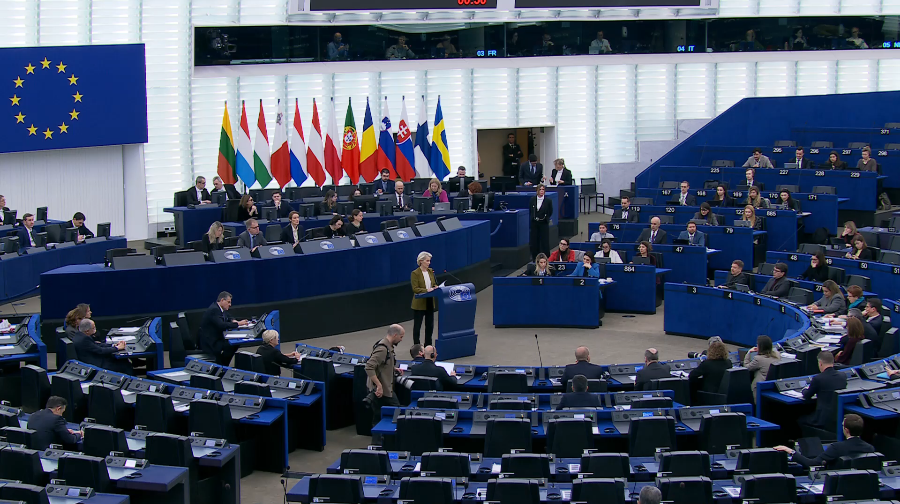
Even the Socialists have reservations about the EPP’s approach. “You can’t compete by cutting wages and eroding workers’ rights,” thundered S&D group leader Iratxe Garcia Perez, who is also unconvinced that simplification is the way forward: “We need more integration that protects workers rather than profits.”
Brussels is well aware that there are different points of view around the leaders’ table. EU sources assure that the informal European Council summit “is not just about simplification.” It is “certainly an important element,” but at the same time, there is full awareness that “simplification is not just deregulation, but also harmonisation between different national regulations.” The President of the European Council, Antonio Costa, therefore, intends to use this opportunity, which does not require any conclusions at the end of the proceedings, to have an open, wide-ranging discussion on the paths to follow for a new course for the 27 member states. “Certainly, the removal of cross-border barriers and simplification finds a certain consensus” among Member States, it is acknowledged, just as “all leaders agree that the EU needs to move this agenda forward.”
In this entirely political argument, European Liberals are not opposed to simplification, provided that three things are guaranteed: savings union, investments, and energy sovereignty through a focus on clean sources. These are the conditions outlined by the leader of Renew Europe in Parliament, Valerie Hayer, who reiterates the liberal family’s support for speeding up the strengthening of the single market.
Without delving too deeply into political dynamics and alliances, it is enough to say that the EPP holds almost half of the leaders in the Council, 12 out of 27 (Austria, Bulgaria, Croatia, Cyprus, Finland, Germany, Greece, Latvia, Luxembourg, Poland, Portugal, and Sweden). With the support of liberal leaders (Estonia, France, Ireland, and Slovenia) and also non-left-wing independents (Lithuania, the Netherlands, and Romania), there are enough votes to approve further simplification, the most popular option, and also to proceed through enhanced cooperation, should this recognised option be chosen.
It is true that tomorrow’s meeting could see the growing rift in the so-called Franco-German axis, with the two countries divided on common debt, trade (see EU-Mercosur agreement), European procurement preferences, and how to respond to the White House occupant, Donald Trump. Yesterday (10 February), in an interview with several European newspapers, including Il Sole 24 Ore, French President Emmanuel Macron warned that “Europe is facing a geopolitical and geo-economic state of emergency” and that “if the continent does not invest in its own economy,” and “does not remove obstacles to growth more quickly, it will be ‘swept away’ by American technology and Chinese imports.” At the heart of his words is the issue of the necessary funding, estimated at around 1,200 billion per year in public and private investment for green and digital technologies, defence, and security. His appeal is to “mobilise our savings and create a common debt capacity for these future-oriented expenditures“. The appeal was immediately rejected by Berlin: a German government official close to Chancellor Friedrich Merz explained that Germany opposes the proposal for a common European debt, stressing that it “distracts from the main issue, namely the problem of European productivity” to be discussed at tomorrow’s summit. “It is true that we need more investment, but to be honest, this issue falls within the context of the multiannual financial framework,” the official said.
English version by the Translation Service of Withub