Brussels – Opportunity, security, and resilience: these are the three areas on which Irishman Séamus Boland focused his work during the first 100 days (which ended on 10 February) of his term as president of the European Economic and Social Committee (EESC). A member since 2011 and president of the Committee’s civil society organisations group from 2020 to the present, Boland was elected in October 2025 and will lead the EU body representing civil society for a two-and-a-half-year term until 2028. Combating poverty, defending democracy, and adapting to the challenges posed by climate change are among his agenda’s priorities. “We are living through extraordinary times in so many ways. Unimaginably, war is again scarring the European continent – a war every EU institution and body must play its part in opposing, while continuing to support Ukraine and its people,” he said in his working document for the year 2026. “Horrific events have been searing the Middle East. A multiplicity of global insecurities and planetary crises are becoming ever more acute. The triple planetary crises of Climate Change, biodiversity loss, and water shortages all demand our active engagement,” he added.
With his anti-poverty strategy, the Irish president – a farmer who has been involved in civil society for over 40 years, working with young people, ethnic minorities, people with disabilities, and people living in isolated rural areas – aims to guarantee equal opportunities for the European population by establishing an advisory group within the EESC presidency to encourage greater civil society participation in the Committee’s work, including investigating the role of Member States in eradicating poverty. “During my mandate as President of the EESC, I will prioritise a people-centred work programme, where the Committee takes on a leading role in positioning civil society at the heart of the EU,” he explains in a document on the work programme for 2026. “At the centre of this vision is the eradication of poverty. Although economic growth and employment creation directly contribute to reducing poverty, in-work poverty remains a reality within our societies, alongside child poverty, inter-generational poverty, and poverty among older persons,” he points out.
In addition to this work, Boland believes it is necessary to talk about a ‘union of security’ to defend democracy, strengthening the soft power of European institutions to enhance their democratic legitimacy, combating growing disinformation, and protecting media independence. Boland stresses the need to ensure a secure Union, also through external engagement to ensure geopolitical stability in the region, reaffirming the Committee’s solidarity with the Ukrainian people and its commitment to supporting Ukrainian civil society.
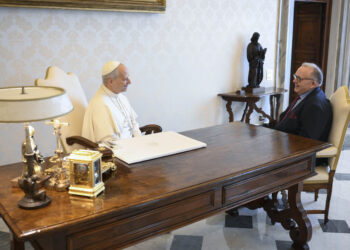
Finally, Boland said, it is essential to increase Europeans’ ability to adapt and withstand climate, industrial, territorial, and demographic challenges. Building a resilient Union, as specified in his programme, means promoting sustainable agri-food systems, ensuring food security, and supporting vibrant rural communities. Since October, when he was elected, the President has stated that he wants to proceed in tandem with Member States and, above all, with other institutions. For example, Boland is working with the Cypriot Presidency of the Council of the EU on energy poverty and with the President of the European Council, Antonio Costa, and the European Commissioner for Energy and Housing, Dan Jorgensen, on the strategy for affordable housing, as requested by the Commission. Finally, Boland raised the issue of the housing emergency – presented as a priority for the EU– with Pope Leo XIV in a January meeting. Looking ahead to the year ahead, Boland promises to continue along these lines. And in October, on the International Day for the Eradication of Poverty, the EESC will host a high-level conference on the subject.
English version by the Translation Service of Withub

![Da sinistra: il presidente del Consiglio europeo, Antonio Costa; il presidente dell'Ucraina, Volodymir Zelensky: la presidente della Commissione europea, Ursula von der Leyen [Bruxelles, 18 giugno 2024. Foto: European Council]](https://www.eunews.it/wp-content/uploads/2026/06/euco_ua260618-120x86.jpg)
![[foto: Saverio De Giglio/imagoeconomica]](https://www.eunews.it/wp-content/uploads/2026/10/cpt-120x86.png)