Brussels – Combating disinformation, strengthening democratic institutions and civic participation: these are the cornerstones of the European Centre for Democratic Resilience, which started operating today (24 February). The project—whose launch was celebrated by the European Commission and the Presidency of the Council of the European Union together with the ministers of the 27 Member States in the context of the EU General Affairs Council—is part of the European Democracy Shield initiative, which aims to strengthen the defence of the Union’s democratic values against foreign manipulation and interference. “With the European Centre for Democratic Resilience, we will strengthen our collective capacity to counter information manipulation and disinformation by foreign actors. This will ensure that European public debate remains open, fair, and participatory,” said Commission President Ursula von der Leyen, announcing the initiative.
As explained by the Commission, for its first year of operation, the Centre will focus on six operational priorities: developing tools and measures to protect electoral processes from interference and disinformation campaigns; developing a European action plan to increase Member States’ response capacity and preparedness; creating a dedicated platform bringing together civil society, research centres, academics, fact-checkers, and the media; promoting the exchange of experiences between Member States, with the support of those Member States that are most advanced in combating hybrid threats; strengthening cooperation with candidate countries, which are often priority targets for external influence campaigns; and finally, directly involving citizens in the defence of democracy through two European panels on preparedness and resilience.
“Today’s wars are not only fought with tanks and drones, but also with lies and algorithms,” emphasised Kaja Kallas, High Representative of the Union for Foreign Affairs and Security Policy and Vice-President of the Commission. “European democracies are already being targeted by disinformation operations sponsored by states such as Russia and China. The new Centre will support our partners and candidate countries in developing common awareness and defences against these threats,” she explained.
The Centre will act as a voluntary strategic hub for cooperation between Member States, providing a focal point for analysis, prevention and response to hybrid threats. The European Commission will provide administrative and operational support through a Secretariat, in close cooperation with the European External Action Service (EEAS) and its Early Warning System. The aim is to avoid fragmentation of existing efforts by linking networks and structures that address the prevention, detection, and analysis of threats in the information space.
The initiative responds to growing internal and external pressure on democratic systems. According to the Eurobarometer special report, 49% of European citizens consider distrust of institutions to be one of the main challenges for democracy, while 42% fear the influence of information manipulation, particularly during election periods.
Other initiatives of the European Democracy Shield have the same purpose, such as the European Commission’s support for the European Digital Media Observatory (EDMO) and the European Fact-Checking Standards Network (EFSCN), an independent association of European organisations that defends and promotes the highest standards of fact-checking and media literacy to combat disinformation in the public interest. In this landscape, the Centre “transforms these individual forces into collective resilience,” pointed out European Commissioner for Democracy, Justice and the Rule of Law, Michael McGrath. “It helps us connect the dots, bringing together governments and societies to safeguard our democracies and shape a future based on our fundamental values and rights, in particular freedom of vote and freedom of expression,” he concluded.
English version by the Translation Service of Withub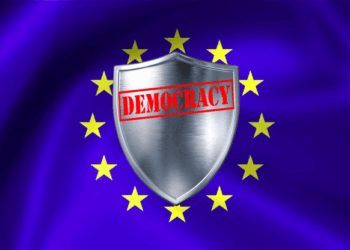


![Da sinistra: il presidente del Consiglio europeo, Antonio Costa; il presidente dell'Ucraina, Volodymir Zelensky: la presidente della Commissione europea, Ursula von der Leyen [Bruxelles, 18 giugno 2024. Foto: European Council]](https://www.eunews.it/wp-content/uploads/2026/06/euco_ua260618-120x86.jpg)
![[foto: Saverio De Giglio/imagoeconomica]](https://www.eunews.it/wp-content/uploads/2026/10/cpt-120x86.png)