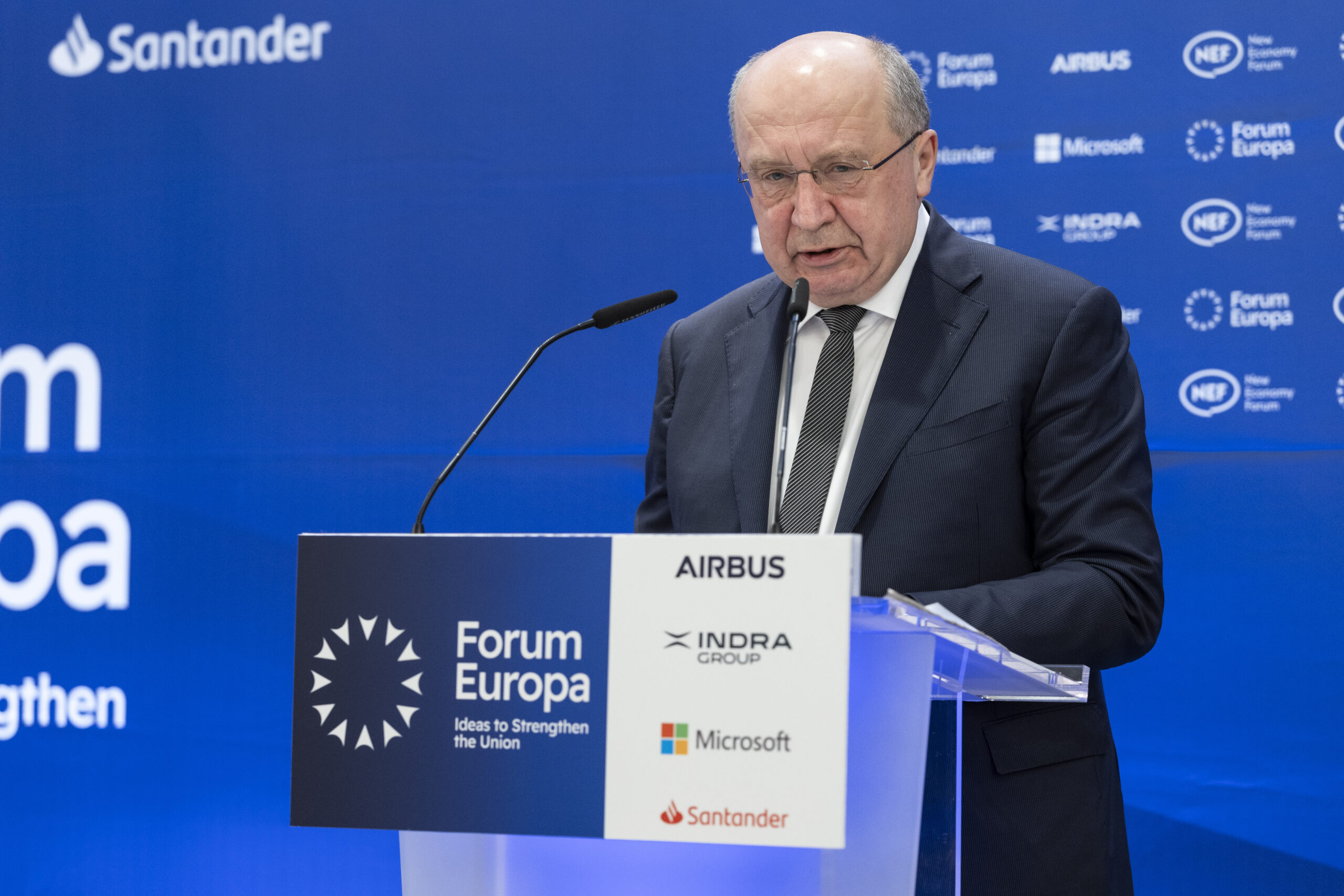
Brussels – “The likelihood that Europe will face a Russian aggression in the future is high, and that is why we must be ready to achieve military independence and strengthen our ability to defend ourselves.” The European Commissioner for Defence and Space, Andrius Kubilius—speaking today (16 March) at the “Ideas for Strengthening the European Union” event, organised by the Forum Europa platform—chose these words to reflect on how to make the European Union stronger in terms of its defence industry.
Referring to certain passages from the speech delivered last week by the President of the European Commission, Ursula von der Leyen, at the Ambassadors’ Conference, Kubilius focused on the Russian threat, which, for the first Defence Commissioner in the EU’s history, remains the primary reason why the EU must become stronger and more independent militarily. “Currently, Moscow’s military spending amounts to around 85 per cent of that of the entire Union, and by 2026 the Russian army could be capable of deploying between 7 and 9 million drones,” he specified. These figures paint a picture of a country “with a much stronger army than at the start of the invasion in 2022” and, above all, “with direct experience of modern warfare that no EU state possesses”.
At the same time, the moves by the other global superpower should also spur Brussels and the Member States into action. “The United States is gradually shifting its focus towards the Indo-Pacific, asking Europeans to take direct responsibility for the defence of their own continent: there is no reason to disagree,” said the former Prime Minister of Lithuania. Finally, there is the new front in the war in the Middle East, a conflict which—Kubilius warns—“could affect us not only in terms of high energy prices, but also through ballistic missile strikes with a range of up to 3,000 km”.
According to the Commissioner, it is precisely the field of ballistics where the EU must act most swiftly in order to “strengthen Europe’s capacity to produce air defence missiles and ballistic missiles independently“. Since the start of Russia’s war of aggression against Ukraine, “from 2022 to 2026, Ukraine’s defence industrial production has increased 50-fold: from €1 billion in 2022 to €50 billion in 2025. And at the same time, the Ukrainians have managed to create the most innovative defence industry in the world. We must increase production to meet our own defence needs and those of Ukraine. And we must do so now,” the Commissioner emphasised. To this end, Kubilius has launched the “Missile Tour” because “air defence missiles and anti-ballistic missiles are currently the biggest shortfall”. In terms of numbers, “in 2025, Ukraine faced 2,000 Russian missile attacks. Of these, 900 were ballistic. To shoot them down, Ukraine needs around 2,000 anti-ballistic missiles a year. Mainly Patriot missiles,” he noted. Furthermore, “The New York Times reported that in the first five days of hostilities with Iran, the United States and its allies used over 800 Patriot anti-ballistic missiles”, whilst “public sources indicate that total annual production of Patriots stands at 750 units: this is why we need independent missile production in Europe”.
Kubilius makes no secret of the numerous obstacles that have so far made it difficult—if not impossible—to strengthen European defence capabilities at a continental level, rather than solely at a national level. But he stresses that this is an obligation under the EU Treaties. “First of all, there is an institutional issue, as the EU Treaties stipulate that defence is a national responsibility, and this has led to the creation of twenty-seven different armies and military cooperation that remains, even today, too complex and slow,” he explained. Yet, it is also the Treaties—more specifically Article 42 of the Treaty on European Union—that require Member States “to progressively establish a common defence policy.” Therefore, “it is an obligation under the treaties for Member States to pursue ‘common defence’ and ‘if we do not do so now, before Russia attacks us, when will we do it?’”, warned Kubilius, once again raising the spectre of a future invasion by Moscow. The second obstacle is the fragmentation of the EU defence industry. “Twenty-seven different armies also mean twenty-seven different defence industries and the absence of full European cooperation in this sector,” the Commissioner insisted. And the effects are clear: “National defence budgets are rising, but industrial production is not keeping pace, leading to higher prices and longer delivery times,” he noted. Kubilius said he was “increasingly concerned” about this situation—the lack of a rise in industrial-scale production.
“To date, the EU has failed to overcome the lack of institutional and industrial coordination that undermines its ability to defend itself, but we are now doing a great deal to change that,” he reassured. Among the measures proposed by Brussels are “the creation of new instruments to assist Member States in implementing joint projects such as the coordinated development of weapons systems or joint procurement.” And “as of today,” the Commissioner noted, “the 27 Member States must let us know if they are interested in participating in the European Defence Projects of Common Interest (EDPCI), which will be approved by the Council and funded through European funds.”
Finally, a reference to the most ambitious and long-term goal: “We must press ahead with the initiative to create a European Defence Union that also includes the United Kingdom, Norway, and Ukraine.” The experience gained on the ground by Kyiv over four years of war is something the Lithuanian politician wishes to capitalise on through a “deep integration” of the Ukrainian defence industry with that of Europe: “If the Gulf states are asking help from Kyiv to shoot down Iranian Shahed drones, why shouldn’t the EU recognise the excellence of Ukrainian military expertise?”, asked the Commissioner.
In short, Kubilius believes the era of slow and timid decision-making on European defence must come to an end: “It is a way of thinking that is fine in times of peace” and gives the impression “that we continue to dream that peace in Europe is eternal.” Yet, like Ukraine, “we too are not at peace.” Kubilius believes a wake-up call is needed: “We must radically change this attitude. We must wake up from this dream to avoid the nightmare of war.”
English version by the Translation Service of Withub