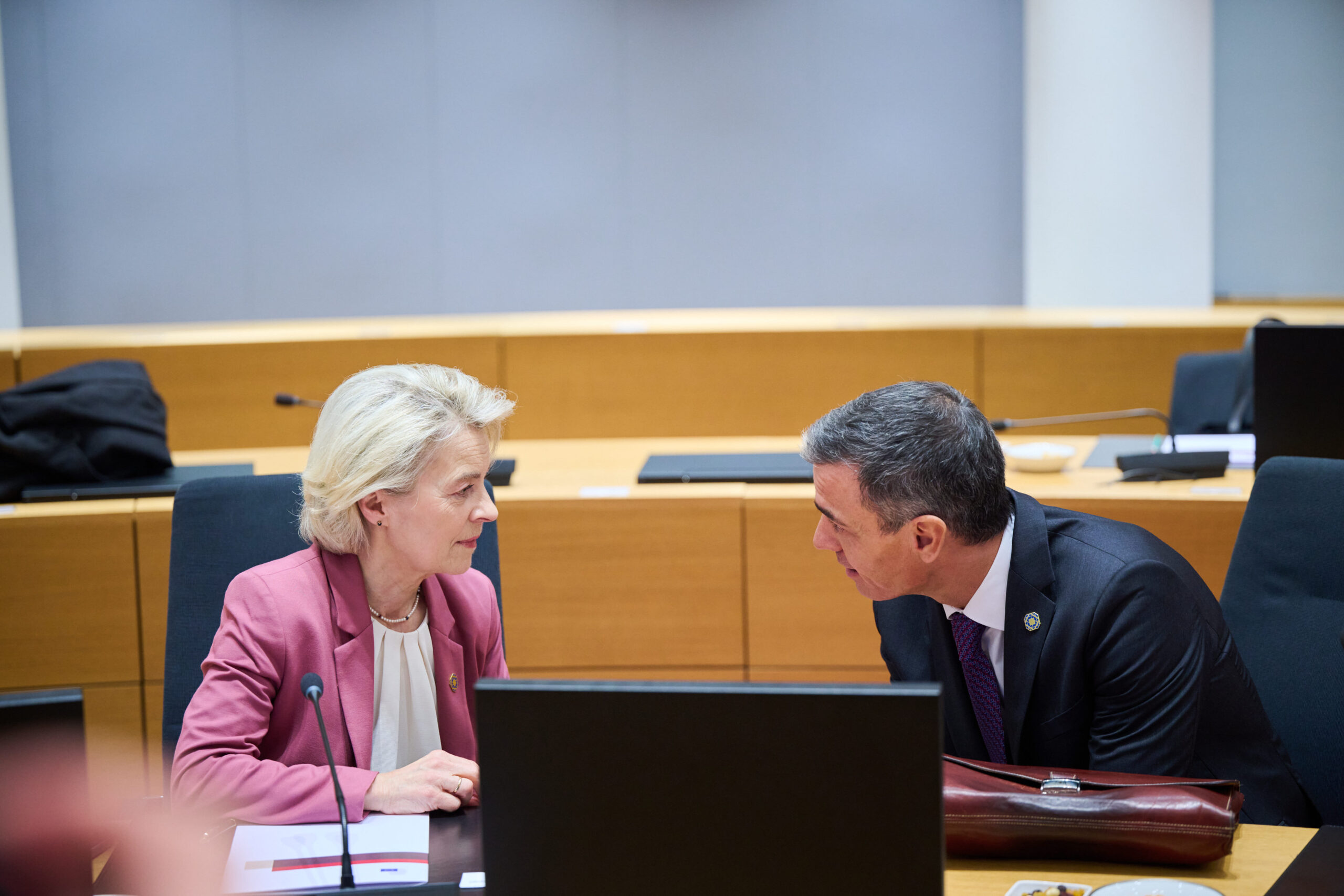

Brussels – After unsuccessfully calling for the suspension of the Association Agreement between the European Union and Israel, Spain and Slovenia are once again attempting to elicit a response from Brussels in the face of a world where the principles of international law are increasingly being called into question. This time, the request from the Prime Minister of Madrid, Pedro Sanchez, and that of Ljubljana, Robert Golob, to the European Commission is to protect the International Criminal Court (ICC) and the UN from sanctions imposed against some of their members by the United States. In particular, the two governments are calling on the EU executive to activate the Blocking Statute, a legal shield designed by the EU to protect European individuals and entities from the extraterritorial effects of measures imposed by third countries. The response from the Berlaymont building, however, is currently lacking, with no indication of whether the EU executive supports activating the instrument requested by the leaders of Spain and Slovenia.
US sanctions
The International Criminal Court, which has been trying individuals responsible for the most serious violations of international and humanitarian law since 2002, has come under fire from Washington following President Donald Trump’s return to the White House in November 2024. It was during those very days that The ICC has issued an arrest warrant for Israeli Prime Minister Benjamin Netanyahu, in relation to the actions of the Tel Aviv military in the Gaza Strip. Accusing the judges in The Hague of targeting a US ally, in February 2025, the tycoon issued an executive order imposing a series of sanctions against several ICC members, ranging from the freezing of assets on US territory to the closure of bank accounts and services, as well as a ban on entry into the US and a series of measures against those who collaborate with the Court.
Overall, the Trump administration’s measures have affected 11 judges at the Court (including the Chief Prosecutor, Karim Khan, and the two Deputy Prosecutors, Nazhat Shameem Khan and Mame Mandiaye Niang). Subsequently, in July last year, Washington’s retaliation reached the United Nations, when similar sanctions were imposed on the UN Special Rapporteur on the Occupied Palestinian Territories, Francesca Albanese. Finally, three leading figures from movements defending Palestinian rights were added to the sanctions list, precisely because of their links with the ICC.
The political nature of these measures, moreover, became clear last December, when an investigation by the online site Middle East Eye revealed how the US administration had pressured the Court to halt its investigations into Israeli war crimes in Palestine (as well as those committed by the United States itself in Afghanistan following the 2001 invasion), offering the lifting of sanctions in return.
The request from Spain and Slovenia
Faced with such a scenario, the proposal put forward by Spain and Slovenia is to apply the EU Regulation 2271, which in 1996 established the “blocking statute”. Originally designed to protect European economic operators from the extraterritorial application of laws from third countries (primarily the US) that compromise the interests of the entire Union, the two governments aim to enable this mechanism to transcend its purely commercial logic. The legal basis for applying it in the context of the ICC, moreover, would be fairly easy to identify: although not a Community institution, the Court is based in an EU Member State (the Netherlands) and could thus benefit from the protection afforded by the Statute.
“Spain will not look the other way, and the EU cannot stand idly by in the face of this persecution,” wrote Pedro Sánchez on X in announcing his appeal. “For this reason, we call on the Commission to activate the Blocking Statute to protect the independence of the ICC and the UN and their efforts to end the genocide in Gaza: while some attempt to dismantle the international order by force, Spain will continue to defend human rights and those who work to ensure they are respected,” he added.
Expressing “strong support” for the Madrid initiative, Robert Golob stressed that “Europe’s response has so far been inadequate given the gravity of the situation” and recalled that “the EU’s fundamental values cannot be put to a price and the independence of international courts is non-negotiable.”
Among those expressing satisfaction with the proposal put forward by the two governments is Marco Cappato, who has long been involved in civil society in this fight to safeguard the role of the ICC. The founder of Eumans and former Radical MEP had organised a demonstration in front of the Berlaymont Building on 14 April, also announcing the start of a relay hunger strike to urge the Commission to take action. “Following Sanchez’s statements,” he said today, “we hope that Ursula von der Leyen will finally make a decision: we will continue with the fast and with new demonstrations.”
The Commission’s (non-)response
While individual Member States may request the activation of the blocking statute, it is up to the Commission to actually implement it. And—judging by today’s statement from the EU executive’s spokesperson, Siobhan McGarry—it is difficult to imagine that Cappato’s hope will be realised. During the usual midday press briefing, McGarry merely stated that the Berlaymont building “has consulted with Member States on what concrete and feasible solutions might be available to support the Court,” refusing to express a view for or against the possibility of invoking the Blocking Statute.
While awaiting a clearer response from Brussels, Sanchez has no choice but to act independently and express—even if only symbolically—his country’s solidarity with the targets of Trump’s diplomatic offensive. Today (7 May), the Spanish Prime Minister received Francesca Albanese at the Moncloa Palace and presented her with the Order of Civil Merit. “Public responsibility also entails a moral obligation not to look the other way,” wrote the Spanish Prime Minister on X.
English version by the Translation Service of Withub
![Un momento del consiglio Affari esteri [Lussemburgo, 21 aprile 2026. Foto: European Council]](https://www.eunews.it/wp-content/uploads/2026/04/fac-260421-350x250.jpg)



![[credits: Dietmar Rabich / Wikimedia Commons / “Münster, Stadtweinhaus, Beflaggung Ukraine und EU -- 2022 -- 0219” / CC BY-SA 4.0]](https://www.eunews.it/wp-content/uploads/2026/03/ue-ucraina-120x86.jpg)