Brussels – From nit‑picking regulator to facilitator of the Old Continent’s industrial competitiveness. The European Union has long pursued this ‘genetic mutation’, aimed at radically reshaping its very raison d’être — or at least how it is commonly understood in public discourse. The main pillar of this renewal strategy is the so-called Omnibus: measures for regulatory simplification, often on a considerable scale, through which Brussels aims to radically cut the bureaucratic red tape that frequently hampers European businesses’ activities. A different package has been drawn up for each economic sector, and today (10 June), the EU Parliament and Council have made progress on the text of the so-called Omnibus V, dedicated to the defence sector.
Based on the recommendations set out in a White Paper published in March 2025, the package aims to strengthen the operational readiness of the EU’s defence by 2030 by facilitating investment, simplifying authorisation and procurement procedures, and streamlining intra-EU cooperation.
Following its adoption by the European Commission in June last year, the text was referred to the Parliament and the Council for consideration. This morning, representatives of the two institutions announced that they had reached a provisional agreement on the final provisions at the heart of Omnibus V (following an initial agreement finalised on 20 May), retaining the substance of what the Commission had already decided. MEPs and Member States will have to formally adopt the text for it to enter into force.
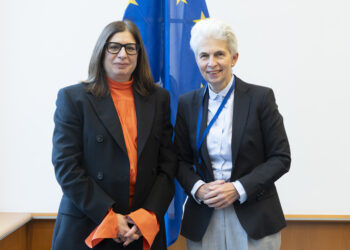
The Cypriot presidency of the EU Council expressed its satisfaction with the agreement through the Deputy Minister for European Affairs, Marilena Raouna. “With today’s agreement, we are simplifying rules for defence-related projects and providing greater support to Europe’s defence industry,” she stressed. In Parliament, she was echoed by the Democratic Party MEP and co-rapporteur for the measure, Pierfrancesco Maran (S&D), who clarified that today’s agreement “strengthens European defence readiness while maintaining a high level of protection for health, the environment and the integrity of the internal market.”
A new approach to the European Defence Fund: simplification and greater accessibility for SMEs
The agreement signed today primarily aims to simplify the management and implementation of the European Defence Fund (EDF). Established in 2021, it is the financial instrument created by the Commission to support research and development of Made in the EU military technologies. To facilitate its use, the agreement provides that companies interested in participating in joint projects funded by the EDF will face less cumbersome bureaucratic procedures than at present.
Furthermore, the Parliament and the Council have reached a compromise on a particularly sensitive issue: access to the ‘results’ of projects supported by the Fund. Member States argued that, as co-financers of the project, they were responsible for controlling the use of military technologies developed with EDF funding. The companies involved, on the other hand, claimed control over their products and the intellectual property rights to them. Ultimately, the text of the agreement provides for “preserving the right of co-financing states to access projects,” while ensuring “adequate protection of the intellectual property rights of industry”.
The set of rules governing the EDF aims to increase the involvement of small and medium-sized enterprises (SMEs) in intra-European initiatives, as these companies increasingly have innovative capacity that is not far behind that of the major defence giants. In particular, the agreement introduces the so-called funding rate bonus: if a SME participates in a project, the share of funding covered by the EDF increases proportionally. This way, according to the co-legislators, large companies should have a greater incentive to involve smaller players.
Finally, the agreement aligns with the Commission’s proposal to relax certain EU environmental rules, providing for exceptions to the use of certain chemicals (which would otherwise be banned) in defence projects. The ‘fig leaf‘ inserted by Parliament and the Council is a vague pledge to nonetheless ensure “a high level of protection for human health and the environment.“
Authorisation procedures: “Cutting red tape”
Another issue the agreement addresses, central to Brussels’ efforts to simplify regulations, concerns the authorisation procedures for launching new industrial projects in the defence sector. According to the EU, the first step towards making them more “streamlined” is to Europeanise them, but Member States are reluctant to relinquish the power to approve or reject certain military technologies.
For this reason, the Parliament and the Council are again proposing a compromise. On the one hand, this ensures the “preservation of Member States’ competences;” on the other, it establishes a “harmonised framework” with common rules.
For example, the aim is to set a European limit on the maximum duration of the authorisation procedure: 42 working days, which may be extended to 102 if national authorities deem that “exceptional circumstances” exist. If no decision has been made by the deadline, the application is deemed tacitly approved. “At the same time, Member States may provide for exceptions to this principle in cases where there is a serious risk to public health or national security,” the Council points out.
Slovak MEP Lucia Yar (Renew), one of the measure’s co‑rapporteurs, particularly stressed the cut in authorisation‑related red tape. “For too long, authorisations have taken up to two years, while this agreement paves the way for a radical reduction in these timescales, while maintaining the necessary safeguards,” she said.
New rules for tender procedures and intra-EU transfers
In Brussels’ view, even the procurement procedures through which a Member State decides from which industry to purchase arms and other military technologies are an obstacle to the development of the EU’s defence “readiness.” With the aim of “eliminating administrative delays” that characterise these processes, the agreement seeks to “adapt the general EU rules on public procurement to the specificities of the sector.” And it does so while maintaining the same leitmotif: fewer safeguards on controls, faster decision-making.
Among the measures envisaged in this regard is raising the threshold above which a contract must follow stricter, more time-consuming procedures. Thus, administrative burdens will be eased, giving authorities “more time to focus on the major defence projects that really matter,” the Council’s press release explains.
Finally, the drive for simplification also extends to the rules governing transfers between EU Member States of the various military components that need to be assembled to produce the final product. In this area too, the aim is to streamline authorisation procedures by introducing two new general transfer licences.
The first will regulate exchanges between EU-certified organisations, while the second will govern flows between organisations from different countries collaborating on joint projects (so-called “European partnerships”). In both cases, those involved will be able to operate with greater ease and freedom. In both cases, they will again be subject to less stringent and potentially safer checks.
English version by the Translation Service of Withub